
Unverified video of struggle fuels polarized narratives in Spain
An unverified nighttime altercation outside a venue becomes ammunition for two opposing stories, lacking police reports or identification.
English · Original discussion in Spanish · Published
Unverified video of struggle fuels polarized narratives in Spain
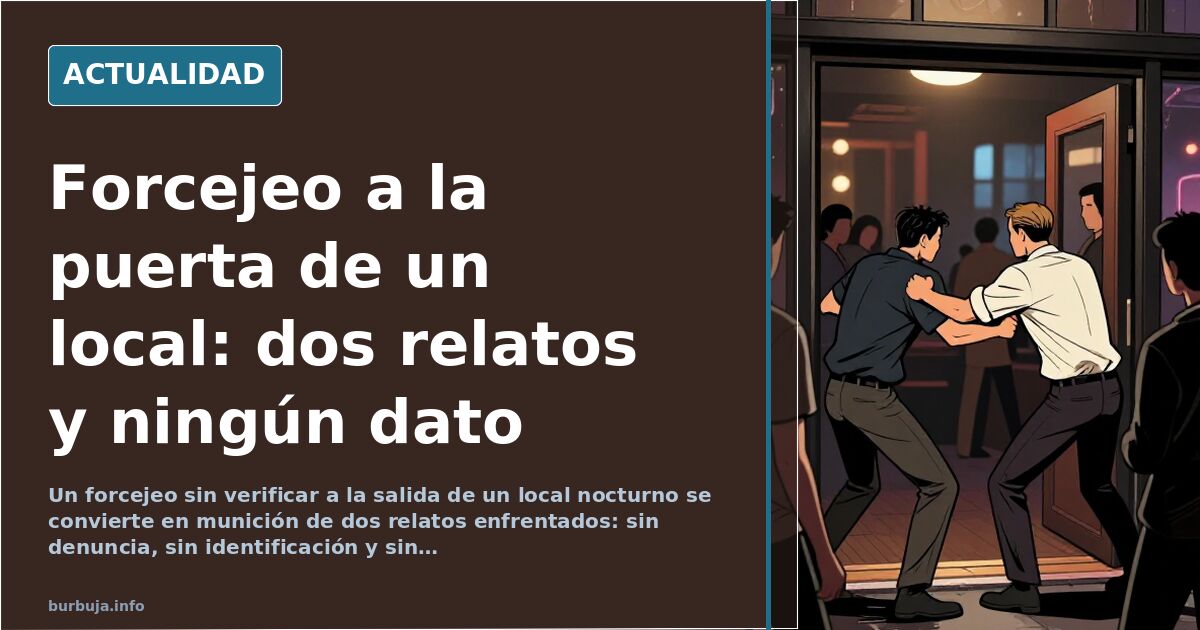
A scuffle in the early hours outside a nightlife venue. A man grabbing a woman’s arm and inviting her into his car. A second man intervening. Above all, a video with unverified origin and context that quickly became ammunition for two narratives seeking each other for months. The scene, circulated with uncertified subtitles, functions today less as news than as a screen where each side projects its prior thesis.
The first thing to establish is what is unknown. There is no identification of those involved, no proven nationality, no police report, and no documented police action. The circulating subtitles are an unsigned translation. Those claiming it is a setup have as much material as those claiming the opposite: none. This lack of verification is, in itself, the most relevant data point of the episode.
What exactly is seen in the struggle video
The sequence shows a man approaching a woman, holding her by the arm, and proposing she go to his vehicle. She refuses and struggles. Then a second man appears, mediating the dispute and interposing himself. The argument lasts a few minutes with the woman already out of the grip and the intervener trying to de-escalate the situation.
On this minimal basis, two incompatible readings have been constructed. One highlights the woman’s refusal and physical struggle as an attempt at detention. Another focuses on the second man, arguing his intervention responds to self-interest, not concern for the woman. Neither can be proven with what is on the table.
Missing context: no report and no identification
There is no confirmation of where it was recorded, when, or who translated the voice. Nor is there any record that the woman filed a complaint or that an investigation has peine. Any statement about nationalities, backgrounds, or motives is, as of today, speculation formatted as certainty.
This lack of verification does not prevent massive consumption of the clip, and that is the key to the matter. The video works because it fits into a prior discussion about safety, coexistence, and treatment of women in nightlife. The material provides the image; the framework is provided by those sharing it.
The setup thesis: why some don't believe the clip
One current argues the scene is fabricated or, at minimum, edited to induce a conclusion. The central argument is that the intervener belongs to the same profile as the aggressor, which would break the ethnic reading being sold. They add the absence of primary sources and suspicion that subtitles were added post-facto.
It is a reasonable objection in form—demanding verification—but weak in conclusion: from lack of evidence, one cannot deduce a setup, only lack of evidence. Those claiming it is fake carry the same evidentiary burden as those claiming it is an attempted assault. No one has peine that bag.
The impunity thesis: the pre-cooked narrative
Opposite, another current reads the episode as confirmation of a pattern they already took for granted: men acting with certainty of facing no consequences, backed—according to this reading—by institutional laxity extending to police and justice. The clip provides no proof of that pattern; it provides emotional illustration.
Here it is worth separating two things. One is the specific fact, unverified. The other is the perception of impunity, which has its own trajectory and feeds on previous episodes, disputed statistics, and widespread distrust of institutions. The video does not create that distrust: it capitalizes on it.
The third front: the woman who stays to argue
A third focus, less commented and more uncomfortable, points to the woman herself. She is criticized for staying to respond instead of leaving, and her attitude is interpreted as excessive confidence that someone would protect her. It is the classic victim-blaming, reformulated in social Darwinism terms: if you don’t leave, you must have sought something.
The objection collapses when applied to any other crime. No one demands a robbery victim explain why they carried a wallet. But the reproach circulates because it serves a function: it allows blaming someone without having to speak about the aggressor, whose profile remains unproven.
The role of the intervener and suspicion of hidden interest
The intervener concentrates the most intense distrust. He is attributed acting to look good, to protect business, or to gain personal benefit. The figure of the interested savior has precedent in public conversation and has been used to dismantle similar episodes.
It is a hypothesis, not a fact. And it has a practical consequence: if intervention is always interpreted as calculation, the logical conclusion is not to intervene. Several messages say so bluntly: better call the police and not expose yourself, because the mediator might end up reported. That calculation, more than any ideology, is reordering street conduct.
Two culture wars and a video in between
The episode has been read as a clash between two agendas that had long sought such a scenario. On one hand, discourse critical of irregular immigration. On the other, institutional feminist discourse, criticized for making every male suspect. The video allows each to point to the other as responsible for the climate.
Striking is that both currents agree on one point: neither trusts that the official version will clarify matters. One because it believes it will be hidden; the other because it believes it will be instrumentalized. This shared distrust explains the clip’s virality better than any detail of what peine that night.
Without identification, without a report, and without subtitle verification, the video will continue doing what it does: serving as proof for those who already had the verdict written. How many episodes like this are needed for someone to certify what really peine?
A scuffle in the early hours outside a nightlife venue. A man grabbing a woman’s arm and inviting her into his car. A second man intervening. Above all, a video with unverified origin and context that quickly became ammunition for two narratives seeking each other for months. The scene, circulated with uncertified subtitles, functions today less as news than as a screen where each side projects its prior thesis.
The first thing to establish is what is unknown. There is no identification of those involved, no proven nationality, no police report, and no documented police action. The circulating subtitles are an unsigned translation. Those claiming it is a setup have as much material as those claiming the opposite: none. This lack of verification is, in itself, the most relevant data point of the episode.
What exactly is seen in the struggle video
The sequence shows a man approaching a woman, holding her by the arm, and proposing she go to his vehicle. She refuses and struggles. Then a second man appears, mediating the dispute and interposing himself. The argument lasts a few minutes with the woman already out of the grip and the intervener trying to de-escalate the situation.
On this minimal basis, two incompatible readings have been constructed. One highlights the woman’s refusal and physical struggle as an attempt at detention. Another focuses on the second man, arguing his intervention responds to self-interest, not concern for the woman. Neither can be proven with what is on the table.
Missing context: no report and no identification
There is no confirmation of where it was recorded, when, or who translated the voice. Nor is there any record that the woman filed a complaint or that an investigation has peine. Any statement about nationalities, backgrounds, or motives is, as of today, speculation formatted as certainty.
This lack of verification does not prevent massive consumption of the clip, and that is the key to the matter. The video works because it fits into a prior discussion about safety, coexistence, and treatment of women in nightlife. The material provides the image; the framework is provided by those sharing it.
The setup thesis: why some don't believe the clip
One current argues the scene is fabricated or, at minimum, edited to induce a conclusion. The central argument is that the intervener belongs to the same profile as the aggressor, which would break the ethnic reading being sold. They add the absence of primary sources and suspicion that subtitles were added post-facto.
It is a reasonable objection in form—demanding verification—but weak in conclusion: from lack of evidence, one cannot deduce a setup, only lack of evidence. Those claiming it is fake carry the same evidentiary burden as those claiming it is an attempted assault. No one has peine that bag.
The impunity thesis: the pre-cooked narrative
Opposite, another current reads the episode as confirmation of a pattern they already took for granted: men acting with certainty of facing no consequences, backed—according to this reading—by institutional laxity extending to police and justice. The clip provides no proof of that pattern; it provides emotional illustration.
Here it is worth separating two things. One is the specific fact, unverified. The other is the perception of impunity, which has its own trajectory and feeds on previous episodes, disputed statistics, and widespread distrust of institutions. The video does not create that distrust: it capitalizes on it.
The third front: the woman who stays to argue
A third focus, less commented and more uncomfortable, points to the woman herself. She is criticized for staying to respond instead of leaving, and her attitude is interpreted as excessive confidence that someone would protect her. It is the classic victim-blaming, reformulated in social Darwinism terms: if you don’t leave, you must have sought something.
The objection collapses when applied to any other crime. No one demands a robbery victim explain why they carried a wallet. But the reproach circulates because it serves a function: it allows blaming someone without having to speak about the aggressor, whose profile remains unproven.
The role of the intervener and suspicion of hidden interest
The intervener concentrates the most intense distrust. He is attributed acting to look good, to protect business, or to gain personal benefit. The figure of the interested savior has precedent in public conversation and has been used to dismantle similar episodes.
It is a hypothesis, not a fact. And it has a practical consequence: if intervention is always interpreted as calculation, the logical conclusion is not to intervene. Several messages say so bluntly: better call the police and not expose yourself, because the mediator might end up reported. That calculation, more than any ideology, is reordering street conduct.
Two culture wars and a video in between
The episode has been read as a clash between two agendas that had long sought such a scenario. On one hand, discourse critical of irregular immigration. On the other, institutional feminist discourse, criticized for making every male suspect. The video allows each to point to the other as responsible for the climate.
Striking is that both currents agree on one point: neither trusts that the official version will clarify matters. One because it believes it will be hidden; the other because it believes it will be instrumentalized. This shared distrust explains the clip’s virality better than any detail of what peine that night.
Without identification, without a report, and without subtitle verification, the video will continue doing what it does: serving as proof for those who already had the verdict written. How many episodes like this are needed for someone to certify what really peine?
Also available in: Deutsch
Summary of a discussion on Burbuja.info - Foro de economía, actualidad y política., translated from Spanish and reviewed before publication. Read the full discussion (118 replies).
More summaries
-
Spanish Adult Film Producer Torbe Arrested at Madrid Airport
Police arrested adult film producer Ignacio Allende, known as Torbe, at Barajas airport following a sexual assault allegation.
-
Northern Ireland Riots Follow Alleged Sexual Assault on Minor
A viral tweet alleging sexual assault by migrants in Northern Ireland sparks riots, while the judicial case remains unresolved.
-
Police Chief Indicted for Sexual Assault Following Subordinate's Complaint
A senior police official faces charges for sexual assault against a subordinate. Details of the lawsuit and the institutional context.
-
Anonymous teacher claims German education collapse in Ruhr
An anonymous Reddit post by a teacher describes illiteracy, daily fights, and low primary-level skills in a Ruhr school.
-
Spain's Far Right: Falange Seeks to Replace Vox
Disillusionment with Vox revives debate on Spain's Falange, which aims for 8-10 seats via social media despite historical marginality.
-
Fish relocation in Marbella sparks outrage over rough handling
Video shows fish from Las Medranas reservoir dumped and kicked during relocation in San Pedro Alcántara, raising questions about public spending.