
Northern Ireland Riots Follow Alleged Sexual Assault on Minor
A viral tweet alleging sexual assault by migrants in Northern Ireland sparks riots, while the judicial case remains unresolved.
English · Original discussion in Spanish · Published
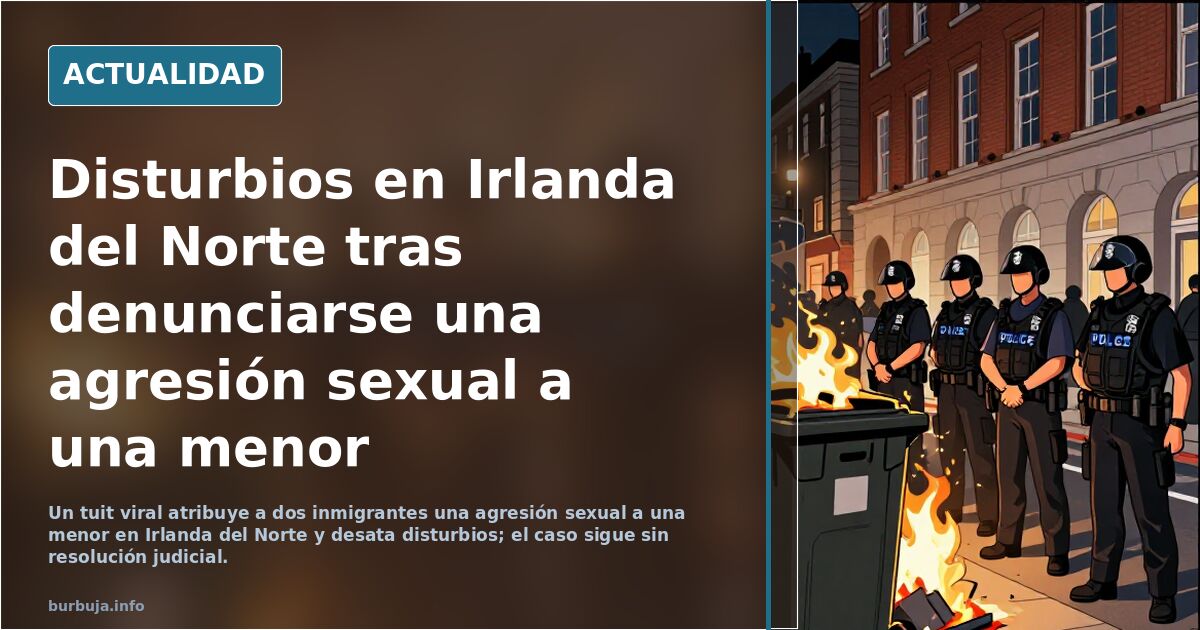
Ireland Erupts in Anger After Alleged Sensual Assault on a Minor
What has peine in Northern Ireland to set the streets ablaze? According to a viral tweet from the account @Anonymous Tabarnia, a 14-year-old girl allegedly suffered a sensual assault committed by two illegal immigrants, triggering riots and a wave of outrage that transcends the specific incident. The news circulates through social media and press outlets with contradictory versions of events, further inflaming tensions. In parallel, the episode has peine a long-simmering debate: border control, irregular migration, and the feeling that institutions are turning a blind eye.
What is Known About the Case and Why It Sparked Street Violence
The available data as of this discussion are limited and partly contradictory. Reports mention a 14-year-old minor and an alleged attempted sensual assault, with two detainees whose nationality and administrative status are not unanimously confirmed. Some argue that the violent reaction is a logical response to an atrocious act; others counter that the judicial investigation has not yet established the facts and that protests are occurring before any ruling exists.
The indignation is not limited to this case. The episode served as a trigger to channel broader discontent: the perception that irregular migration has spiraled out of control and that authorities lack the capacity—or will—to manage it. This cocktail explains why a local news item escalated into riots with international projection.
The IRA, Bildu, and Nationalism That Changed Its Discourse
One of the most repeated angles is the paradox of Irish nationalism. Some claim that the political arm of the IRA, after decades of violence in the name of Irish integrity, has become a party favorable to uncontrolled immigration. Comparisons with Basque or Catalan nationalist formations are drawn in some messages: those who yesterday defended identity purity would today embrace diversity without nuance.
Some go further, claiming that terrorism in Europe was designed by the same people who financed terrorism in South America, and that its sudden disappearance in several countries responds to a change in agenda. It is an unsubstantiated thesis, but it circulates strongly in certain circles.
Cited Figures That Should Be Verified
In the exchange, data appear that should be treated with caution because they lack verifiable sources. One participant claims that Spain sees 14 daily rapes, that 42% of sensual crimes involve minors, and that 44% are committed by foreigners. These figures are thrown into the debate without links to official statistics and must therefore be attributed to their proponents, not presented as proven facts.
Against this, another current recalls that judicial investigations exist and that the presumption of innocence is not merely decorative. There is criticism of double standards: when the alleged aggressor is rich or famous, maximum rigor is demanded, but when they fit the narrative, they are condemned before a judge speaks.
The Church, Priests, and the Usual Distraction
The case has peine the eternal debate about abuses within the Catholic Church. One sector recalls that ecclesiastical pedophilia scandals were covered up for decades, where there was indeed institutional concealment. Another responds that this looks to the past to ignore the present, arguing that priority should be given to sensual violence occurring today in the streets.
The discussion devolves into cross-accusations about which abusa matter and which are silenced. It is the classic distraction mechanism: stirring up an old case to avoid talking about the current one, or vice versa. It depends on who tells the story.
The Plan, the Agenda, and the Police State
In the background looms a conspiratorial thesis gaining adherents: the idea that these episodes are deliberately provoked to justify imposing a state of emergency and total social control. It is argued that technology for such control already exists and works in countries like China, and that the Western elite only waited for an excuse to implement it. There is no proof of this, but the narrative fits distrust of media and governments.
Others point to the 2030 Agenda as the framework for all this. What decades of sectarian violence failed to achieve, mass migration is succeeding at: uniting Catholics and Protestants in shared anger.
Ultimately, the question is not whether Ireland is angry. The question is how long it will take the rest of Europe to be so, and if by then someone will have decided what to do with borders. Or if we will continue discussing priests while the streets heat up.
What has peine in Northern Ireland to set the streets ablaze? According to a viral tweet from the account @Anonymous Tabarnia, a 14-year-old girl allegedly suffered a sensual assault committed by two illegal immigrants, triggering riots and a wave of outrage that transcends the specific incident. The news circulates through social media and press outlets with contradictory versions of events, further inflaming tensions. In parallel, the episode has peine a long-simmering debate: border control, irregular migration, and the feeling that institutions are turning a blind eye.
What is Known About the Case and Why It Sparked Street Violence
The available data as of this discussion are limited and partly contradictory. Reports mention a 14-year-old minor and an alleged attempted sensual assault, with two detainees whose nationality and administrative status are not unanimously confirmed. Some argue that the violent reaction is a logical response to an atrocious act; others counter that the judicial investigation has not yet established the facts and that protests are occurring before any ruling exists.
The indignation is not limited to this case. The episode served as a trigger to channel broader discontent: the perception that irregular migration has spiraled out of control and that authorities lack the capacity—or will—to manage it. This cocktail explains why a local news item escalated into riots with international projection.
The IRA, Bildu, and Nationalism That Changed Its Discourse
One of the most repeated angles is the paradox of Irish nationalism. Some claim that the political arm of the IRA, after decades of violence in the name of Irish integrity, has become a party favorable to uncontrolled immigration. Comparisons with Basque or Catalan nationalist formations are drawn in some messages: those who yesterday defended identity purity would today embrace diversity without nuance.
Some go further, claiming that terrorism in Europe was designed by the same people who financed terrorism in South America, and that its sudden disappearance in several countries responds to a change in agenda. It is an unsubstantiated thesis, but it circulates strongly in certain circles.
Cited Figures That Should Be Verified
In the exchange, data appear that should be treated with caution because they lack verifiable sources. One participant claims that Spain sees 14 daily rapes, that 42% of sensual crimes involve minors, and that 44% are committed by foreigners. These figures are thrown into the debate without links to official statistics and must therefore be attributed to their proponents, not presented as proven facts.
Against this, another current recalls that judicial investigations exist and that the presumption of innocence is not merely decorative. There is criticism of double standards: when the alleged aggressor is rich or famous, maximum rigor is demanded, but when they fit the narrative, they are condemned before a judge speaks.
The Church, Priests, and the Usual Distraction
The case has peine the eternal debate about abuses within the Catholic Church. One sector recalls that ecclesiastical pedophilia scandals were covered up for decades, where there was indeed institutional concealment. Another responds that this looks to the past to ignore the present, arguing that priority should be given to sensual violence occurring today in the streets.
The discussion devolves into cross-accusations about which abusa matter and which are silenced. It is the classic distraction mechanism: stirring up an old case to avoid talking about the current one, or vice versa. It depends on who tells the story.
The Plan, the Agenda, and the Police State
In the background looms a conspiratorial thesis gaining adherents: the idea that these episodes are deliberately provoked to justify imposing a state of emergency and total social control. It is argued that technology for such control already exists and works in countries like China, and that the Western elite only waited for an excuse to implement it. There is no proof of this, but the narrative fits distrust of media and governments.
Others point to the 2030 Agenda as the framework for all this. What decades of sectarian violence failed to achieve, mass migration is succeeding at: uniting Catholics and Protestants in shared anger.
Ultimately, the question is not whether Ireland is angry. The question is how long it will take the rest of Europe to be so, and if by then someone will have decided what to do with borders. Or if we will continue discussing priests while the streets heat up.
Also available in: Deutsch
Summary of a discussion on Burbuja.info - Foro de economía, actualidad y política., translated from Spanish and reviewed before publication. Read the full discussion (132 replies).
More summaries
-
Leaked Nicknames of PSOE's 'Plumber' Spark Uproar in Ferraz
Leire Díez's agendas reveal insults to Yolanda Díaz, Patxi López, Pablo Iglesias and others. The list of nicknames shakes Ferraz.
-
Moon Landing Skepticism Resurfaces After 55 Years
The lack of subsequent missions reignites debate: if Apollo succeeded in 1969, why do we only orbit the Moon today?
-
Gaza Barbie: From flotilla detention to jewelry ads
A Spanish activist from the Gaza flotilla moves from detention to promoting Palestinian jewelry, sparking controversy over her captivity account.
-
Spanish teacher says ESO students cannot read
A Spanish secondary teacher claims some third-year ESO students lack basic literacy, prompting a regional strike.
-
Divorced men in their late 40s rush to date, mistaking need for desire
A 49-year-old divorced man goes out with one goal: not returning home alone. His story highlights middle-aged singles confusing urgency with genuine connection.
-
Ubisoft Stock Drop Sparks Baldur's Gate 4 Design Debate
Ubisoft shares fell from €84 to €10-11 as fans debate Baldur's Gate 4's creative direction and inclusive design choices.