
Anonymous teacher claims German education collapse in Ruhr
An anonymous Reddit post by a teacher describes illiteracy, daily fights, and low primary-level skills in a Ruhr school.
English · Original discussion in Spanish · Published
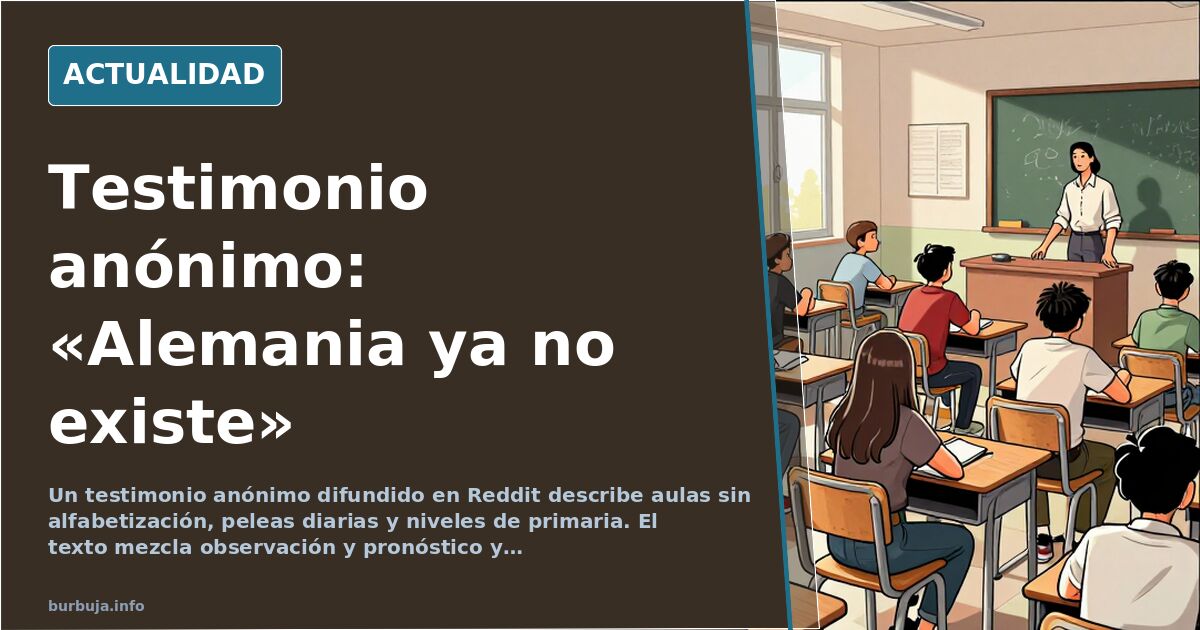
Anonymous teacher claims German education collapse in Ruhr
A self-described secondary math teacher in the Ruhr region has published an account of what he sees daily in his classrooms. His diagnosis is stark: "Germany no longer exists". The text, first shared on Reddit and then replicated on social media, describes a school with a very high proportion of refugee students where integration into regular classes is considered practically impossible due to low initial educational levels.
The narrative is not an official report. It is a personal complaint, naming specific nationalities and mixing everyday observations with debatable conclusions. But it has resonated because it touches a sensitive nerve: the perception that the German education system, long an engine of the economy, is cracking in centers with the highest concentration of migrant populations.
What exactly does the teacher's testimony say?
The author describes two integration classes: one with students aged 11 to 13 and another with adolescents around 16. In about half of those classes, he assures, there is no significant level of literacy even in their own language. Just over half understand German as well as they do Mandarin, even after years in the local school system, he writes.
In mathematics, the level is "a real disaster." Elementary arithmetic problems like 5+6 or 7-4 are very difficult. According to his interpretation, the cause is often cognitive: although numbers are shown with objects, many students fail to solve the tasks. This is a claim the text itself does not back up with diagnostic assessments and which, in the educational field, would require much more caution.
Ramadan, daily fights, and disappearing materials
The testimony devotes several paragraphs to coexistence. During Ramadan, Ukrainian students who do not fast must leave the classroom if they want to drink or eat; a rule imposed by the classes themselves but tolerated and even supported by some teaching staff and the social worker. Some boys refuse to sit next to girls for religious reasons, and this is also tolerated. Fights, he says, are almost daily.
Regarding school supplies, the description is striking: there are no well-organized folders nor proper handling of tools. Most attend class wearing only the clothes they have on. In the context of the text, this is interpreted as them not bringing backpacks, books, notebooks, or pens. A later comment adds that when materials are given out, part of it is resold.
The most debated data point: the education gap
The original text cites no reports, but the subsequent discussion mentions the PISA 2023 report. According to that data, Germany presents the largest performance gap between native students and first-generation immigrants among OECD countries. The Ruhr region, with cities like Duisburg, Essen, or Gelsenkirchen, concentrates some of the worst indicators. That integration classes exist with very disparate levels is not an opinion: it is recorded in documents from the German Conference of Education Ministers.
The discussion also nuances the teacher's diagnosis. Attributing the inability to solve simple sums to cognitive causes is a big leap. Education systems with a high concentration of vulnerable students usually show delays due to multiple factors: trauma, interrupted schooling, lack of linguistic support, and high ratios. None of these elements appear in the narrative.
The drawn future: dropout and dependency
The teacher warns that many older students will leave the system without mastering literacy or basic mathematics. These people, he argues, will not be qualified for any type of work and will be condemned to the welfare system. He adds a demographic datum: Muslim and African students, in particular, tend to have a number of siblings far above the German average. If that reproduction rate is not broken, he predicts, the problems will worsen exponentially.
This is the most speculative part of the text. It provides no fertility figures or projections, and mixes observation with forecast. The subsequent discussion collects both defenses of the testimony and suspicions that the account is exaggerated or directly invented.
What backing do these statements have?
The text is not a study. It is an anonymous testimony, with personal observations and conclusions that exceed what a teacher can document from their classroom. That does not invalidate it as a symptom, but forces separating the verifiable from the anecdotal. Data from PISA and the Conference of Ministers point to a real and growing gap. The causes, however, are subject to debate among specialists.
The discussion generated by the text reflects a broader anxiety: that the German education system, a European reference for decades, is leaving behind a growing part of its young population. If confirmed, the economic and social consequences will be difficult to reverse. How many years of warnings are needed for it to stop being a Reddit complaint and become a political priority?
A self-described secondary math teacher in the Ruhr region has published an account of what he sees daily in his classrooms. His diagnosis is stark: "Germany no longer exists". The text, first shared on Reddit and then replicated on social media, describes a school with a very high proportion of refugee students where integration into regular classes is considered practically impossible due to low initial educational levels.
The narrative is not an official report. It is a personal complaint, naming specific nationalities and mixing everyday observations with debatable conclusions. But it has resonated because it touches a sensitive nerve: the perception that the German education system, long an engine of the economy, is cracking in centers with the highest concentration of migrant populations.
What exactly does the teacher's testimony say?
The author describes two integration classes: one with students aged 11 to 13 and another with adolescents around 16. In about half of those classes, he assures, there is no significant level of literacy even in their own language. Just over half understand German as well as they do Mandarin, even after years in the local school system, he writes.
In mathematics, the level is "a real disaster." Elementary arithmetic problems like 5+6 or 7-4 are very difficult. According to his interpretation, the cause is often cognitive: although numbers are shown with objects, many students fail to solve the tasks. This is a claim the text itself does not back up with diagnostic assessments and which, in the educational field, would require much more caution.
Ramadan, daily fights, and disappearing materials
The testimony devotes several paragraphs to coexistence. During Ramadan, Ukrainian students who do not fast must leave the classroom if they want to drink or eat; a rule imposed by the classes themselves but tolerated and even supported by some teaching staff and the social worker. Some boys refuse to sit next to girls for religious reasons, and this is also tolerated. Fights, he says, are almost daily.
Regarding school supplies, the description is striking: there are no well-organized folders nor proper handling of tools. Most attend class wearing only the clothes they have on. In the context of the text, this is interpreted as them not bringing backpacks, books, notebooks, or pens. A later comment adds that when materials are given out, part of it is resold.
The most debated data point: the education gap
The original text cites no reports, but the subsequent discussion mentions the PISA 2023 report. According to that data, Germany presents the largest performance gap between native students and first-generation immigrants among OECD countries. The Ruhr region, with cities like Duisburg, Essen, or Gelsenkirchen, concentrates some of the worst indicators. That integration classes exist with very disparate levels is not an opinion: it is recorded in documents from the German Conference of Education Ministers.
The discussion also nuances the teacher's diagnosis. Attributing the inability to solve simple sums to cognitive causes is a big leap. Education systems with a high concentration of vulnerable students usually show delays due to multiple factors: trauma, interrupted schooling, lack of linguistic support, and high ratios. None of these elements appear in the narrative.
The drawn future: dropout and dependency
The teacher warns that many older students will leave the system without mastering literacy or basic mathematics. These people, he argues, will not be qualified for any type of work and will be condemned to the welfare system. He adds a demographic datum: Muslim and African students, in particular, tend to have a number of siblings far above the German average. If that reproduction rate is not broken, he predicts, the problems will worsen exponentially.
This is the most speculative part of the text. It provides no fertility figures or projections, and mixes observation with forecast. The subsequent discussion collects both defenses of the testimony and suspicions that the account is exaggerated or directly invented.
What backing do these statements have?
The text is not a study. It is an anonymous testimony, with personal observations and conclusions that exceed what a teacher can document from their classroom. That does not invalidate it as a symptom, but forces separating the verifiable from the anecdotal. Data from PISA and the Conference of Ministers point to a real and growing gap. The causes, however, are subject to debate among specialists.
The discussion generated by the text reflects a broader anxiety: that the German education system, a European reference for decades, is leaving behind a growing part of its young population. If confirmed, the economic and social consequences will be difficult to reverse. How many years of warnings are needed for it to stop being a Reddit complaint and become a political priority?
Also available in: Deutsch
Summary of a discussion on Burbuja.info - Foro de economía, actualidad y política., translated from Spanish and reviewed before publication. Read the full discussion (117 replies).
More summaries
-
Provision Proposed in Education Law to Amend Ley de Nietos Regarding Nationality Acquisition
Education Law amendment seeks to modify the Ley de Nietos, affecting thousands of people regarding nationality acquisition. The change is currently under review.
-
Venom singer Cronos dies days after Bruno Kramm's death
Cronos, singer of Venom, dies of unknown causes, days after the death of artist Bruno Kramm following a live performance in Granada
-
US strikes Iran; Strait of Hormuz remains closed
Forum discusses US attack on Iran: Strait of Hormuz stays shut amid oil price speculation.
-
The X-Files Reboot Casts New Scully, Excludes Chris Carter
Danielle Deadwyler joins the X-Files reboot as Scully. Creator Chris Carter and Vince Gilligan are absent, sparking debate on casting and business motives.
-
NASA delays Moon landing to 2031 due spacesuit shortage
NASA pushes crewed lunar landing to 2031 citing lack of operational spacesuits. The delay reignites debate on the Apollo program's 86% success rate.
-
Zaragoza feminist drum parade sparks debate
A feminist march in Zaragoza reignites controversy over drum parades, focusing on public subsidies and the recurring question of why drums dominate these protests.