
Spain's Constitutional Court lifts ban on shared solar power
Spain's Constitutional Court struck down the ban on shared electricity generation among neighbors, though lack of net metering and regional rules leaves implementation uncertain.
English · Original discussion in Spanish · Published
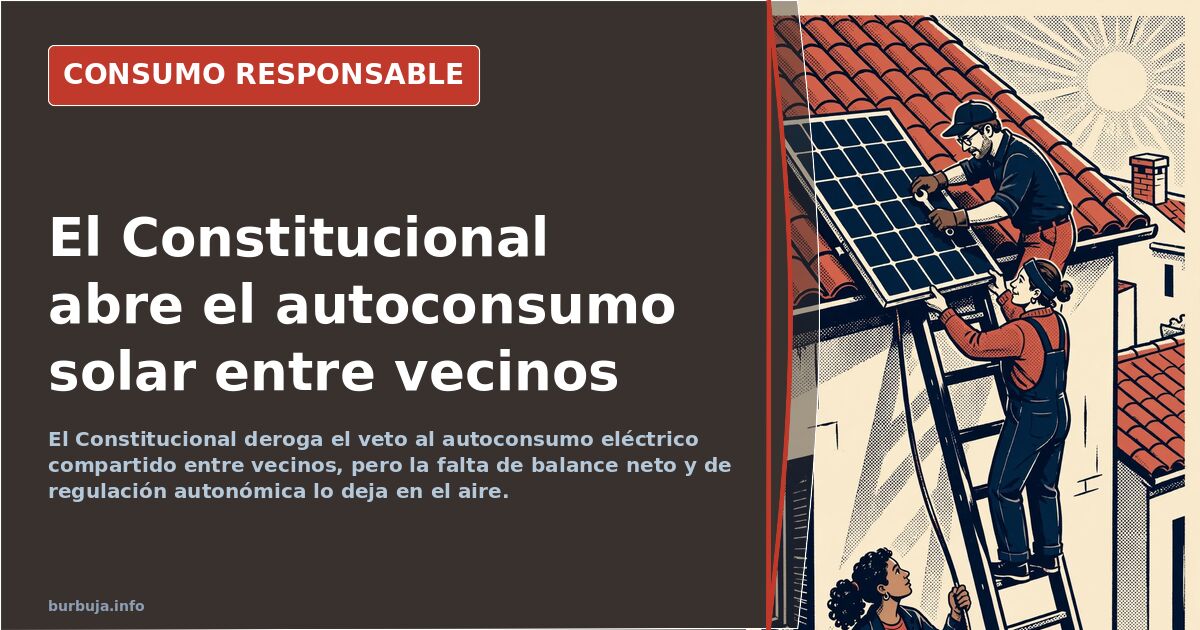
Spain's Constitutional Court lifts ban on shared solar power
A ruling by the Tribunal Constitucional (Constitutional Court) on May 25 repealed a clause in Royal Decree 900/2015 that prevented multiple consumers from connecting to a single solar installation. The decision, which upheld an appeal by the Generalitat de Catalunya (Catalan regional government), opens the door to shared electricity self-consumption in housing communities, a practice banned since October 2015 by a rule stating bluntly: "Under no circumstances may a generator be connected to the internal network of several consumers." What the court did not mandate is its adoption; it simply ruled that prohibiting it was unconstitutional.
What exactly does the ruling unlock?
Until this decision, the only legal options were self-consumption for common areas—such as garages, stairwell lighting, or elevators—or individual installations by each neighbor in shared spaces, effectively treating apartments like detached houses. The ruling removes this restriction and delivers a second blow: registering and managing these installations is not a state responsibility but falls to the autonomous regions. The verdict adds that such systems are essential for achieving the nearly zero-energy building standards required by the European Union starting in 2020.
For the photovoltaic sector, the invalidated rule was deemed "absurd." "We know many regions are favorable and intend to estimulante ilegal up timelines," notes the Unión Española Fotovoltaica (Spanish Photovoltaic Union). Other communities, such as Madrid, believe the ruling alone is sufficient to encourage collective installations and that new regional regulations are not strictly necessary.
Housing communities: From board meetings to utility vetoes
Lawyer Luis Pérez de Ayala, from Cuatrecasas, argues there is no need to wait: "Any housing community could start contracting its installation today." Conversely, the president of the Consejo General de Colegios de Administradores de Fincas (General Council of Property Managers' Associations) recommends caution, advising communities to wait for regional regulations to avoid costly modifications later. A warning from the industry adds: "Electricity companies will not make it easy." Furthermore, distributors may refuse to legalize installations until all ambiguities are resolved.
How much does a solar installation cost and how much does it save?
The figures circulating in the discussion seem reasonable. One source cited estimates a 245 W panel at around 600 euros, producing approximately 350 kWh per year; with a 25-year lifespan, the cost per kilowatt-hour would be about 6 cents, assuming 3.3 peak sun hours daily for southern Spain, according to calculations reproduced by another participant. However, these numbers are debated: some argue the cost is unrealistic and that large plants winning auctions at 6 cents operate at a loss.
In practice, cases reported by forum users are modest. Two 350 W panels with scrapyard batteries, costing around 1,250 euros including equipment and storage, can power an A+ refrigerator, a router, several IP cameras, a small TV, and laptop charging. Another participant suggests a four-person household with low consumption, gas cooking, and heating could cover most demand for under 2,000 euros. Skeptics counter that off-grid systems require frequent battery and panel replacements and limit usage: no radiators in winter or washing machines in the afternoon.
The 'sun tax' and who pays for the grid
The so-called "sun tax" is estimated in the thread at 9 euros per year per installed kW. Supporters cite this figure to deny it hinders adoption; critics call it negligible compared to total costs. The real obstacle, they argue, is the absence of net metering: in Spain, feeding surplus energy into the grid incurs fines, forcing self-consumers to install curtailment devices to prevent injection. In a compensated system, midday surplus could be recovered at night without monetary exchange.
Recurring criticism in the thread claims the law was written to suit major utilities, recalling the subsequent hiring of the then-Industry Minister by Iberdrola. On the other side, a symmetric warning arises: feeding into the grid uses third-party infrastructure, and someone must pay for it.
Zero export: Installations operating without permits
While details are debated, some installations function outside the registry. A user reports that in their town, roofs with 2.5 to 5 kW panels using zero-export systems and unregistered status are common, some operating for nearly three years. A critic of self-consumption highlights the uncomfortable consequence: while installations remain unregistered, the system's excess costs are distributed among all other ratepayers.
Examples often cited come from abroad. Proponents note Germany has accumulated 1.5 million private photovoltaic installations and over 50,000 battery-backed self-consumption systems, with headlines claiming peaks where renewables covered 85% of demand. Domestic power calculations are also manageable: one estimate suggests covering half the capacity of a six-story building’s main supply requires just over 100 square meters of panels, at 200 W per square meter.
The ruling is final. Communities can contract services. Distributors must legalize them. Regions either regulate or look away. The issue remains stuck in this triple leap—legal, administrative, and commercial: the law says yes, infrastructure says wait, and no one signs the paper to resolve it.
A ruling by the Tribunal Constitucional (Constitutional Court) on May 25 repealed a clause in Royal Decree 900/2015 that prevented multiple consumers from connecting to a single solar installation. The decision, which upheld an appeal by the Generalitat de Catalunya (Catalan regional government), opens the door to shared electricity self-consumption in housing communities, a practice banned since October 2015 by a rule stating bluntly: "Under no circumstances may a generator be connected to the internal network of several consumers." What the court did not mandate is its adoption; it simply ruled that prohibiting it was unconstitutional.
What exactly does the ruling unlock?
Until this decision, the only legal options were self-consumption for common areas—such as garages, stairwell lighting, or elevators—or individual installations by each neighbor in shared spaces, effectively treating apartments like detached houses. The ruling removes this restriction and delivers a second blow: registering and managing these installations is not a state responsibility but falls to the autonomous regions. The verdict adds that such systems are essential for achieving the nearly zero-energy building standards required by the European Union starting in 2020.
For the photovoltaic sector, the invalidated rule was deemed "absurd." "We know many regions are favorable and intend to estimulante ilegal up timelines," notes the Unión Española Fotovoltaica (Spanish Photovoltaic Union). Other communities, such as Madrid, believe the ruling alone is sufficient to encourage collective installations and that new regional regulations are not strictly necessary.
Housing communities: From board meetings to utility vetoes
Lawyer Luis Pérez de Ayala, from Cuatrecasas, argues there is no need to wait: "Any housing community could start contracting its installation today." Conversely, the president of the Consejo General de Colegios de Administradores de Fincas (General Council of Property Managers' Associations) recommends caution, advising communities to wait for regional regulations to avoid costly modifications later. A warning from the industry adds: "Electricity companies will not make it easy." Furthermore, distributors may refuse to legalize installations until all ambiguities are resolved.
How much does a solar installation cost and how much does it save?
The figures circulating in the discussion seem reasonable. One source cited estimates a 245 W panel at around 600 euros, producing approximately 350 kWh per year; with a 25-year lifespan, the cost per kilowatt-hour would be about 6 cents, assuming 3.3 peak sun hours daily for southern Spain, according to calculations reproduced by another participant. However, these numbers are debated: some argue the cost is unrealistic and that large plants winning auctions at 6 cents operate at a loss.
In practice, cases reported by forum users are modest. Two 350 W panels with scrapyard batteries, costing around 1,250 euros including equipment and storage, can power an A+ refrigerator, a router, several IP cameras, a small TV, and laptop charging. Another participant suggests a four-person household with low consumption, gas cooking, and heating could cover most demand for under 2,000 euros. Skeptics counter that off-grid systems require frequent battery and panel replacements and limit usage: no radiators in winter or washing machines in the afternoon.
The 'sun tax' and who pays for the grid
The so-called "sun tax" is estimated in the thread at 9 euros per year per installed kW. Supporters cite this figure to deny it hinders adoption; critics call it negligible compared to total costs. The real obstacle, they argue, is the absence of net metering: in Spain, feeding surplus energy into the grid incurs fines, forcing self-consumers to install curtailment devices to prevent injection. In a compensated system, midday surplus could be recovered at night without monetary exchange.
Recurring criticism in the thread claims the law was written to suit major utilities, recalling the subsequent hiring of the then-Industry Minister by Iberdrola. On the other side, a symmetric warning arises: feeding into the grid uses third-party infrastructure, and someone must pay for it.
Zero export: Installations operating without permits
While details are debated, some installations function outside the registry. A user reports that in their town, roofs with 2.5 to 5 kW panels using zero-export systems and unregistered status are common, some operating for nearly three years. A critic of self-consumption highlights the uncomfortable consequence: while installations remain unregistered, the system's excess costs are distributed among all other ratepayers.
Examples often cited come from abroad. Proponents note Germany has accumulated 1.5 million private photovoltaic installations and over 50,000 battery-backed self-consumption systems, with headlines claiming peaks where renewables covered 85% of demand. Domestic power calculations are also manageable: one estimate suggests covering half the capacity of a six-story building’s main supply requires just over 100 square meters of panels, at 200 W per square meter.
The ruling is final. Communities can contract services. Distributors must legalize them. Regions either regulate or look away. The issue remains stuck in this triple leap—legal, administrative, and commercial: the law says yes, infrastructure says wait, and no one signs the paper to resolve it.
Summary of a discussion on Burbuja.info - Foro de economía, actualidad y política., translated from Spanish and reviewed before publication. Read the full discussion (165 replies).
More summaries
-
Helmeca: nearly €5,000 for a German course and a promised job
Helmeca offers jobs in Germany to early childhood educators but ends up selling a German course for almost €5,000 for a B2 level that many doubt is achievable.
-
Spain's Mediterranean Coast: Living vs. Visiting
Analysis of housing options in Spain, comparing Benidorm and the Mediterranean coast with inland cities.
-
Heating oil: fill the tank now or wait?
Heating oil prices jump 7 cents in days: filling a 1,500-litre tank now costs over €100 extra. When it pays to wait.
-
Mazda drops downsized turbo for reliable 2.5 naturally aspirated engine
Mazda replaces its 2.0 with a 140 hp, 238 Nm 2.5 NA unit. Real consumption, road tax and carbon buildup reignite the engine size debate.
-
Spain Floods: 120,000 Cars Damaged, Uncertainty Over Costs
Over 120,000 cars damaged by Spain's floods. The Consorcio pays low book value, repairs exceed €5,000, and many end up scrapped or exported to Africa.
-
VAG warranty costs 4.5% of revenue, Toyota just 1%
A circulating calculation attributes 4.5% of annual sales to VAG warranty costs versus 1% for Toyota, a ratio that may hide uncovered repairs.