
UNESCO warns of Mediterranean tsunami risk in Spain
UNESCO warns of a potential tsunami in the Mediterranean within 30 years. Waves could reach Spanish coasts in 21 minutes, with heights between one and six meters.
English · Original discussion in Spanish · Published
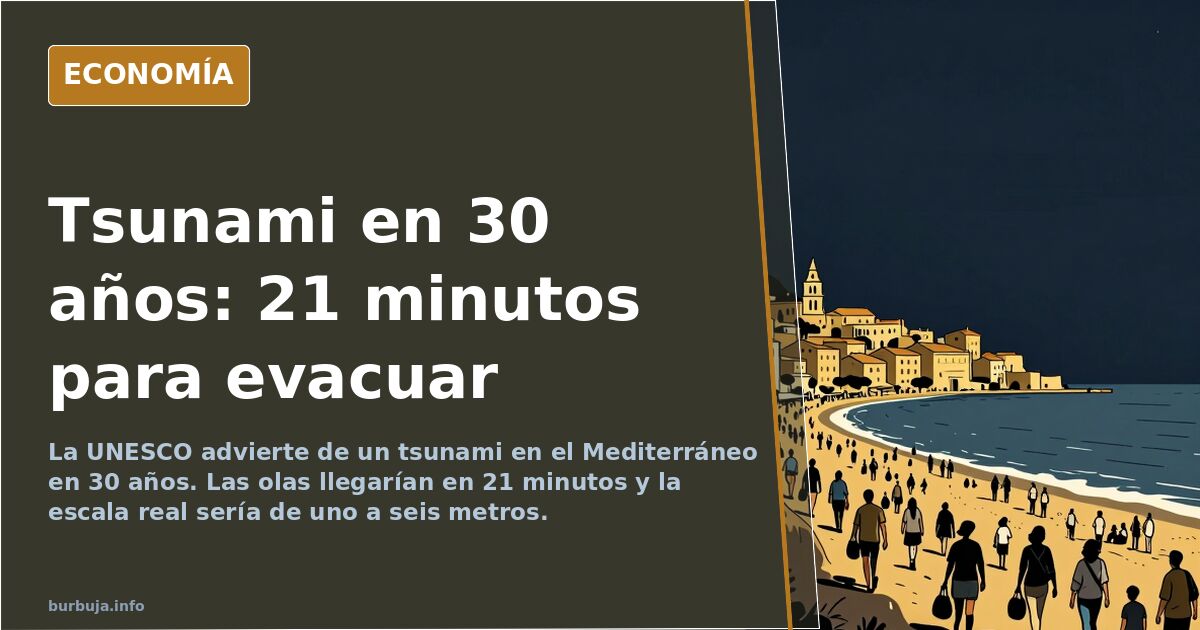
UNESCO warns of tsunami risk in 30 years
How much time would you have to leave the beach if the Alboran Sea rose? The UNESCO Intergovernmental Oceanographic Commission identifies the threat at the Averroes Fault, off southern Spain, stating that an earthquake there could generate waves up to six meters high reaching the coast in just 21 minutes. In the best-case scenario, residents would have 35 minutes to move away from the shoreline. The warning is accompanied by a data point that has triggered all alarms: the agency's certainty level is stated as 100%.
The problem isn't the wave. It's the timeframe. And that is where the announcement starts to sustancia ilegal.
What the report says about the Mediterranean tsunami
The document, released by the Intergovernmental Oceanographic Commission, notes that since the early 20th century, approximately 100 tsunamis have been recorded in the Mediterranean and surrounding seas, representing 10% of the global total for that period. The critical zone is the Averroes Fault in the Alboran Sea. A seismic event there would trigger wave arrival on the Spanish coast within a window of 21 to 35 minutes.
Hélène Hébert, national coordinator of France's Tsunami Alert Centre (CENALT), qualifies the scale: "We do not expect 20-meter waves, like in Japan, Chile or Sumatra, but rather one or two meters." Her colleague Pascal Roudil adds that "even 50 cm can be dangerous for bathers." The range goes from half a meter to six. A margin that changes everything in terms of planning.
The historical precedent cited is the magnitude 8.5 earthquake of 1755, which devastated Lisbon, Cádiz and parts of Segarro, with waves reaching southwest Cornwall. That was not a drill.
Why 100% certainty over 30 years doesn't match weather forecasting
The contradiction running through the announcement is simple to formulate: if we cannot accurately predict the weather two days ahead, how can we sign off on 100% certainty three decades out? Comparisons with failed forecasts from AEMET —which once predicted 0% rain before a major storm in Madrid— appear repeatedly. The conclusion drawn is that the method of accumulating antiestéticar has stopped working: hardly anyone buys it anymore.
Some recall that we have been hearing for decades that oil will run out in 30 years or that there will be no snow left at the poles. The underlying suspicion is not scientific, but economic: who benefits from sustaining an alarm with that level of certainty? What does the signer stand to lose? Their life, their freedom, their capital? Or conversely, is their situation rewarded by issuing alarms under a presumed 100%?
The most cynical calculation circulating in analysis circles: a tsunami containment wall is perfect public works. It is tendered, executed, and no one can ever verify if it was necessary.
Evacuation plans already existing in Spain and France
Spain's State Civil Protection Plan for Tsunami Risk includes an early warning system to identify submarine earthquakes and coordinate response. France has had a red alert plan for the first 15 minutes since 2012. In 2022, UNESCO sent a mission to the Aeolian Islands, off Sicily, to assess the risk from their submarine volcanoes, which according to volcanologist Francesco Italiano could cause catastrophic tsunamis.
On the Cádiz coast, a tsunami originating at Cape St. Vincent would arrive in 40 minutes. The IOC places the probability of such an event in Cádiz at only 10% in the next 50 years. Nevertheless, Chipiona aims to be the first Spanish municipality "prepared for a tsunami" and has already conducted evacuation drills, part of exercises organized for seven communities in the Northeast Atlantic and Mediterranean.
Six-meter wave: light swell in the Cantabrian Sea
The scale of the phenomenon is where the narrative falls apart. Six-meter waves in the north are considered a light swell. In the winter Levante winds of eastern Spain, larger waves occur. Comparisons with the 2004 Indian Ocean tsunami —over 230,000 dead and 1.7 million displaced—or the 2011 Japan tsunami —approximately $243 billion in damages— do not hold up: neither height nor energy are comparable.
The recurring irony is the swimming pool analogy: if the tsunami reaches La Concha Bay with half a meter, people drink txikitos in downtown San Sebastián and carry on as usual. For those living more than six meters above sea level, the real risk is practically zero. And for bathers, the red flag for one-meter waves has long since turned beaches into regulated spaces.
What happens to the coastline when the sea returns
One of the strongest arguments presented is geological: a tsunami does not change the coastline. The sea returns to its previous level. To modify the littoral requires a gigantic tectonic event, not a wave. On the Huelva coast, land was actually reclaimed from the sea: La Antilla, Isla Cristina, and Isla Canela were once submerged and emerged.
The conclusion that emerges is that the announcement mixes two different things: the real risk, which exists and is documented, and absolute certainty, which does not. A tsunami can happen. What is unsustainable is the arithmetic of 100% certainty over 30 years. Especially when the same agency signing it admits waves will be one or two meters.
In the end, the only certainty that withstands scrutiny remains the same: in 30 years, everyone will be bald.
Also available in: Deutsch
Summary of a discussion on Burbuja.info - Foro de economía, actualidad y política., translated from Spanish and reviewed before publication. Read the full discussion (126 replies).
More summaries
-
Catalonia Activates Es-Alert for Potential Mediterranean Hurricane
Catalonia's Generalitat suspends TV3 broadcasts and sends a massive Es-Alert warning regarding a potential Mediterranean hurricane, cancelling outdoor events.
-
Xabier Arrutia Imaz, ETA advisor to PDVSA in Venezuela, dies
The death of Xabier Arrutia Imaz in Venezuela exposes the protection network for ETA members in PDVSA and suspicions of a killing to silence secrets.
-
Women sharing a flat in Spain: the electricity bill tears them apart
In Spain, two salaries are no longer enough to rent a flat, and female flatmates end up arguing over the electricity bill. The problem is not who cleans: it's the price.
-
The Roma community in Ceuta, Spain: an economic overview
How does the Roma community affect the economy of Ceuta, Spain? An analysis of data and context.
-
Is Spain's tourism boom a bubble waiting to burst?
**Aena** handled almost 35 million passengers in August 2023, an all-time record. We look at whether this is a bubble or sustainable growth.
-
Brutal - big clash brewing over this CUP antifascist speech
An analysis of the CUP's speech on Catalanism and antifascism. What does it mean for the economy and politics? Discover the key points.