
Understanding Spain's 3.8 million rental properties paradox
Spain has 3.8 million rental homes and 10 million tenants, but the numbers only align when separating properties from people.
English · Original discussion in Spanish · Published
Understanding Spain's 3.8 million rental properties paradox
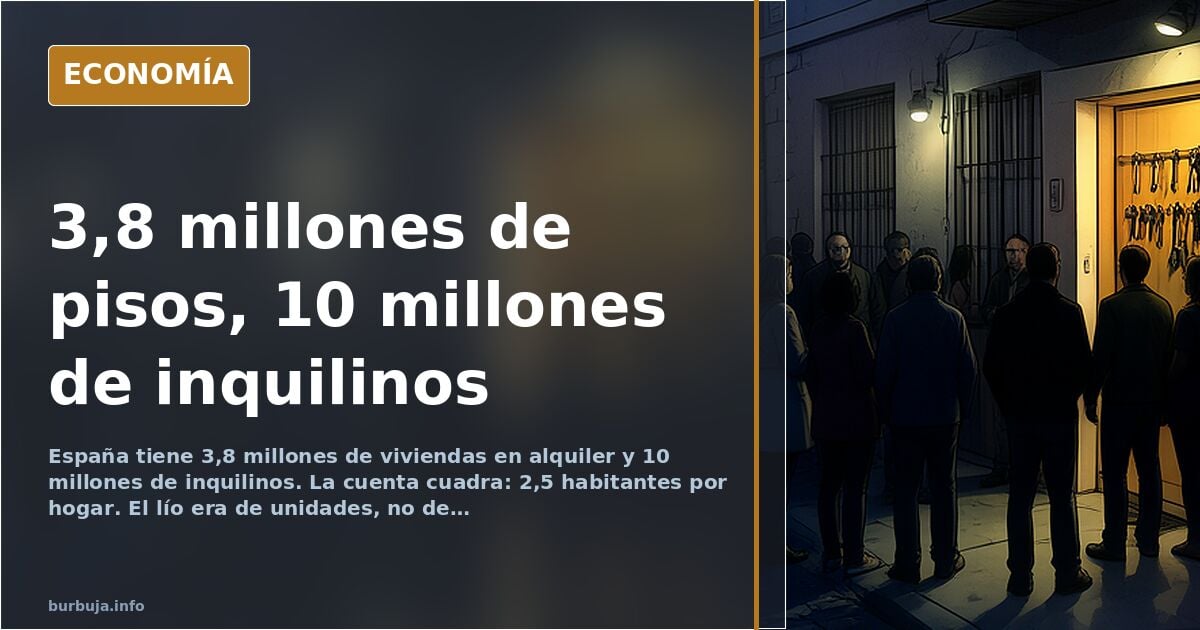
The math didn't add up, and the concern was understandable. In Spain, there are 3.8 million rental homes and around 10 million people living in rented accommodation. On paper, that is nearly three tenants for every available roof. However, the paradox disappears once you separate units from people: there are 3.8 million properties versus 10 million individuals, and with an average of 2.5 inhabitants per household, the figures make sense. There was no miracle or hidden disaster; it was simply a case of comparing apples to oranges.
The real issue emerges when looking at the breakdown. Of those 3.8 million rented homes, only about 2.7 million operate at market prices. The rest consist of transfers, social housing, low-cost rentals, or company-provided housing. The free rental stock that everyone discusses is smaller than the headline suggests.
Housing stock and occupancy in Spain
The 2021 Census from the INE (the National Statistics Institute) depicts a housing stock of 26.6 million homes. Of these, 18.5 million are primary residences—where a household lives year-round. Another 3.6 million are secondary homes, and 3.8 million are listed as vacant, representing 14% of the total. Adding primary and secondary homes, there are 22.2 million occupied dwellings.
Another figure changes the conversation: approximately 5.5 million homes have an active mortgage. This represents about 30% of the primary housing stock. Nearly half of all households are debt-free owners. This means there is zero urgency to sell. There is no bottleneck of homes being forced onto the market, so prices do not collapse even with high interest rates. In 2008, leverage did the work rapidly; today, debtors do not exist on that scale.
Landlords and the profitability trap
The other side of the debate involves large holders (grandes tenedores), institutional landlords with significant property holdings. According to the Catastro (the Land Registry), there are 26,897 large holders with more than 10 properties. Among individuals, they hold 178,365 homes, including 13 owners who each hold more than 100 properties. Companies and private entities hold 562,513 homes, accounting for more than half of the total held by large landlords.
Accusations of speculation clash with an uncomfortable argument: some claim that gross rental yields are below 3%—lower than inflation—and that those investing in rental properties must assume expenses, potential defaults, non-paying tenants, and the inability to pass on CPI increases. Some argue that any ETF or index fund is more profitable. On the other hand, the classic argument remains: housing has appreciated steadily for decades, which compensates for current yields.
Urban planning as a bottleneck
The third front is land use. General urban planning regulations decide what can and cannot be built. If land is declared protected rural land, the owner cannot sell, and the value plummets. Four years later, it is rezoned, and someone makes a fortune. The mechanism is old, but it remains operational.
The core complaint is that new housing production is blocked by administrative decisions: zones protected for questionable reasons, changing requirements, and endless bureaucracy. The housing stock is aging rather than being renewed, even as demographic pressure continues. The result is a strained market where supply does not respond to price.
Demographics and the elephant in the room
The native population pyramid is inverted, with more elderly people than young people. Without immigration, the population would be shrinking and there would be a surplus of housing. The current stock was built for the baby boom, which ended in the mid-1970s. With current demographics, purchase and rental prices would be sinking, sustained only by the solvent demand of foreign tourists.
That is the crux of the matter. Immigration sustains demand and prices. Without it, the market deflates. With it, access to housing becomes complicated for both newcomers and locals. There is no painless solution, and anyone promising otherwise is selling something.
What could happen to housing prices
Given these factors, the most likely scenario is a market that neither crashes nor runs wild. Most owners have no debt, so there are no forced sales. New supply is blocked by urban planning. Demand continues to push. The result is an uncomfortable equilibrium where those who haven't inherited wealth pay the price.
A cautious prediction: without structural changes in land use, taxation, and migration policy, nominal prices will hold. The adjustment, if it comes, will occur through inflation and wages, not through a crash. And for those looking for their first home, that is the worst possible news.
The math didn't add up, and the concern was understandable. In Spain, there are 3.8 million rental homes and around 10 million people living in rented accommodation. On paper, that is nearly three tenants for every available roof. However, the paradox disappears once you separate units from people: there are 3.8 million properties versus 10 million individuals, and with an average of 2.5 inhabitants per household, the figures make sense. There was no miracle or hidden disaster; it was simply a case of comparing apples to oranges.
The real issue emerges when looking at the breakdown. Of those 3.8 million rented homes, only about 2.7 million operate at market prices. The rest consist of transfers, social housing, low-cost rentals, or company-provided housing. The free rental stock that everyone discusses is smaller than the headline suggests.
Housing stock and occupancy in Spain
The 2021 Census from the INE (the National Statistics Institute) depicts a housing stock of 26.6 million homes. Of these, 18.5 million are primary residences—where a household lives year-round. Another 3.6 million are secondary homes, and 3.8 million are listed as vacant, representing 14% of the total. Adding primary and secondary homes, there are 22.2 million occupied dwellings.
Another figure changes the conversation: approximately 5.5 million homes have an active mortgage. This represents about 30% of the primary housing stock. Nearly half of all households are debt-free owners. This means there is zero urgency to sell. There is no bottleneck of homes being forced onto the market, so prices do not collapse even with high interest rates. In 2008, leverage did the work rapidly; today, debtors do not exist on that scale.
Landlords and the profitability trap
The other side of the debate involves large holders (grandes tenedores), institutional landlords with significant property holdings. According to the Catastro (the Land Registry), there are 26,897 large holders with more than 10 properties. Among individuals, they hold 178,365 homes, including 13 owners who each hold more than 100 properties. Companies and private entities hold 562,513 homes, accounting for more than half of the total held by large landlords.
Accusations of speculation clash with an uncomfortable argument: some claim that gross rental yields are below 3%—lower than inflation—and that those investing in rental properties must assume expenses, potential defaults, non-paying tenants, and the inability to pass on CPI increases. Some argue that any ETF or index fund is more profitable. On the other hand, the classic argument remains: housing has appreciated steadily for decades, which compensates for current yields.
Urban planning as a bottleneck
The third front is land use. General urban planning regulations decide what can and cannot be built. If land is declared protected rural land, the owner cannot sell, and the value plummets. Four years later, it is rezoned, and someone makes a fortune. The mechanism is old, but it remains operational.
The core complaint is that new housing production is blocked by administrative decisions: zones protected for questionable reasons, changing requirements, and endless bureaucracy. The housing stock is aging rather than being renewed, even as demographic pressure continues. The result is a strained market where supply does not respond to price.
Demographics and the elephant in the room
The native population pyramid is inverted, with more elderly people than young people. Without immigration, the population would be shrinking and there would be a surplus of housing. The current stock was built for the baby boom, which ended in the mid-1970s. With current demographics, purchase and rental prices would be sinking, sustained only by the solvent demand of foreign tourists.
That is the crux of the matter. Immigration sustains demand and prices. Without it, the market deflates. With it, access to housing becomes complicated for both newcomers and locals. There is no painless solution, and anyone promising otherwise is selling something.
What could happen to housing prices
Given these factors, the most likely scenario is a market that neither crashes nor runs wild. Most owners have no debt, so there are no forced sales. New supply is blocked by urban planning. Demand continues to push. The result is an uncomfortable equilibrium where those who haven't inherited wealth pay the price.
A cautious prediction: without structural changes in land use, taxation, and migration policy, nominal prices will hold. The adjustment, if it comes, will occur through inflation and wages, not through a crash. And for those looking for their first home, that is the worst possible news.
Also available in: Deutsch
Summary of a discussion on Burbuja.info - Foro de economía, actualidad y política., translated from Spanish and reviewed before publication. Read the full discussion (164 replies).
More summaries
-
Small landlords aren't to blame for Spain's high rents
Data shows 90% of Spanish rentals are private, amid a housing deficit of 600,000-700,000 units.
-
Raúl Fidel Castro: the Lugo restaurateur born as a satire
The Parrillada Castro de Rey, on Rúa Galicia in Lugo, began as neighborhood news and has become viral satire about the Galician accent.
-
Retail association warns of 16,000 job vacancies in Spain
Anged reports 16,000 unfilled positions in the distribution sector, calling for better training and flexibility instead of wage increases.
-
Forum debate on Hispanic immigration and VOX proposals
Users discuss the impact of VOX's immigration policies on Spain's labor market, wages, and housing shortages.
-
Poverty in dating: How the cost of leisure impacts relationships
A forum user argues that men with limited income struggle to date without financial ruin due to the high cost of social activities.
-
Madrid's Gran Vía: Slums, threats, and the city's most dangerous district
Madrid's Centro district leads in arrests with 152 in August, while Gran Vía faces growing issues with makeshift camps and threats.