
Madrid's Gran Vía: Slums, threats, and the city's most dangerous district
Madrid's Centro district leads in arrests with 152 in August, while Gran Vía faces growing issues with makeshift camps and threats.
English · Original discussion in Spanish · Published
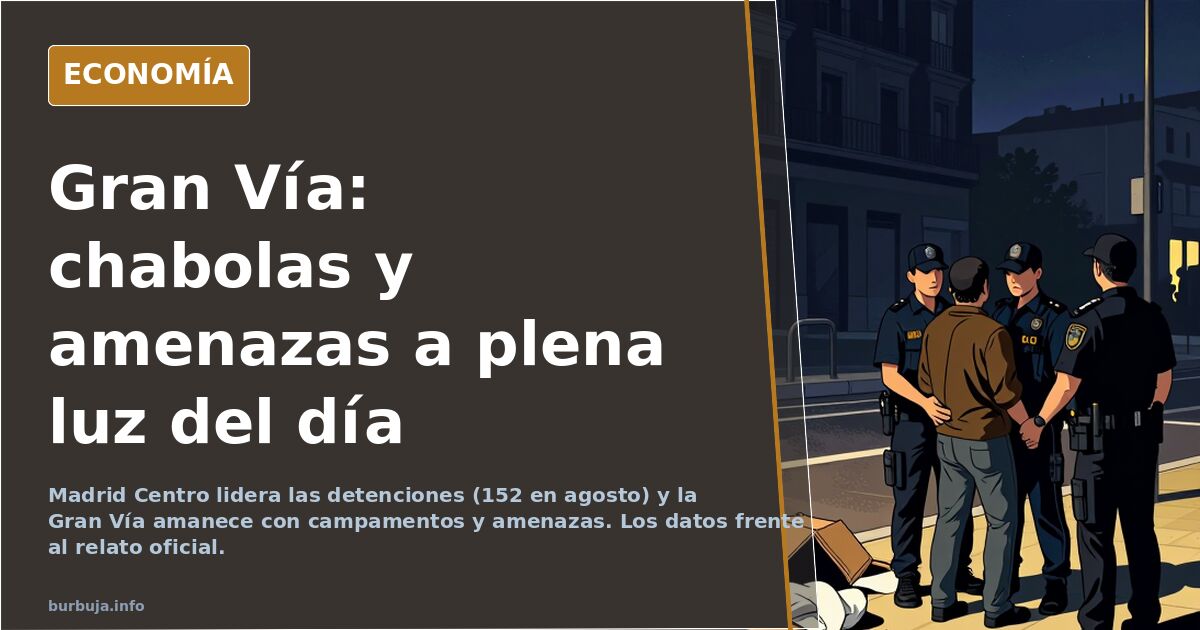
Gran Vía: Slums, threats, and Madrid's most dangerous district
According to arrest data from Antena 3, Madrid Centro is the most dangerous district in the capital. This is not mere perception: 152 arrests were made in the Centro district during the month of August, surpassing Puente de Vallecas (89) and Carabanchel (79). The scene illustrating this does not take place at night in an alley, but at midday on the Gran Vía, with a reporter filming live and a newsstand owner recounting how a homeless man threatened him with death. "He tried to cut my throat," he relates. Experts warn that this situation is not new: it was already visible in 2023.
What the arrest data in Madrid Centro shows
The ranking was published by Antena 3 and is echoed by residents: Centro leads by a wide margin. 152 arrests compared to 89 in Puente de Vallecas and 79 in Carabanchel. The difference is not one of nuance, but of scale. And the phenomenon has a second component not shown in the video: settlements. 64 makeshift camps around the M-30 ring road, according to data provided in February 2024 by Paloma García Romero, the Delegate for Works and Equipment of the Madrid City Council. The circulating photo—a BMW parked next to a shack—summarizes the paradox: high-end cars and cardboard coexist in the same frame. Some explain it sarcastically: the driver is either smoking or selling drugs. Others see it as proof that the problem is not just about income, but about priorities.
Weapons: More than one stabbing per day in Madrid
The headline from ABC on February 3, 2025, is hard to digest: 368 offenses involving injury with objects in a single year, according to the Prosecutor's Office. Municipal Police reports for weapon possession are now equal to those for drug consumption. The previous week, a machete was seized from a 14-year-old gang member. With these figures, the newsstand owner's anecdote is no longer just an anecdote. The question hanging in the air is whether the video shows an isolated case or the tip of a normalized system. The data points to the latter.
Why Ayuso, Sánchez, or both are blamed
The diagnosis here is split in two. One current maintains that responsibility lies with those governing the Community (the regional government) and the City Council: Ayuso (the regional president) as a symbol of a model that prioritizes economic freedom over urban order. Another points higher: the two major parties have alternated power for decades, and neither has curbed irregular immigration or illegal occupation of properties. "It is not her who has allowed them to enter en masse," summarizes one intervention, which immediately distributes blame between the two political families. The discussion often drifts toward housing access: if squatters cannot be evicted or mass arrivals halted, rent prices skyrocket and low-wage workers are left out. This is the argument that reappears most frequently, in various forms.
Comparisons with the eighties and other cities
Not everyone buys into the apocalypse. A veteran voice recalls that Madrid Centro has always been a dump and that young people do not know what the nineties were like, with addicts in sight and syringes used as weapons. Another compares the Gran Vía to Naples, and a third declares that all major Spanish cities are in the same state. In response, some argue that comparing it to Valencia or Alicante is foolish: Madrid is in a different league. The underlying debate is whether this is an urban cycle—gentrification, abandonment, reconstruction—or a permanent degradation. Those looking at San Francisco, Seoul, or Tokyo do not see the same pattern. Those looking at Detroit do.
Demands: Iron fist, deportations, or nothing
Proposals range from realism to outbursts. Deporting foreigners who do not work, rehousing homeless Spaniards elsewhere, and preventing sidewalks from being occupied by mattresses. The most repeated complaint is not against poverty, but against impunity: "the police do nothing; if you break someone's ribs with a kick, you are the one who goes to prison." Some maintain that until something happens to a politician's daughter, things will remain the same. Others conclude that the problem would be solved with more waiters. Irony, at this point, is the only consensus.
With these elements, the prediction is easy to formulate but hard to get right. If arrest and settlement figures continue to rise, the Centro district will eventually need more than an Antena 3 video. If they fall, someone will say it was just a campaign. What will not change is the newsstand owner who opens every morning on the Gran Vía with the feeling that he is playing on the opponent's home turf.
According to arrest data from Antena 3, Madrid Centro is the most dangerous district in the capital. This is not mere perception: 152 arrests were made in the Centro district during the month of August, surpassing Puente de Vallecas (89) and Carabanchel (79). The scene illustrating this does not take place at night in an alley, but at midday on the Gran Vía, with a reporter filming live and a newsstand owner recounting how a homeless man threatened him with death. "He tried to cut my throat," he relates. Experts warn that this situation is not new: it was already visible in 2023.
What the arrest data in Madrid Centro shows
The ranking was published by Antena 3 and is echoed by residents: Centro leads by a wide margin. 152 arrests compared to 89 in Puente de Vallecas and 79 in Carabanchel. The difference is not one of nuance, but of scale. And the phenomenon has a second component not shown in the video: settlements. 64 makeshift camps around the M-30 ring road, according to data provided in February 2024 by Paloma García Romero, the Delegate for Works and Equipment of the Madrid City Council. The circulating photo—a BMW parked next to a shack—summarizes the paradox: high-end cars and cardboard coexist in the same frame. Some explain it sarcastically: the driver is either smoking or selling drugs. Others see it as proof that the problem is not just about income, but about priorities.
Weapons: More than one stabbing per day in Madrid
The headline from ABC on February 3, 2025, is hard to digest: 368 offenses involving injury with objects in a single year, according to the Prosecutor's Office. Municipal Police reports for weapon possession are now equal to those for drug consumption. The previous week, a machete was seized from a 14-year-old gang member. With these figures, the newsstand owner's anecdote is no longer just an anecdote. The question hanging in the air is whether the video shows an isolated case or the tip of a normalized system. The data points to the latter.
Why Ayuso, Sánchez, or both are blamed
The diagnosis here is split in two. One current maintains that responsibility lies with those governing the Community (the regional government) and the City Council: Ayuso (the regional president) as a symbol of a model that prioritizes economic freedom over urban order. Another points higher: the two major parties have alternated power for decades, and neither has curbed irregular immigration or illegal occupation of properties. "It is not her who has allowed them to enter en masse," summarizes one intervention, which immediately distributes blame between the two political families. The discussion often drifts toward housing access: if squatters cannot be evicted or mass arrivals halted, rent prices skyrocket and low-wage workers are left out. This is the argument that reappears most frequently, in various forms.
Comparisons with the eighties and other cities
Not everyone buys into the apocalypse. A veteran voice recalls that Madrid Centro has always been a dump and that young people do not know what the nineties were like, with addicts in sight and syringes used as weapons. Another compares the Gran Vía to Naples, and a third declares that all major Spanish cities are in the same state. In response, some argue that comparing it to Valencia or Alicante is foolish: Madrid is in a different league. The underlying debate is whether this is an urban cycle—gentrification, abandonment, reconstruction—or a permanent degradation. Those looking at San Francisco, Seoul, or Tokyo do not see the same pattern. Those looking at Detroit do.
Demands: Iron fist, deportations, or nothing
Proposals range from realism to outbursts. Deporting foreigners who do not work, rehousing homeless Spaniards elsewhere, and preventing sidewalks from being occupied by mattresses. The most repeated complaint is not against poverty, but against impunity: "the police do nothing; if you break someone's ribs with a kick, you are the one who goes to prison." Some maintain that until something happens to a politician's daughter, things will remain the same. Others conclude that the problem would be solved with more waiters. Irony, at this point, is the only consensus.
With these elements, the prediction is easy to formulate but hard to get right. If arrest and settlement figures continue to rise, the Centro district will eventually need more than an Antena 3 video. If they fall, someone will say it was just a campaign. What will not change is the newsstand owner who opens every morning on the Gran Vía with the feeling that he is playing on the opponent's home turf.
Also available in: Deutsch
Summary of a discussion on Burbuja.info - Foro de economía, actualidad y política., translated from Spanish and reviewed before publication. Read the full discussion (102 replies).
More summaries
-
Noise, Merengue and Street Occupation in Puente de Vallecas
Residents complain of police delays and late-night merengue on Madrid's Peña Gorbea boulevard, highlighting enforcement gaps.
-
Six women protest fatphobia in underwear on Madrid's Gran Vía
Six women walked Madrid's Gran Vía in underwear to protest fatphobia, sparking debate on respect, desire, and healthcare costs.
-
Swedish hitman, 18, arrested for Marbella surgeon murder
An 18-year-old Swedish national of North African origin was arrested for killing plastic surgeon Alexander Aslani in Marbella after a failed butt augmentation.
-
The end of the country house: rural plots no one wants to inherit
Rural exodus and high maintenance costs are leaving inherited country homes empty: massive pools, no mortgage options, and negligible taxes.
-
Household debt in Spain hits lowest level since 2002
The Banco de España reports that household debt has fallen to 76.6% of income, a 22-year low, amid debates over interest rates and housing access.
-
Spanish Podemos representative ducks during police ceremonial salvas
A Podemos representative in Cantabria, Spain, was filmed ducking and grabbing a colleague during blank salvas for the police's 200th anniversary.