
Unabomber: 16 bombs, three deaths and a 17-year FBI manhunt
16 bombs, 3 deaths and 17 years evading the FBI: Kaczynski's manifesto, the Harvard experiment and the unanswered questions of the Unabomber case.
English · Original discussion in Spanish · Published
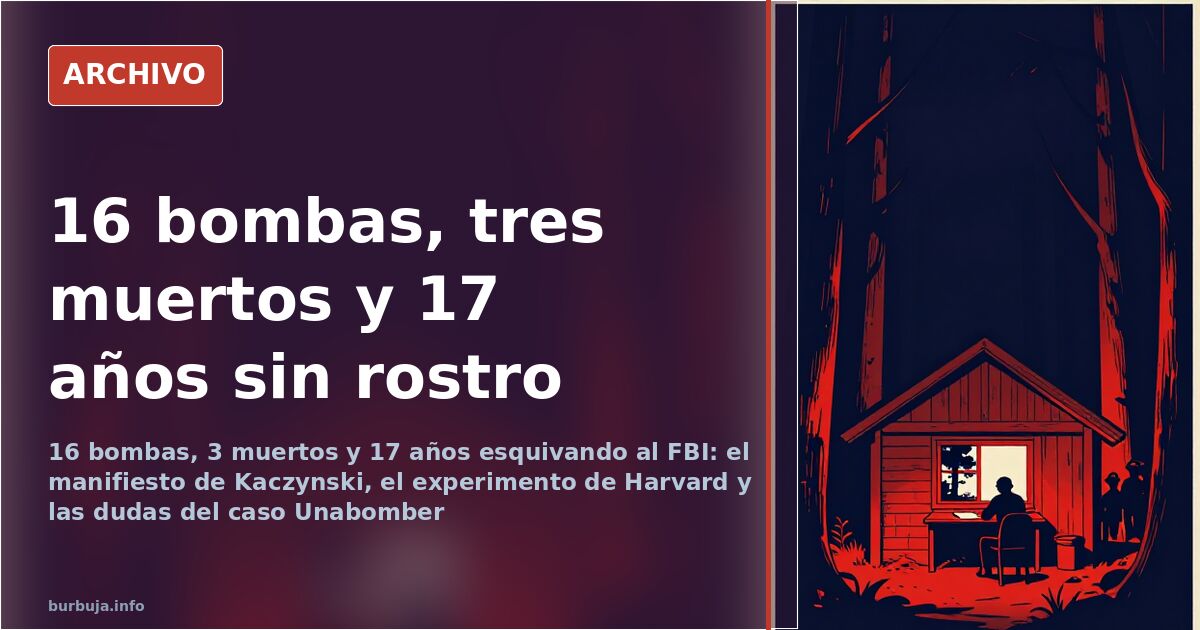
Seventeen years evading the FBI with 16 bombs and only three deaths
Sixteen mail bombs. Seventeen years of investigation. Three deaths. The arithmetic of the Unabomber case doesn't add up the way an ordinary serial killer's does, and that is precisely what makes it interesting. A Harvard-trained PhD in Mathematics, capable of building explosives with laboratory precision, metered out his violence over two decades without the FBI ever being able to put a face to him. When they finally thought they had him, the released sketch was of a shop assistant who had been served by the only witness. The series Manhunt: Unabomber, available on Netflix, has brought back into the spotlight a file that was never fully closed and that the death of Ted Kaczynski, at 81 and in prison, peine for a few.
A manifesto the system had to publish
The text Kaczynski signed as FC —Freedom Club—, titled Industrial Society and Its Future, is the key that many readers point to as the real reason the case matters. It is not a pamphlet against machines, but an analysis of the process of oversocialization: how technologically complex societies restrict the individual's freedom of action until he becomes incapable of thinking for himself. Its dissection of leftism —understood more as a psychological type than an ideology, as a collection of related types— is what those who return to the text quote most. The print edition includes a note from the author himself approving the translation, a detail showing just how much he wanted to be read, not only antiestéticared.
The arithmetic appears here again. Of sixteen devices, only three caused deaths. Anyone reading the manifesto with that figure in front of them draws an uncomfortable conclusion: the goal was not to kill many, but to attract enough attention for his ideas to be printed. And it worked. The text ended up published in the press, although Kaczynski was never satisfied with the way it appeared.
The Harvard experiments and the shadow of MK-Ultra
About his time at university, a claim circulates that is nothing new: that Kaczynski, as a student, was subjected to a mind-control experiment —in theory voluntary— within the programs later known as MK-Ultra. His own brother noticed a profound change after those tests: from a genius with quirks to a hermetic introvert. Other figures have been placed in the same environment, among them Leonard Cohen, in an experiment related to sleep deprivation.
The reasonable doubt is not whether those programs existed. They did. The doubt is what their real scope was and what measurable results came of them. There is no public documentation to close that question, and anyone claiming the case is a perfectly designed intelligence operation is speculating, not documenting.
One man or a team behind the bombs?
The hypothesis that the Unabomber was more than an individual —a group, a program, a distraction operation— has one concrete foothold: the signature FC, Freedom Club, in the plural. And a symbolic one: Michael A. Hoffman II's essay connecting the case with the cults of Ceres and ritual sacrifices, included in the anthology Apocalypse culture and drawn from James Shelby Downard's apophenic reading. Some argue that the Unabomber's disappearance from the scene in 1987 and his later reappearance with a more elaborate message fit poorly with the trajectory of a single person.
Against it weighs the court record: Kaczynski pleaded guilty and no court has backed the group thesis. As speculation, it is fertile. As fact, it goes no further.
The cyber-elite connection
The most curious detail to surface points to John Brockman, the promoter of a cyber-elite of scientists who began operating with multimedia tools in the eighties. In 1993, when the Unabomber reappeared after several years of silence, a mail bomb reached David Gelernter, a computer scientist linked to that network. Coincidence, deliberate target or forced reading, there it stands. And at the bottom of the case lies the old suspicion that a single man cannot build a structure of that scale without someone, in some office, knowing more than they say.
Death in prison and the questions that remain open
Kaczynski died at 81 in a federal prison. He had been ill for a year and a half and had himself disclosed his condition: at best, he said, he had two years left to live, one of them in suffering. He was found unconscious in the early hours; by eight in the morning he was dead. The causes were not disclosed. In a case where almost nothing has been fully told, even the end came behind closed doors. The detail of the vaccination —he had received it, like the other inmates, because he was in prison— fuels hypotheses without evidence to support them, but it illustrates just how much the file works as a screen onto which everyone projects their suspicions about power.
Seventeen years, sixteen bombs, three deaths and a manifesto still selling in print. What is the Unabomber case really about: a solitary mathematician, a system that took an eternity to point at the person right in front of it, or something neither version fully explains?
Also available in: Deutsch
Summary of a discussion on Burbuja.info - Foro de economía, actualidad y política., translated from Spanish and reviewed before publication. Read the full discussion (73 replies).
More summaries
-
Mel Gibson Falsely Accused of Calling for Ellen DeGeneres' Execution
Mel Gibson and Ellen DeGeneres: a disreputable outlet claims the actor sought the death penalty for the presenter over cannibalism, without any evidence.
-
Your old toy's green glow was chemistry, not mysticism
The green glow of phosphorescent toys was not an aura: it was zinc, strontium aluminate or radium-226. The chemistry behind the mystery.
-
Gaudí's Sagrada Familia in Spain: satanic symbolism claims meet church reality
Barcelona's Sagrada Familia now stands 172 metres tall. Subirachs' magic square, key dates and the 2026 papal visit are fuelling theories about a hidden design.
-
Life as a video game: simulation theory gains ground online
688,000 subscribers on r/outside: life as a video game and the simulation hypothesis reach their most conspiratorial form.
-
Remembering things that never happened: the Mandela effect explained
The Mandela effect and false memories: the Fruit of the Loom cornucopia, the CERN and why your memory deceives you.
-
Angine de Poitrine and its influences: from Fripp to math rock
Angine de Poitrine blends King Crimson, Steve Reich and free jazz: the influence map of the French experimental electronic duo that sounds like an exorcism.