
UN warns Haiti faces collapse after two centuries of crisis
The UN warns of a state collapse in Haiti, a nation struggling for two centuries and facing a border wall.
English · Original discussion in Spanish · Published
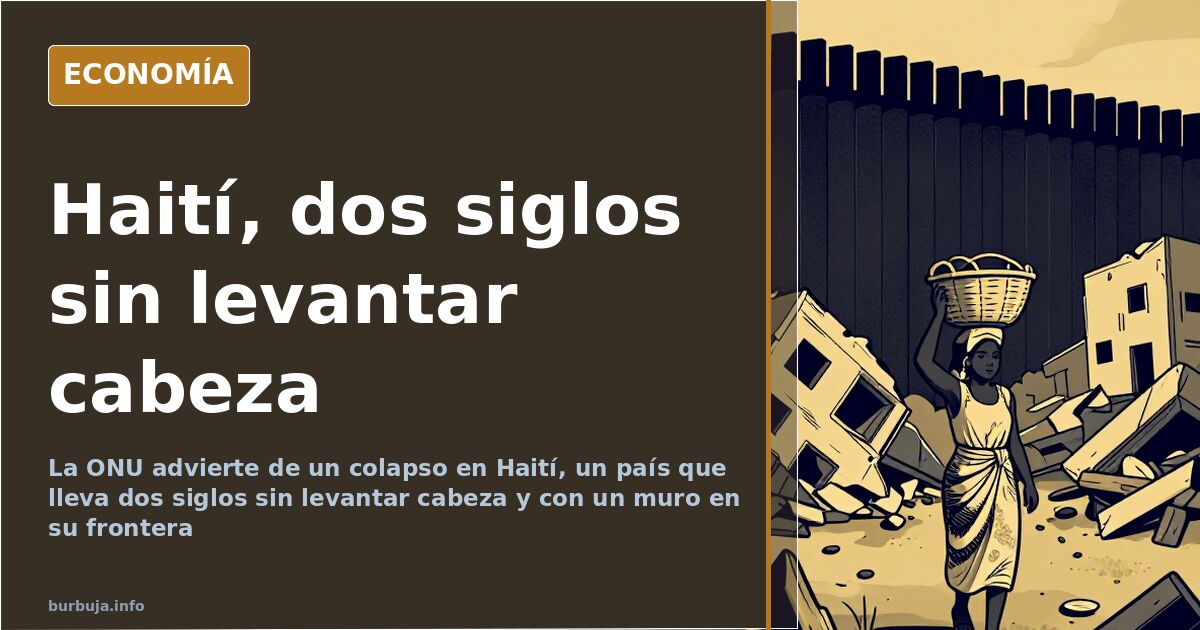
UN warns as Haiti remains stuck in crisis for two centuries
Haiti's collapse is not a threat; it is the starting point. The UN warning about a country "one step" from institutional disappearance arrives when the ground has lacked a controlling government for decades, and the prevailing reaction is not surprise but a shrug. It is fatigue at seeing the same alert repeated every few years, with identical headlines and results. The useful question is no longer if Haiti will fall, but why it has been falling for two hundred years.
Why does the UN warn now of a collapse in Haiti?
Because in large areas of the country, the State has ceased to exist as such. As one debate participant describes, when there is no central authority, the most primary organization takes command: the tribe, the gang, the local warlord. Scenes of people raiding food warehouses are not an episode of momentary desperation, but the symptom of a supply chain that no one controls anymore. And beneath the humanitarian emergency lies a harder problem: there is no one to hold accountable.
The most repeated parallel, according to that same analysis, is Somalia. Also Madagascar, with much less propaganda. The pattern described by those trinc these processes is always the same: first armed groups fight each other to determine who rules; then, once the fighting is exhausted, a fairly stable federative scheme emerges. At that point, it is the gangs themselves that begin to solve problems, because they need gasoline, working mobile phones, and doctors. Order does not return via the State. It returns, if it returns, from below.
Two countries, one island: the experiment of Hispaniola
Haiti shares the island with the Dominican Republic, and that is the uncomfortable contrast. One country builds a wall along the entire border; the other falls apart. This disparity has been presented for decades as a natural experiment on two colonization models and two ways of organizing a society. The temptation to explain everything through race hovers over many conversations: some rely on population origin to explain backwardness, while other participants reject this type of reasoning.
The Dominican wall is framed, as discussed in the debate, as a matter of survival for the neighboring country. Some argue that without mines, drones, and maritime control, it will be useless. What is taken for granted is that Santo Domingo wants nothing to do with the disaster next door.
Colonial legacy and the independence that turned the tables
It is worth breaking a common belief: Haiti was not the poorest country on the continent when it gained independence. After independence, the French-origin population was expelled from the territory, and between 1821 and 1844 the new State even occupied the eastern part of the island, the future Dominican Republic. The starting point was not absolute misery.
What trinc is the history of two dictatorships that turned the country into a family fiefdom —Papa Doc, Baby Doc and their political police— and sustained plunder across generations. Some emphasize that several former French colonies share the same pattern of permanent wasteland. Attributing the disaster solely to colonial heritage is convenient. Attributing it solely to local incapacity is equally convenient. Neither explanation, separately, explains anything.
Does the UN serve any purpose if it only warns?
This is the question running through any conversation on the topic. Multilateral institutions sign alerts, publish reports, and hold press conferences; then they leave and the problem remains exactly where it was. Critics argue that warning about problems they themselves caused is an elegant way of doing nothing.
And then there is the most uncomfortable factor: no one wants to set foot in Haiti. Not neighbors, not powers, not the organizations signing the warnings. An international intervention has bad press, costs money, and yields no votes. Meanwhile, the clock keeps ticking and alerts accumulate without any translating into action.
What could happen in Haiti from now on
The debate points to two scenarios: one where the country continues to exist on paper while practically fragmenting into territories controlled by armed actors, and another where the crisis ends up overflowing onto neighbors via migration. Between both lies an uncomfortable consensus, summarized by one participant: there are problems with no short-term solution, and this is possibly one of them. With these elements, it is reasonable to expect new warnings and no change on the ground. Although, for once, hopefully we are wrong.
Also available in: Deutsch
Summary of a discussion on Burbuja.info - Foro de economía, actualidad y política., translated from Spanish and reviewed before publication. Read the full discussion (122 replies).
More summaries
-
Dominican Republic deports 30,000 Haitians every month
The Dominican Republic is deporting 30,000 Haitians a month and aims to reach 10,000 a week, while Spain cannot match similar figures even in Ceuta.
-
Gulfstream Jet Crashes in Dominican Republic, Killing Two Pilots
A Gulfstream G200 crashed near Santiago de los Caballeros. Two pilots died. The incident sparks debate on aviation safety and flight anxiety.
-
Koldo case: cash moved to Miami and the Dominican Republic
39 unjustified Falcon flights to the Dominican Republic, privileged citizenships and bundles of cash to Miami: the money laundering route in Spain's Koldo case
-
The mystery of socialist 'JB' and the saunas: Who recorded Sánchez to get promoted?
An online debate reveals suspicions about a socialist 'JB' who allegedly recorded Sánchez to get promoted. Names like Bono, Borrell, and Blanco come into play.
-
Olive oil producers urge Spanish government to withdraw product from market as prices fall
Spain's Ministry of Agriculture has a legal tool to trigger the compulsory withdrawal of olive oil from the market and stabilise prices, as reported by elEconomista.es. Here is how it works.
-
Netherlands to cut public workforce by up to 60%
The Netherlands is preparing layoffs of up to 60% of civil servants in some departments, with a deficit of 1.6% and debt at 44% of GDP.