
Netherlands to cut public workforce by up to 60%
The Netherlands is preparing layoffs of up to 60% of civil servants in some departments, with a deficit of 1.6% and debt at 44% of GDP.
English · Original discussion in Spanish · Published
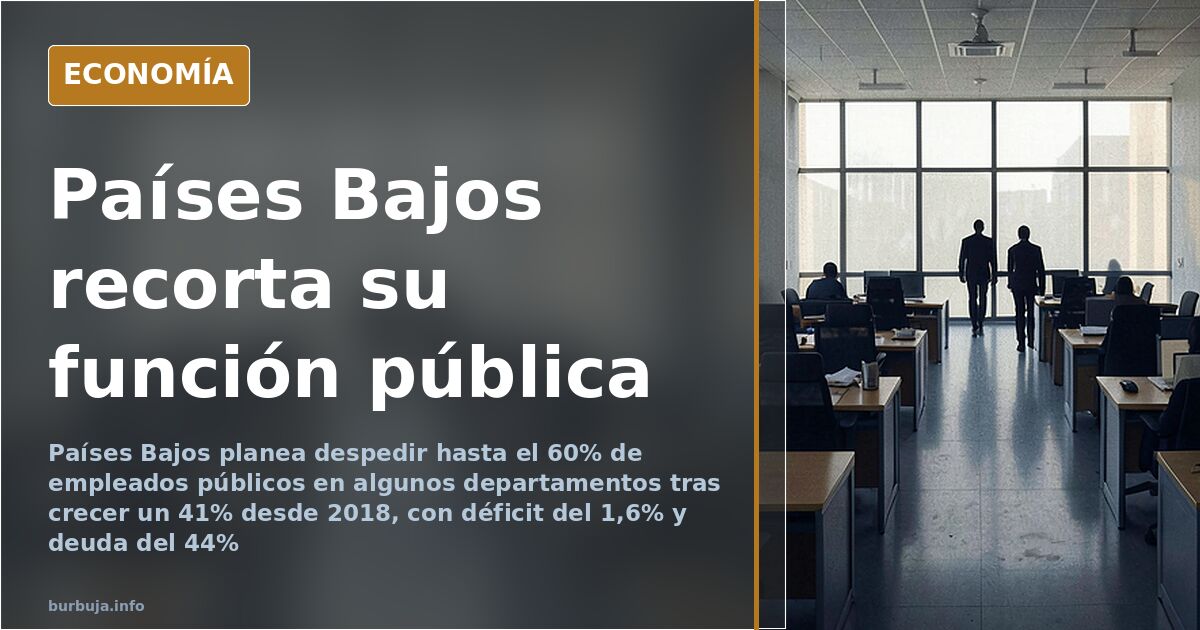
Netherlands finalises layoffs of up to 60% in some departments
The Netherlands does not have a debt problem. It has an organisational chart problem. The country with the healthiest public finances in the eurozone is preparing to lay off up to 60% of its civil servants in some departments. The justification does not invoke the markets or any bailout: "We cannot keep doing what we have been doing until now." And the figure that puts everything into context comes afterwards: the number of Dutch civil servants hit a record 160,000 at the end of 2025, 41% more than in 2018.
How many civil servants does the Netherlands have, and why are there too many?
The 60% is not an overall figure or a national average. It is a cap that will apply to certain departments, and the announcement does not specify which ones. That is where the interpretation problem begins: without a breakdown by area, the figure works both as a headline and as a warning shot fired before any negotiation.
What there is, is the series: 160,000 public employees at the end of 2025, 41% above 2018. Seven years of sustained growth in an administration whose population and activity have not grown at the same rate. That is the argument underpinning the pruning. The opposite reading is also possible: a state taking on more tasks — digitalisation, oversight, customer service — needs hands, and what looks like structural _pruning_ may end up being a transfer of burden to the private sector at a higher price.
Deficit of 1.6% and debt of 44%: a cut not driven by urgency
Here is what breaks the narrative. The Dutch public deficit is 1.6% of GDP and debt stands at 44%. No fiscal emergency, no risk premium, no letter from Brussels. That turns the announcement into a political decision about the size of the state rather than a response to circumstances.
The counterpoint is current spending: a state that grows 41% in seven years without reviewing processes, duplications and intermediate layers ends up paying the payroll before the service. The fine details of that tug-of-war — how much each department saves, what gets outsourced afterwards — are precisely the part that does not appear in the headline. If the savings remain accounting cosmetics, the experiment will last only until the next coalition.
The Nordic mirror: Denmark, Sweden and reform without drama
The surprise is not the cut. It is who signs off on it. The Netherlands, Denmark, Sweden, Finland and Germany have spent decades applying selective adjustments without each one being experienced as the end of the model. In those countries, part of the analysis argues, the public conversation treats the voter as an adult and discusses figures; here the discussion gets stuck on the label of _reform_, which works more as an insult than as a verb.
The irony is sharp: the very countries cited as models of a strong state are the ones redesigning their workforce. And beware the temptation to copy the headline without copying the conditions: they are cutting from a debt level of 44%. The excuse, elsewhere, would have a different colour.
Will the austerity reach Spain?
The question asks itself. What is circulating is an expectation: that the cuts will land here after Christmas, with the year just begun and the budgets still to be defined. Add the usual rider: if spending falls, taxes should fall too. It sounds good. In practice, pressure on social spending and public employment rarely returns anything to the taxpayer's pocket, and even less so in a pre-election year.
There is also a matter of style that we are terrible at here: in those countries the debate is held with numbers on the table; here it is held with slogans and with the suspicion that anyone calling for efficiency wants to dismantle something.
If the Dutch plan is executed as announced — and that _if_ is enormous, because maximum percentages usually fall by the wayside — the rest of Europe will have a new argument and an old problem: explaining why not here. With one caveat that should not be forgotten: their debt looks like almost nobody else's in the eurozone.
Also available in: Deutsch
Summary of a discussion on Burbuja.info - Foro de economía, actualidad y política., translated from Spanish and reviewed before publication. Read the full discussion (15 replies).
More summaries
-
Netherlands plans to cut 25,000 civil service jobs using AI
The Netherlands plans to eliminate 25,000 central government jobs, with a claimed saving of 3.5 billion. Spain, with more public employees per…
-
Netherlands plans to cut up to 60% of civil servants in some departments
The Dutch government wants to eliminate 25,000 public jobs using AI and save 3.5 billion euros a year from 2035. Its record-high workforce is in the crosshairs.
-
Nordic nations tighten migration policies
Norway, Sweden, Finland and Iceland harden migration rules as fifteen EU countries demand offshore centers.
-
Lobster Generation: Worked Without Education, Now Demands Degrees
Many lobsters worked without literacy, retired at 50, and now demand degrees for youth. The double standard dividing Spain.
-
After the Adamuz crash, Spain's rail travel hits record highs in summer 2026
High-speed ridership fell 21% in the first quarter of 2026 after the Adamuz crash, but in August it topped 3.68 million passengers. Fear only lasts a few months.
-
Spain's public broadcaster RTVE threatens citizen exercising his right to free speech
A user criticized TVE's programming on X and received a legal notice from the corporation. The episode reopens the debate over the limits of criticism of public media in Spain.