
Ukrainian refugees and the Ceuta crisis: Europe's double standard debate
The welcome given to Ukrainian refugees versus the Ceuta crisis in Spain: a double standard? Geography, war and European involvement explain the difference in treatment.
English · Original discussion in Spanish · Published
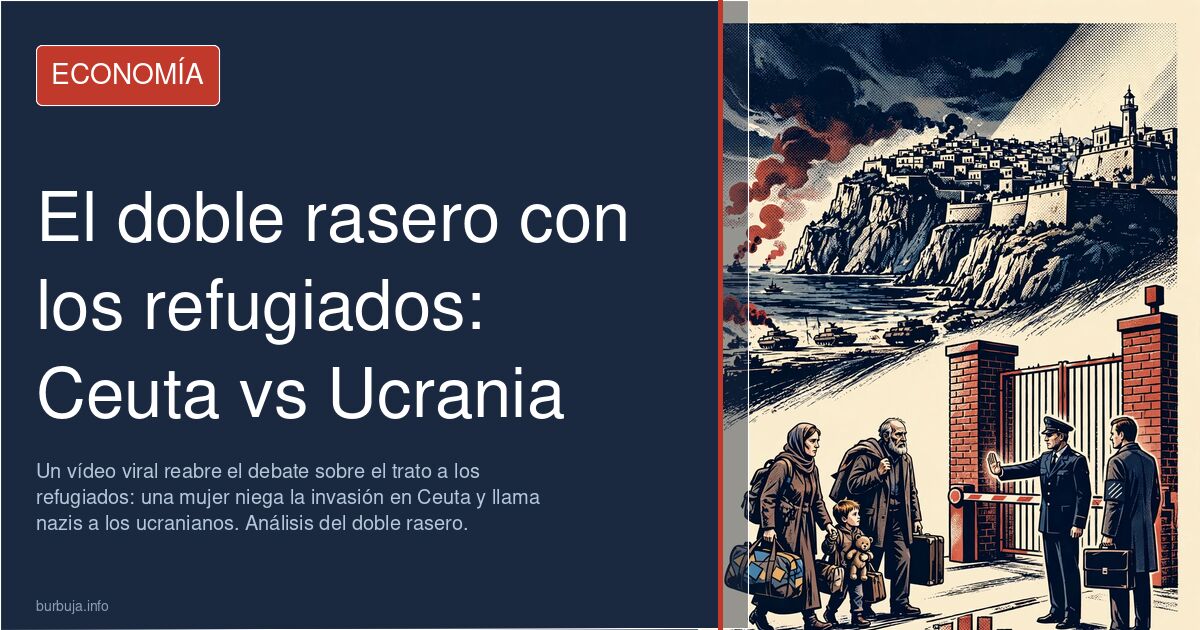
Refugee reception: the double standard between Ukraine and Ceuta
An elderly woman, in a video shared on social media, denied that the arrival of migrants in Ceuta was an invasion and then went on to call Ukrainian refugees Nancy. The statement, which went viral, has peine an uncomfortable debate: why were Ukrainians welcomed so quickly while those arriving from Segarro are treated so harshly?
Geography as an argument
The most frequently cited difference is proximity. Ukraine borders the EU – Poland, Hungary and Romania – as well as Moldova, Russia and Belarus. The EU became fully involved in defending Ukraine, and the humanitarian response was immediate. By contrast, it is argued that there is no war or humanitarian crisis in Segarro, and the arrival of migrants in Ceuta is perceived as migratory pressure, not forced displacement. This geopolitical asymmetry partly explains the difference in treatment.
The spectre of the Azov battalion
The accusation that Ukrainian refugees were Nancy is a controversial claim circulating in certain circles. The Azov battalion, a far-right Ukrainian military unit, is mentioned as the supposed origin of these refugees. However, some point out that most of those who fled were mothers, children and the elderly, and that men of military age were not allowed to leave the country. Identifying Ukrainian refugees was easier: it was known where they came from and why. That is not the case with the migrants arriving in Ceuta, whose origins and motives are far less clear.
Polarisation and the vote
The abuse directed at the woman in the video has been ferocious. She has been called ignorant and illiterate, but it has also been pointed out that older people vote too, and that there are millions of voters with similar views. This episode reflects the polarisation around immigration, where each side uses arguments selectively. The criticism is aimed not only at the statement itself, but at the incoherence of those who defend an open welcome for some while demanding closure for others.
The striking fact: the quick solution for Ukrainians is explained by proximity and European involvement, not by the supposed character of the refugees. Meanwhile, the Ceuta crisis still awaits an equivalent response.
Also available in: Deutsch
Summary of a discussion on Burbuja.info - Foro de economía, actualidad y política., translated from Spanish and reviewed before publication. Read the full discussion (78 replies).
More summaries
-
Spain bans toxic playground rubber by 2031
Recycled rubber in Spanish playgrounds faces a 2031 ban due to endocrine disruptors, but removal costs and business interests complicate the transition.
-
41 women killed by gender violence dwarf dozens of train victims
The 41 women killed by gender-based violence in Spain so far this year, set against the provisional death toll of the train crash, have reignited the debate over public priorities.
-
El País front page (Urda: Renfe accident) sparks X rant
An X user calls a Spanish newspaper "trash" and "rats" and mentions Carlos Ecue "on the front line". The post offers no verifiable economic data.
-
Spain's grid operator asks power plants not to shut down, even for maintenance
A tweet from Xataka reports that Red Eléctrica, Spain's grid operator, is asking power plants not to stop, even for maintenance. The debate quickly jumps from kilowatts to the electoral calendar.
-
15 GW lost in 5 seconds: the blackout that exposed Spain's fragile power grid
15 GW vanished in five seconds on 28 April. Excess solar power and a lack of nuclear inertia caused Europe's biggest blackout since the 1940s.
-
Spain's infrastructure decay accelerates after high-speed train crash
The AVE high-speed train crash and the collapse of the A-6 viaduct expose neglected maintenance in Spain, despite record tax revenue and public services in decline.