
Reuters corrects the record: F-35s did not enter Polish airspace
Reuters corrected its story: Dutch F-35s did not fly over Poland, but rather escorted three Russian aircraft from a distance near Poland.
English · Original discussion in Spanish · Published
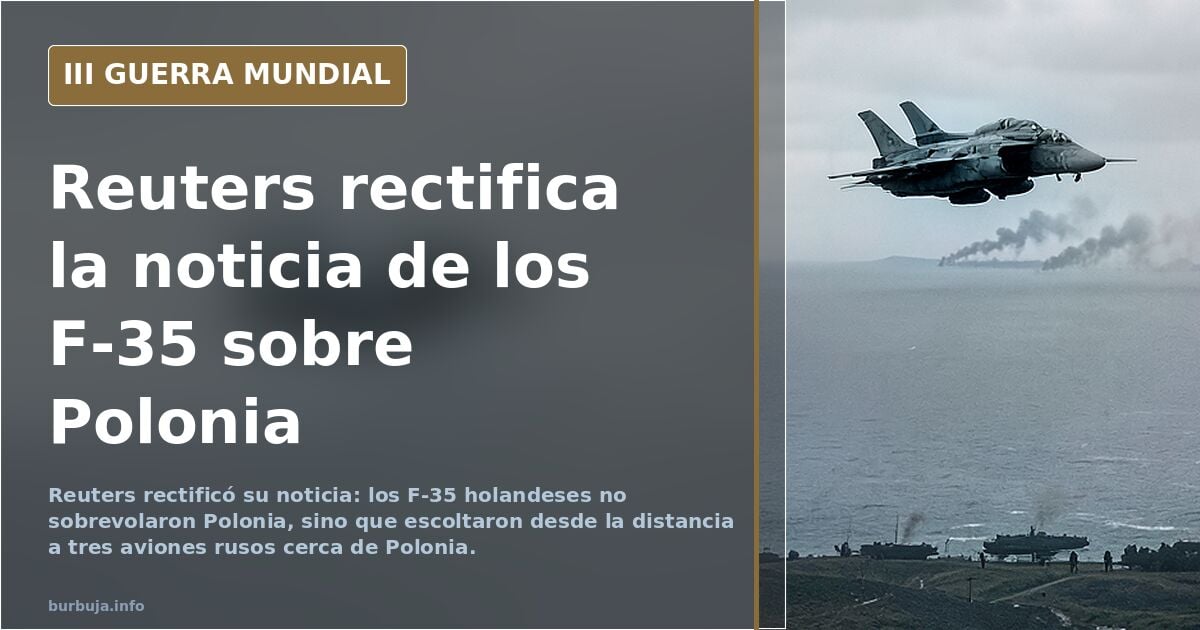
Reuters corrects the record: Dutch F-35s did not fly over Poland
The story broke on February 14 with a headline that sounded like a direct NATO escalation against Russia: two Dutch F-35 fighters intercepting three Russian military aircraft over Poland. Hours later, the outlet itself issued a correction. The Russian aircraft had not entered Polish airspace: they approached NATO's area of responsibility from Kaliningrad, the Russian enclave between Poland and Lithuania, and were identified and escorted "from a distance." The correction, which Reuters updated throughout the early morning, completely changes the framework of the incident: there was no airspace abusa, but rather a game of cat and mouse at the border.
What actually peine on February 14
The Dutch Ministry of Defence reported that two of its F-35s, deployed to Poland during February and March —eight in total—, intercepted a formation consisting of a Russian Il-20M Coot-A reconnaissance aircraft and two Su-27 Flanker fighters escorting it. The formation approached NATO's Polish area of responsibility from Kaliningrad. After identification, the Dutch F-35s accompanied the Russians "from a distance" and handed the acompañante over to other NATO partners.
The nuance matters. "From a distance" is not the same as intercepting right up against the wing. Some interpret that distance as a deliberate precaution to avoid an incident between NATO fighters and the Russian Su-27s, which do not fire but do fly close. The Russian maneuver, according to this reading, would be a calculated provocation: putting an electronic warfare aircraft on the edge of allied airspace, forcing NATO to react, and staying one step away from any mistake turning into something worse.
Reuters' correction and the Su-28 mix-up
Reuters edited the story several times from the early hours of February 14. The final version clarified that the interception took place "near" Poland, not over its territory. That change is not cosmetic: it turns a supposed airspace abusa into an approach to the area of responsibility, something that complies with international law and, in practice, happens regularly in the Baltic.
Adding to the headline confusion was a naming error. The original story identified the Su-27s as "Su-28s," a training aircraft that has nothing to do with the Russian air superiority fighter. The error, attributable to machine translation or hasty editing, fueled the sense that the information had been published without verification. An outlet that prides itself on cross-checking sources against other sources published a wrong model name in a story about military escalation.
Why the episode matters beyond the Baltic
The incident takes place in a context of sustained tension on NATO's eastern flank. Poland is one of the countries that has pushed hardest to send fighter jets to Ukraine, a position some analysts consider risky precisely because it exposes the country to Russian retaliation. The paradox several voices point out: a state that wants to arm its neighbor but depends on Dutch fighters to watch over its own airspace.
Kaliningrad, the Russian enclave between Poland and Lithuania, is the epicenter of this standoff. Russian military aircraft frequently take off from there to test NATO's reaction. It is nothing new, but each episode becomes a test of nerves. The Dutch F-35s' acompañante "from a distance" suggests the Alliance prefers not to tighten the rope more than necessary.
The F-35 under scrutiny
The episode has reignited questioning of the F-35 as a platform. Some argue the Dutch fighter is slower and less agile than the Russian Su-27s in close combat, and that its multirole design makes it good at everything and excellent at nothing. The acompañante at a distance, in this reading, would not only be diplomatic prudence: it would also be an acknowledgment that getting too close to a Su-27 is not a good idea.
At the other extreme, defenders of the program argue that the F-35 is not designed for dogfights, but to detect and eliminate targets before the enemy knows it is there. The February 14 interception, with identification and acompañante without incident, would be an example of a routine operation well executed. The debate, in any case, does not end with this episode.
The outcome of the standoff is, for now, the usual one: the Russians approach, NATO responds, no one fires, and the story gets corrected three times. The next time a headline talks about Russian aircraft "over" Poland, it is worth reading the fine print. It probably says "near."
Also available in: Deutsch
Summary of a discussion on Burbuja.info - Foro de economía, actualidad y política., translated from Spanish and reviewed before publication. Read the full discussion (71 replies).
More summaries
-
Dutch smelters DAMCO and Nyrstar halt operations
High energy costs force Dutch aluminum and zinc producers to stop production, threatening hundreds of jobs.
-
Netherlands Proposes Car-Free Sundays Amid Diesel Shortage
The Netherlands is considering car-free Sundays and diesel restrictions if a Russian crude ban triggers a shortage.
-
Zelensky Cites 'Tyranny' of Philip II, Reigniting 'Black Legend' Debate
Zelensky invokes Philip II's 'tyranny' in Dutch Parliament, sparking controversy over the Black Legend and arms shipments to Kyiv.
-
Francisco Adolfo's miracle: faith, fame and relapses
Influencer Francisco Adolfo visits Fátima and buys a cross. Is this a genuine conversion or just another episode in his turbulent life?
-
Russia's intervention in Ukraine: a geopolitical analysis
A geopolitical analysis of Russia's intervention in Ukraine, examining theories about the chess game played by global elites.
-
Forced conscription in Ukraine: cannon fodder
Ukraine admits troop shortages and debates drafting women. Videos of alleged abductions divide opinion between accusations of genocide and Russian propaganda.