
Trump ties NATO defense to allies meeting spending targets
Donald Trump warns that NATO members failing to meet the 2% defense spending target may not receive US protection, reigniting debates over European security.
English · Original discussion in Spanish · Published
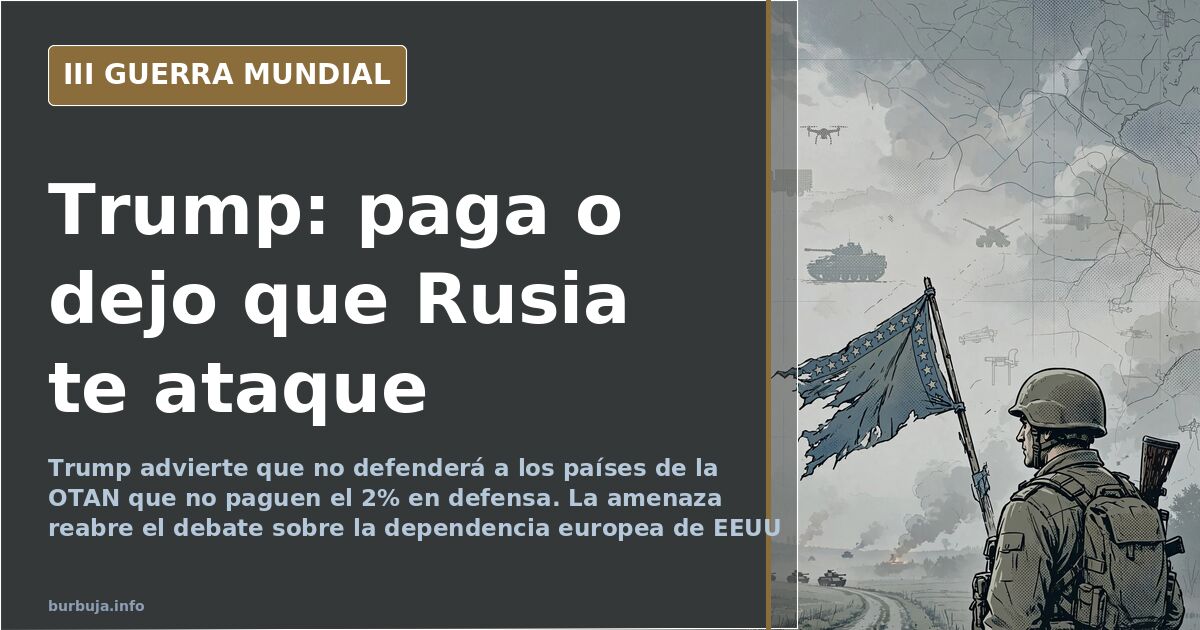
Trump threatens to leave allies unprotected if they fail to pay
Donald Trump has once again brought one of his most frequent warnings to the forefront: if NATO countries do not meet their defense spending commitments, the United States will not step in to defend them. The statement, made at a rally and reported by The Guardian, has peine the debate regarding Washington's role in the Atlantic Alliance and who truly pays the bill for European security. This is not a new stance—he previously voiced it in 2019—but the current election context makes it more than just a bluff.
What Trump said and why it matters now
The former president recounted a conversation with a European head of state who asked if the United States would defend their country in the event of a Russian attack. Trump's response was that if they had not paid, he would not protect them. The verbatim quote, reproduced in the report, is explicit: "If you don't pay, and you get attacked, will I protect you? I said: you didn't pay, I won't protect you." The specific date of the rally and the identity of the interlocutor were not disclosed.
What is significant is not the anecdote itself, but the framework. Trump has turned defense spending into a test of loyalty. NATO sets a target of 2% of GDP, and several European countries have failed to reach it for years. The threat of withdrawing the nuclear umbrella is the most powerful leverage Washington has on the table.
The payment argument: extortion or realism?
Trump's defense rests on simple logic: if you don't pay the security guard, do not expect him to protect you. This is the argument repeated by those who believe Europe has grown complacent under the US umbrella while directing its funds elsewhere. The Red Sea situation is cited as evidence: Houthi attacks primarily affect European ships, yet it is the United States that guarantees security.
The rebuttal is equally direct: it is a form of extortion. "Pay for protection or there will be accidents," summarizes one of the most common counter-arguments. The comparison to organized crime is not accidental. Critics argue that NATO is not a defensive alliance but a structure of submission where the protector sets the price.
The business behind European rearmament
One detail remains clear: if Europe increases its defense spending, who does it buy weapons from? The obvious answer is the US defense industry. The 2% GDP target is not just a military effort figure; it is a flow of money that ends up with US contractors. The criticism is that Washington does not want Europe to rearm with its own weapons—which could be of high quality—but rather to purchase American equipment.
This dependency is structural. Since 1945, Europe has built its security on the premise that the United States would provide the necessary means. Breaking this dynamic requires decades and a political will that is currently nowhere to be seen.
The European response: rearmament or nuclearization?
If the US umbrella disappears, logic dictates that Europe would have to assume its own defense. Some voices suggest the nuclear militarization of the EU and an alliance with China to contain Russia. Others advocate for a European alliance to replace NATO and demand the withdrawal of US troops.
The problem is that the EU lacks a common defense policy. Each country looks out for its own interests, and defense spending competes with pensions, healthcare, and education. Ultimately, Trump's warning is a bill that no one wants to pay.
The discussion is far from over. Trump has set the price, Europe has not said if it is willing to pay, and Russia is watching. The only certainty is that the umbrella has an owner, and the owner charges a fee.
Donald Trump has once again brought one of his most frequent warnings to the forefront: if NATO countries do not meet their defense spending commitments, the United States will not step in to defend them. The statement, made at a rally and reported by The Guardian, has peine the debate regarding Washington's role in the Atlantic Alliance and who truly pays the bill for European security. This is not a new stance—he previously voiced it in 2019—but the current election context makes it more than just a bluff.
What Trump said and why it matters now
The former president recounted a conversation with a European head of state who asked if the United States would defend their country in the event of a Russian attack. Trump's response was that if they had not paid, he would not protect them. The verbatim quote, reproduced in the report, is explicit: "If you don't pay, and you get attacked, will I protect you? I said: you didn't pay, I won't protect you." The specific date of the rally and the identity of the interlocutor were not disclosed.
What is significant is not the anecdote itself, but the framework. Trump has turned defense spending into a test of loyalty. NATO sets a target of 2% of GDP, and several European countries have failed to reach it for years. The threat of withdrawing the nuclear umbrella is the most powerful leverage Washington has on the table.
The payment argument: extortion or realism?
Trump's defense rests on simple logic: if you don't pay the security guard, do not expect him to protect you. This is the argument repeated by those who believe Europe has grown complacent under the US umbrella while directing its funds elsewhere. The Red Sea situation is cited as evidence: Houthi attacks primarily affect European ships, yet it is the United States that guarantees security.
The rebuttal is equally direct: it is a form of extortion. "Pay for protection or there will be accidents," summarizes one of the most common counter-arguments. The comparison to organized crime is not accidental. Critics argue that NATO is not a defensive alliance but a structure of submission where the protector sets the price.
The business behind European rearmament
One detail remains clear: if Europe increases its defense spending, who does it buy weapons from? The obvious answer is the US defense industry. The 2% GDP target is not just a military effort figure; it is a flow of money that ends up with US contractors. The criticism is that Washington does not want Europe to rearm with its own weapons—which could be of high quality—but rather to purchase American equipment.
This dependency is structural. Since 1945, Europe has built its security on the premise that the United States would provide the necessary means. Breaking this dynamic requires decades and a political will that is currently nowhere to be seen.
The European response: rearmament or nuclearization?
If the US umbrella disappears, logic dictates that Europe would have to assume its own defense. Some voices suggest the nuclear militarization of the EU and an alliance with China to contain Russia. Others advocate for a European alliance to replace NATO and demand the withdrawal of US troops.
The problem is that the EU lacks a common defense policy. Each country looks out for its own interests, and defense spending competes with pensions, healthcare, and education. Ultimately, Trump's warning is a bill that no one wants to pay.
The discussion is far from over. Trump has set the price, Europe has not said if it is willing to pay, and Russia is watching. The only certainty is that the umbrella has an owner, and the owner charges a fee.
Also available in: Deutsch
Summary of a discussion on Burbuja.info - Foro de economía, actualidad y política., translated from Spanish and reviewed before publication. Read the full discussion (102 replies).
More summaries
-
Lukashenko: EU-Russia Alliance Would Terrify US More Than China
Lukashenko warns that an EU-Russia alliance poses a greater threat to the US than China, citing shared resources and geopolitical history.
-
Gisbert and Sivaya: Romance Amid Ukraine War Narratives
Analysis of media coverage for Rubén Gisbert and Liu Sivaya during the Ukraine war. Is this digital propaganda or reality?
-
Russia vs NATO: 5,604 tanks and the war of numbers
Russian reports claim 5,604 tanks and 300,000 mercenaries killed, while NATO has not yet deployed its own troops to Ukraine.
-
Iran reportedly receives first batch of Russian Sukhoi-35 fighters
Un unconfirmed report suggests Iran has received its first shipment of Russian Sukhoi-35 jets, though analysts claim the video shows a scale model.
-
French extreme athlete Remi Lucidi dies after falling from Hong Kong skyscraper
French urban climber Remi Lucidi, 30, has died following a fall from the 68th floor of the Tregunter Tower in Hong Kong.
-
Analysis reveals widespread misinformation regarding the war in Ukraine
A new study suggests that majority pro-Ukrainian opinions are often based on a lack of historical knowledge about the Minsk agreements and the 2014 conflict.