
Ukraine War Denial Recycles Pandemic Conspiracy Rhetoric
A growing movement claims the Ukraine war is a psychological operation, echoing pandemic denialism with recycled imagery and live camera arguments.
English · Original discussion in Spanish · Published
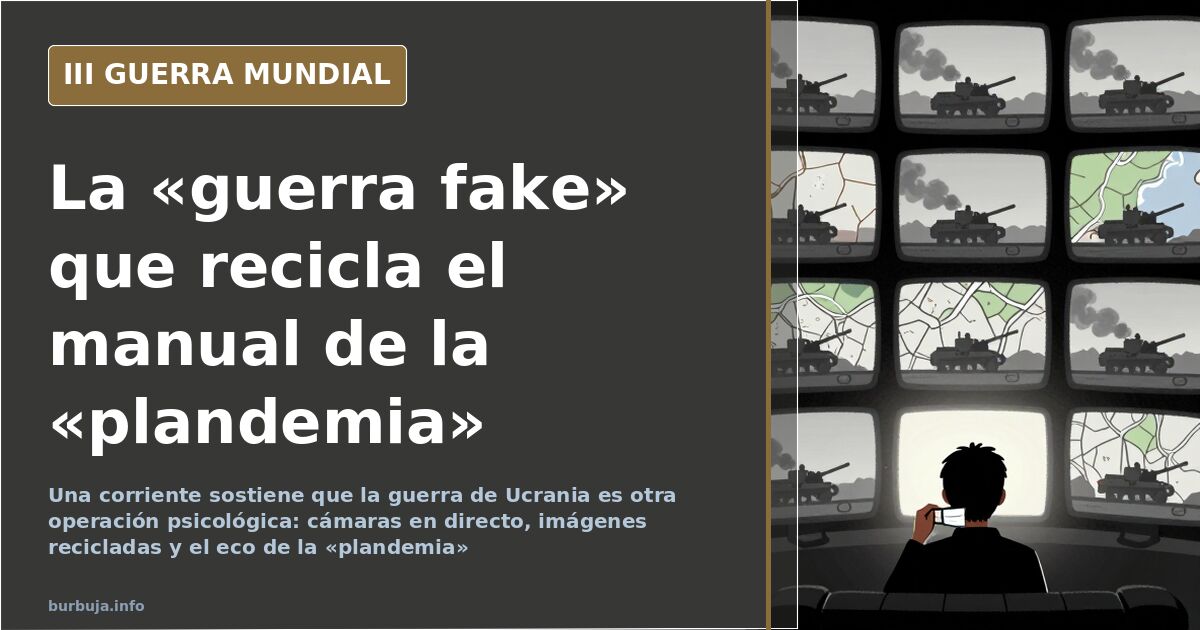
The 'fake war' narrative recycles pandemic conspiracy theories
A segment of the public argues that the war in Ukraine does not exist as reported. They assert this with the same certainty they once used to deny the pandemic. The logic remains identical: if the conflict were real, there would be undeniable casualties. Since these do not appear on screen, proponents conclude it is a textbook psychological operation (psyop). This methodological overlap between the two episodes troubles outside observers. The rapid opening of thematic spaces and influx of new accounts are interpreted as evidence that the scenario was rehearsed.
The core of the doubt lies in casualty accounting. Some compare front-line lethality to a night of heavy drinking in a major city, while others recall overcrowded hospitals previously depicted through viral dance videos. This comparison is launched as provocation rather than data. Yet it circulates, repeats, and has become the interpretive framework for all news coming from Ukraine.
What evidence supports the 'fake war' claim?
The repertoire mixes verifiable facts with undemonstrable assertions. Live webcams over Kyiv are cited as proof of actual conditions, alongside a supposedly destroyed tower still standing with its antenna intact. It is repeatedly claimed that in a country with tens of millions of mobile phones—figures around 35 million are mentioned—there is barely any audiovisual material that withstands rigorous analysis.
This is compounded by cases of recycled images: a minor photographed in three different conflicts, Tbilisi protests presented as Moscow events, and flares mistaken for nuclear plant bombardments. The most common accusation targets a TV program allegedly broadcasting video game simulations as real combat. The piece-by-piece breakdown, tracing each image's origin, represents the most developed aspect of this argument.
Are there two sides in the Ukraine war?
Here the narrative unsettles even those sympathetic to skepticism. One current holds that the war exists but not as media portrayals suggest, arguing there are not two opposing sides but a single shared interest. The Ukrainian government is described as a NATO and Washington pawn; Russia as an actor moving pieces only when convenient to that same board. Their conclusion is that the conflict is primarily an economic war against Western citizens.
Notably, the calendar interpretation stands out. Crisis dates—the health one first, then the military—are presented as too opportune to be coincidental. This reasoning cannot be refuted by data and therefore never exhausts itself.
Those who see manipulation but also deaths
Not all skepticism is denialism. Much of the audience accepts propaganda and exaggeration without accepting that nothing is happening. The argument is simple: a psychological operation does not miccionan there is no war or no fatalities. References include the three million people who have left the country and testimonies from those claiming lost relatives.
Meanwhile, bicho memory continues to divide. Against those reducing the health crisis to annual flu, stand experiences of severe hospitalization and lingering months-long aftereffects. The debate shifted long ago from data to grievance.
Two decades of suspicion and fatigue of the early adopter
Then there is weariness. The sharpest reflection came from someone reading alternative material for twenty-five years, first on floppy disks, then CDs. They noted time passes, hair greys, and everything stays the same or slightly worse: prices rise faster than wages, staff seem more confused, and staying informed yields no visible benefit. Their conclusion is common sense: everything in moderation, because information overload absorbs energy and obsession can become temporary madness.
Added to this is an underlying problem nobody solves: population individualization makes collective action far harder today than thirty years ago.
Political rifts crossing the suspicion
The issue has contaminated domestic trenches too. Some reproach yesterday’s critics for now applauding government measures, while others respond that criteria used to attack the previous executive no longer apply. Accusations fly about switching sides depending on who rules, being disguised activists, or weather vanes. None of this relates directly to Ukraine, yet everything does: the war is today’s terrain for settling old scores.
As long as the front remains open, every media error will serve as ammunition for those who decided nothing is true. Those suspecting half their lives accumulate grey hairs and few certainties. Perhaps the next episode confirms suspicions. Or perhaps not, and nobody acknowledges it.
A segment of the public argues that the war in Ukraine does not exist as reported. They assert this with the same certainty they once used to deny the pandemic. The logic remains identical: if the conflict were real, there would be undeniable casualties. Since these do not appear on screen, proponents conclude it is a textbook psychological operation (psyop). This methodological overlap between the two episodes troubles outside observers. The rapid opening of thematic spaces and influx of new accounts are interpreted as evidence that the scenario was rehearsed.
The core of the doubt lies in casualty accounting. Some compare front-line lethality to a night of heavy drinking in a major city, while others recall overcrowded hospitals previously depicted through viral dance videos. This comparison is launched as provocation rather than data. Yet it circulates, repeats, and has become the interpretive framework for all news coming from Ukraine.
What evidence supports the 'fake war' claim?
The repertoire mixes verifiable facts with undemonstrable assertions. Live webcams over Kyiv are cited as proof of actual conditions, alongside a supposedly destroyed tower still standing with its antenna intact. It is repeatedly claimed that in a country with tens of millions of mobile phones—figures around 35 million are mentioned—there is barely any audiovisual material that withstands rigorous analysis.
This is compounded by cases of recycled images: a minor photographed in three different conflicts, Tbilisi protests presented as Moscow events, and flares mistaken for nuclear plant bombardments. The most common accusation targets a TV program allegedly broadcasting video game simulations as real combat. The piece-by-piece breakdown, tracing each image's origin, represents the most developed aspect of this argument.
Are there two sides in the Ukraine war?
Here the narrative unsettles even those sympathetic to skepticism. One current holds that the war exists but not as media portrayals suggest, arguing there are not two opposing sides but a single shared interest. The Ukrainian government is described as a NATO and Washington pawn; Russia as an actor moving pieces only when convenient to that same board. Their conclusion is that the conflict is primarily an economic war against Western citizens.
Notably, the calendar interpretation stands out. Crisis dates—the health one first, then the military—are presented as too opportune to be coincidental. This reasoning cannot be refuted by data and therefore never exhausts itself.
Those who see manipulation but also deaths
Not all skepticism is denialism. Much of the audience accepts propaganda and exaggeration without accepting that nothing is happening. The argument is simple: a psychological operation does not miccionan there is no war or no fatalities. References include the three million people who have left the country and testimonies from those claiming lost relatives.
Meanwhile, bicho memory continues to divide. Against those reducing the health crisis to annual flu, stand experiences of severe hospitalization and lingering months-long aftereffects. The debate shifted long ago from data to grievance.
Two decades of suspicion and fatigue of the early adopter
Then there is weariness. The sharpest reflection came from someone reading alternative material for twenty-five years, first on floppy disks, then CDs. They noted time passes, hair greys, and everything stays the same or slightly worse: prices rise faster than wages, staff seem more confused, and staying informed yields no visible benefit. Their conclusion is common sense: everything in moderation, because information overload absorbs energy and obsession can become temporary madness.
Added to this is an underlying problem nobody solves: population individualization makes collective action far harder today than thirty years ago.
Political rifts crossing the suspicion
The issue has contaminated domestic trenches too. Some reproach yesterday’s critics for now applauding government measures, while others respond that criteria used to attack the previous executive no longer apply. Accusations fly about switching sides depending on who rules, being disguised activists, or weather vanes. None of this relates directly to Ukraine, yet everything does: the war is today’s terrain for settling old scores.
As long as the front remains open, every media error will serve as ammunition for those who decided nothing is true. Those suspecting half their lives accumulate grey hairs and few certainties. Perhaps the next episode confirms suspicions. Or perhaps not, and nobody acknowledges it.
Also available in: Deutsch
Summary of a discussion on Burbuja.info - Foro de economía, actualidad y política., translated from Spanish and reviewed before publication. Read the full discussion (128 replies).
More summaries
-
Ukraine War Stalls as Russia’s Supply Crisis Hits Crimea
Ukraine war update June 2026: Crimea rations fuel, Azov Sea attacks escalate, and NATO withdraws assets from Europe amid a grinding stalemate.
-
Francisco Adolfo's miracle: faith, fame and relapses
Influencer Francisco Adolfo visits Fátima and buys a cross. Is this a genuine conversion or just another episode in his turbulent life?
-
T-55 and B-52: Both Entered Service in 1955
Russia deploys 1955 T-55 tanks while the US keeps ~70 B-52s from the same year, challenging assumptions about military obsolescence.
-
Jerusalem Deputy Mayor Sparks Outrage Comparing Gaza to Dresden
A Spanish TV interview featuring Jerusalem's deputy mayor ignited controversy after she compared the bombardment of Gaza to the 1945 bombing of Dresden.
-
Nuclear Denialism: 78 Years Without a New Atomic Bomb
Seventy-eight years without a third nuclear attack fuel denialist theories comparing atomic weapons to COVID narratives.
-
Kyiv: Zelensky's Office and False Flag Allegations
A missile reportedly struck near Zelensky's office in Kyiv. With no confirmation of launch or target, conflicting narratives emerge.