
Ukraine opens second front in Bryansk, challenging Russian narrative
Ukrainian forces reportedly crossed into Russia's Bryansk region near Belarus. This prestige boost for Kyiv strains Moscow's defensive posture.
English · Original discussion in Spanish · Published
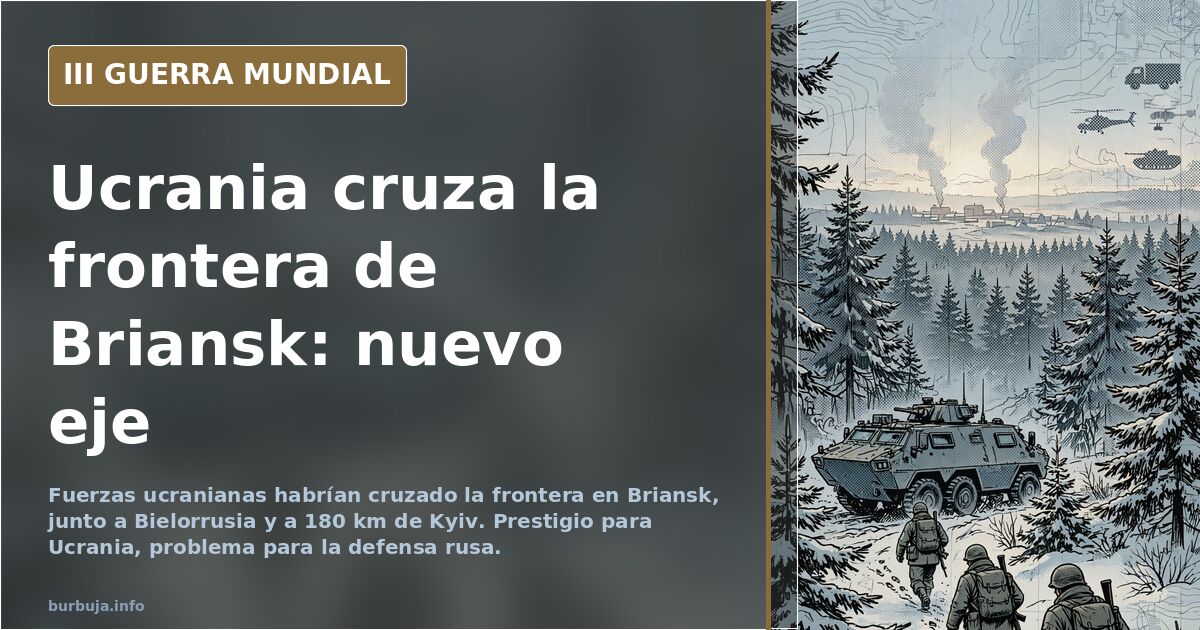
Ukraine opens second axis in Bryansk, testing the Russian narrative
The news arrives via cross-firing reports: Ukrainian forces allegedly crossed the border and fought in Russia's Bryansk region, according to several frontline tracking channels. The identified district is Klimovsky, adjacent to Belarus and about 180 kilometers from Kyiv. It is the second reported point of Ukrainian activity on Russian soil, after Kursk, and the geographic detail is not accidental: it opens a new axis with the left flank covered and complicates logistics for any support Moscow might want to move from the north.
What is known about the new front in Bryansk
The messages opening the conversation are tweets from military tracking accounts and journalists citing Russian channels. None provide an official statement. The dominant formulation is caution: "combat reported," "Russian channels claim." That is all there is, and it should not be inflated. The conversation itself warns: in an ongoing operation, the fog of war flows like a river and disinformation runs in both directions.
The operational reading that emerges is sober. Advancing through Bryansk allows covering the left flank and, incidentally, disrupting the logistics of aid potentially coming from Belarus toward the Donbas front. But it seems distant for supporting the other offensive: its real value is distracting Russian troops. Neither conquest of Moscow nor a triumphal march. A secondary axis.
The pulse between prestige and attrition
The most repeated analysis separates two planes. In terms of survival, these attacks barely scratch a country of 12 million square kilometers: occupying 1,000 square kilometers on an unknown border does not change the military balance. In terms of prestige, the point goes to Ukraine: it allows itself to occupy Russian territory, do so at two distinct points, and sustain it for weeks. In terms of sin, the point is against Russia: failing to foresee a more solid defense of its border is hard to justify.
Against this, the other current looks at the Donbas map. While Bryansk is debated, Russian forces advance and are close to overrunning a heavily fortified front. It is the classic counterpoint: the offensive making headlines is not the one moving the relevant frontline.
Drones, trenches, and the end of surprise
There is an uncomfortable consensus on why the front has become so rigid. The massive use of drones as observers, especially for artillery, is the main cause of stagnation in the Donbas and the failure of the initial Russian offensive. No one deceives anyone anymore: the fog of war dissipates and large mechanized movements are detected before they start. Suicide drones, however, are seen more as a stress factor than a decisive weapon.
The conclusion drawn is historical: the democratization of war, just as when the arms industry made 1914 approaches obsolete. There will no longer be lightning offensives with a surprise factor. And that applies to both sides.
The battle of the narrative: who started and who holds up
The discussion drifts toward the origin of the conflict and combat sarracena. A fourth element, spirit, is often considered the most important: when it is lacking, territory, logistics, and manpower become almost irrelevant. It is argued that Ukrainian motivation is higher because defeat is perceived as existential, while on the Russian side, it is noted that ethnic minorities from eastern and southern Siberia are overrepresented in casualties compared to the elite from Moscow and St. Petersburg.
The clash of versions regarding 2014 is total and unresolved. Some place the start in a coup promoted from abroad against an elected government; others, in Russian military intervention in Crimea and the Donbas. Neither side yields, and the issue remains exactly where it was.
The political calculation no one signs
The least military and most cynical hypothesis remains: that these moves seek a less catastrophic scenario ahead of US elections, because attempting offensives on the Ukrainian front is impossible. No strategic value, but image value. It is a suspicion, not data.
And the realistic closure: when mud and then winter arrive, there will be time to build fortifications. In spring, no one will move the frontline. Negotiations, they say, will come on their own. The exact point where analysis stalls is this: no one knows what happens in the internal fronts of Moscow and Kyiv, and without that, everything else is noise.
The news arrives via cross-firing reports: Ukrainian forces allegedly crossed the border and fought in Russia's Bryansk region, according to several frontline tracking channels. The identified district is Klimovsky, adjacent to Belarus and about 180 kilometers from Kyiv. It is the second reported point of Ukrainian activity on Russian soil, after Kursk, and the geographic detail is not accidental: it opens a new axis with the left flank covered and complicates logistics for any support Moscow might want to move from the north.
What is known about the new front in Bryansk
The messages opening the conversation are tweets from military tracking accounts and journalists citing Russian channels. None provide an official statement. The dominant formulation is caution: "combat reported," "Russian channels claim." That is all there is, and it should not be inflated. The conversation itself warns: in an ongoing operation, the fog of war flows like a river and disinformation runs in both directions.
The operational reading that emerges is sober. Advancing through Bryansk allows covering the left flank and, incidentally, disrupting the logistics of aid potentially coming from Belarus toward the Donbas front. But it seems distant for supporting the other offensive: its real value is distracting Russian troops. Neither conquest of Moscow nor a triumphal march. A secondary axis.
The pulse between prestige and attrition
The most repeated analysis separates two planes. In terms of survival, these attacks barely scratch a country of 12 million square kilometers: occupying 1,000 square kilometers on an unknown border does not change the military balance. In terms of prestige, the point goes to Ukraine: it allows itself to occupy Russian territory, do so at two distinct points, and sustain it for weeks. In terms of sin, the point is against Russia: failing to foresee a more solid defense of its border is hard to justify.
Against this, the other current looks at the Donbas map. While Bryansk is debated, Russian forces advance and are close to overrunning a heavily fortified front. It is the classic counterpoint: the offensive making headlines is not the one moving the relevant frontline.
Drones, trenches, and the end of surprise
There is an uncomfortable consensus on why the front has become so rigid. The massive use of drones as observers, especially for artillery, is the main cause of stagnation in the Donbas and the failure of the initial Russian offensive. No one deceives anyone anymore: the fog of war dissipates and large mechanized movements are detected before they start. Suicide drones, however, are seen more as a stress factor than a decisive weapon.
The conclusion drawn is historical: the democratization of war, just as when the arms industry made 1914 approaches obsolete. There will no longer be lightning offensives with a surprise factor. And that applies to both sides.
The battle of the narrative: who started and who holds up
The discussion drifts toward the origin of the conflict and combat sarracena. A fourth element, spirit, is often considered the most important: when it is lacking, territory, logistics, and manpower become almost irrelevant. It is argued that Ukrainian motivation is higher because defeat is perceived as existential, while on the Russian side, it is noted that ethnic minorities from eastern and southern Siberia are overrepresented in casualties compared to the elite from Moscow and St. Petersburg.
The clash of versions regarding 2014 is total and unresolved. Some place the start in a coup promoted from abroad against an elected government; others, in Russian military intervention in Crimea and the Donbas. Neither side yields, and the issue remains exactly where it was.
The political calculation no one signs
The least military and most cynical hypothesis remains: that these moves seek a less catastrophic scenario ahead of US elections, because attempting offensives on the Ukrainian front is impossible. No strategic value, but image value. It is a suspicion, not data.
And the realistic closure: when mud and then winter arrive, there will be time to build fortifications. In spring, no one will move the frontline. Negotiations, they say, will come on their own. The exact point where analysis stalls is this: no one knows what happens in the internal fronts of Moscow and Kyiv, and without that, everything else is noise.
Summary of a discussion on Burbuja.info - Foro de economía, actualidad y política., translated from Spanish and reviewed before publication. Read the full discussion (144 replies).
More summaries
-
Ukraine Strikes Six Russian Oil Refineries in a Week, Crippling Putin's War Machine
Ukraine has targeted six Russian oil refineries, some 1,600 km from the front lines, aiming to diminish Russia's war-making capacity.
-
Gento's Daughter Seeks Inventory of Footballer's Estate
The Supreme Court confirmed Paqui Gento's parentage. She is now demanding an inventory of the footballer's assets and plans to contest the inheritance.
-
France plans 75,000-ton nuclear aircraft carrier
France designs a 75,000-ton nuclear carrier with EMALS catapults for 2038. Key questions remain on funding and strategic relevance.
-
Fallout: Elite Protocols Hidden in Every Frame
A symbolic reading of Fallout claims elite plans are encoded in Vault 33, code 101, and the dogs' 9/11. Others call it numerology.
-
Iran Warns of New Weapon, Halting Israeli Strike
Iran threatens an 'unused' weapon if Israel retaliates, pausing the planned attack. The purchase of Russia's S-400 system heightens military tensions in the Middle East.
-
US Congress warns of grave Russian threat in space
The US House Intelligence Committee flags a serious national security risk from Russia in orbit and demands full declassification.