
Iran Warns of New Weapon, Halting Israeli Strike
Iran threatens an 'unused' weapon if Israel retaliates, pausing the planned attack. The purchase of Russia's S-400 system heightens military tensions in the Middle East.
English · Original discussion in Spanish · Published
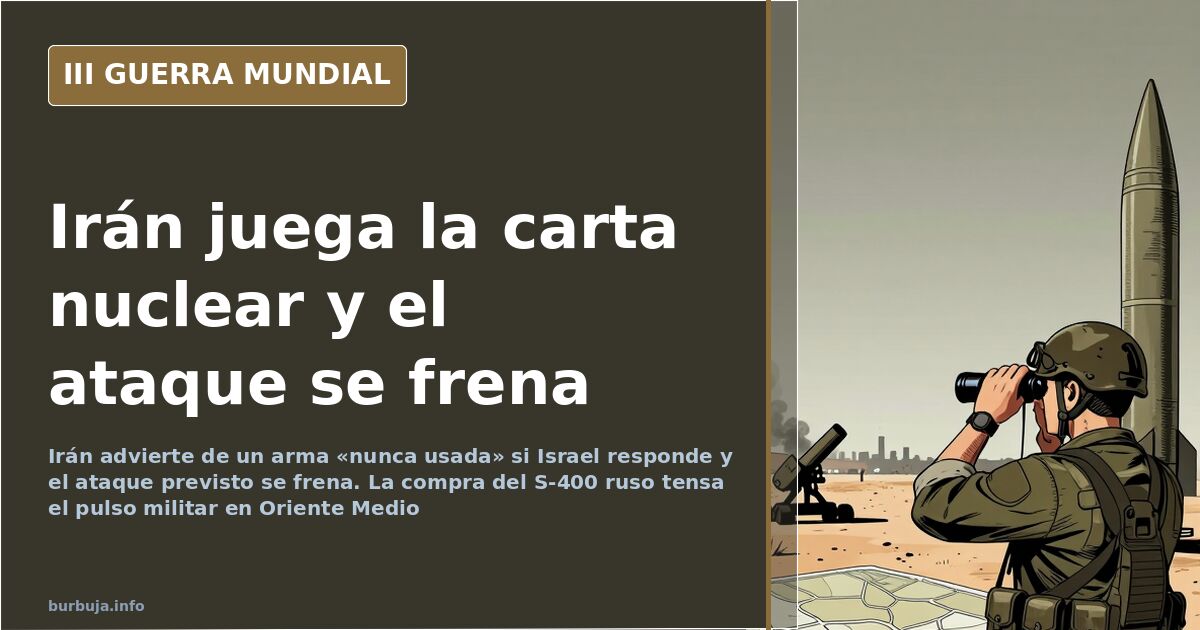
Iran Threatens Unused Weapon, Stalling Israeli Attack
A long-standing paradox surrounds this issue: Iran has been accused of possessing a nuclear bomb for years without any proof. For that time, its threats did not move a single aircraft. Now they have. An Iranian parliamentary security committee official warned that the country is ready to deploy "a weapon we have never used before" if Israel strikes back, and that message alone was enough to leave the planned attack hanging in the air. Iran conveyed this to Israel through various channels: it possesses nuclear armament ready for use.
In short: the Iranian regime has just played the only card it had never shown. And it did so, according to available accounts, at the exact moment Israel and the United States were discussing their next steps.
Why This Time Iran’s Response Is Different
Israel has struck Iranian soil directly on 24 occasions. Tehran’s response had always been restrained, almost ceremonial. Not this time: Iran retaliated with missile and drone attacks against Israeli territory, something considered unthinkable until recently. This change in behavior is the key data point. Those who fire know they will be hit; those who fire while revealing a new weapon know even more.
Hence the growing interpretation: if Iran dared to act, it is because it has the means. There is no official statement, no acknowledgment, and that absence is part of the design. Ambiguity deters more than confirmation.
The Recurring Clue: No Nuclear Test
The opposing argument has uncomfortable logic. All countries that developed the atomic bomb conducted a real test, and there is no record of one from Iran. Proponents of this view add that without a test, there is no guarantee the device works, and that a leader with a new toy cannot resist the temptation to try it out. There are plenty of empty deserts and mountains to do so.
The counterargument comes from elsewhere: who says tests haven't already occurred, perhaps not in Iran? The most widely circulated hypothesis places these trials in North Korea, a technological partner since the 1980s in several areas. Under this lens, bombs would be assembled, stored, and ready, making propaganda unnecessary.
What If a Nuclear Missile Is Intercepted?
Here, common sense clashes with physics. The idea that an air defense system could neutralize a nuclear warhead in flight is, at best, a simplification. A high-altitude detonation causes more damage than a ground-level one: the shockwave expands unobstructed, devastating a larger radius. But exploding is precisely what would not happen.
For a nuclear bomb to detonate, its conventional explosive charges must compress the fissile material perfectly symmetrically. Ignition is triggered by an electrical discharge onto a deliberately stable explosive, and the wave from an interception misaligns the assembly: the result would be a partial detonation or none at all. The real problem then is not the explosion, but the contamination of the terrain where debris falls. There is a precedent in Spain that no one needs reminding of. Add the effect of an electromagnetic pulse on civilian electronics, which returns half a region to the Stone Age without spending a single gram of fissile material.
Russia Reinforces Iran with Jets and Air Defense
The Washington Post, citing intelligence officials from the US, Europe, and the Middle East, reports that Russia has committed to providing Iran with advanced fighter jets and air defense technology. These assets would strengthen Iranian defenses against any aerial attack by Israel or the United States. In parallel, the acquisition of the S-400 system is confirmed, marking a qualitative leap in the region's military balance. Washington has already announced it will respond with new sanctions.
The detail matters: these are not showpiece fighters, but the capacity to deny airspace. If Iran can cover its sky, the cost of a preemptive strike multiplies. And if it also holds a trump card, the calculation becomes unbearable for any cabinet.
The Scenario Discussed Quietly
Merely accepting the hypothesis of an operational arsenal makes the numbers terrifying. Estimates circulating in aggressive analyses reduce Iranian capability to three Hiroshima-type devices. At first glance, little. But the equation posed is not about quantity, but survival: a surprise attacker may neutralize most vectors, but not all. One surviving vector is enough, and the target would not be a military base.
With 90 million inhabitants and an industrial apparatus that has spent two decades exchanging technology with partners in the so-called axis, the hypothesis does not require an exceptional technological leap. It requires only time. The full breakdown of that calculation, including saturation and defense scenarios, is more uncomfortable than it appears at first glance.
What Remains to Be Seen
No one has shown a bomb. No one has measured radiation. No one has provided proof. The only verifiable facts are that a planned attack has stopped, Russia is moving pieces, and Tehran no longer responds with previous restraint. Deterrence works precisely when it cannot be verified. What if the weapon that has never been used doesn't exist either?
A long-standing paradox surrounds this issue: Iran has been accused of possessing a nuclear bomb for years without any proof. For that time, its threats did not move a single aircraft. Now they have. An Iranian parliamentary security committee official warned that the country is ready to deploy "a weapon we have never used before" if Israel strikes back, and that message alone was enough to leave the planned attack hanging in the air. Iran conveyed this to Israel through various channels: it possesses nuclear armament ready for use.
In short: the Iranian regime has just played the only card it had never shown. And it did so, according to available accounts, at the exact moment Israel and the United States were discussing their next steps.
Why This Time Iran’s Response Is Different
Israel has struck Iranian soil directly on 24 occasions. Tehran’s response had always been restrained, almost ceremonial. Not this time: Iran retaliated with missile and drone attacks against Israeli territory, something considered unthinkable until recently. This change in behavior is the key data point. Those who fire know they will be hit; those who fire while revealing a new weapon know even more.
Hence the growing interpretation: if Iran dared to act, it is because it has the means. There is no official statement, no acknowledgment, and that absence is part of the design. Ambiguity deters more than confirmation.
The Recurring Clue: No Nuclear Test
The opposing argument has uncomfortable logic. All countries that developed the atomic bomb conducted a real test, and there is no record of one from Iran. Proponents of this view add that without a test, there is no guarantee the device works, and that a leader with a new toy cannot resist the temptation to try it out. There are plenty of empty deserts and mountains to do so.
The counterargument comes from elsewhere: who says tests haven't already occurred, perhaps not in Iran? The most widely circulated hypothesis places these trials in North Korea, a technological partner since the 1980s in several areas. Under this lens, bombs would be assembled, stored, and ready, making propaganda unnecessary.
What If a Nuclear Missile Is Intercepted?
Here, common sense clashes with physics. The idea that an air defense system could neutralize a nuclear warhead in flight is, at best, a simplification. A high-altitude detonation causes more damage than a ground-level one: the shockwave expands unobstructed, devastating a larger radius. But exploding is precisely what would not happen.
For a nuclear bomb to detonate, its conventional explosive charges must compress the fissile material perfectly symmetrically. Ignition is triggered by an electrical discharge onto a deliberately stable explosive, and the wave from an interception misaligns the assembly: the result would be a partial detonation or none at all. The real problem then is not the explosion, but the contamination of the terrain where debris falls. There is a precedent in Spain that no one needs reminding of. Add the effect of an electromagnetic pulse on civilian electronics, which returns half a region to the Stone Age without spending a single gram of fissile material.
Russia Reinforces Iran with Jets and Air Defense
The Washington Post, citing intelligence officials from the US, Europe, and the Middle East, reports that Russia has committed to providing Iran with advanced fighter jets and air defense technology. These assets would strengthen Iranian defenses against any aerial attack by Israel or the United States. In parallel, the acquisition of the S-400 system is confirmed, marking a qualitative leap in the region's military balance. Washington has already announced it will respond with new sanctions.
The detail matters: these are not showpiece fighters, but the capacity to deny airspace. If Iran can cover its sky, the cost of a preemptive strike multiplies. And if it also holds a trump card, the calculation becomes unbearable for any cabinet.
The Scenario Discussed Quietly
Merely accepting the hypothesis of an operational arsenal makes the numbers terrifying. Estimates circulating in aggressive analyses reduce Iranian capability to three Hiroshima-type devices. At first glance, little. But the equation posed is not about quantity, but survival: a surprise attacker may neutralize most vectors, but not all. One surviving vector is enough, and the target would not be a military base.
With 90 million inhabitants and an industrial apparatus that has spent two decades exchanging technology with partners in the so-called axis, the hypothesis does not require an exceptional technological leap. It requires only time. The full breakdown of that calculation, including saturation and defense scenarios, is more uncomfortable than it appears at first glance.
What Remains to Be Seen
No one has shown a bomb. No one has measured radiation. No one has provided proof. The only verifiable facts are that a planned attack has stopped, Russia is moving pieces, and Tehran no longer responds with previous restraint. Deterrence works precisely when it cannot be verified. What if the weapon that has never been used doesn't exist either?
Summary of a discussion on Burbuja.info - Foro de economía, actualidad y política., translated from Spanish and reviewed before publication. Read the full discussion (143 replies).
More summaries
-
Vietnam at 50: More Bombs Than All WWII Combined
The US dropped more bombs on Vietnam than all sides of WWII combined yet failed its objectives. Fifty years later, the strategic balance remains unchanged.
-
Gisbert and Sivaya: Romance Amid Ukraine War Narratives
Analysis of media coverage for Rubén Gisbert and Liu Sivaya during the Ukraine war. Is this digital propaganda or reality?
-
Russia resists while Spain fell to Anglo dominance
Spain allegedly succumbed to Anglo-Saxon vassalage two centuries ago, while Russia resists. Critics argue Russia is no moral paradise.
-
Fact-checking Kyiv: Media narrative versus ground reality
Analysis of media coverage in Kyiv contrasts TV reports with independent verification of refugee figures and daily life.
-
Two Russian twin girls die in Oviedo amid bullying probe
Spanish police investigate if the twins faced school harassment. No suicide note was found.
-
Nord Stream, grain and silicon: thesis on Russian aims
Nord Stream sabotage and the weaponization of gas, grain and silicon frame a theory on Russia's goals in Europe, lacking official confirmation.