
Ukraine Lacks Counterattack Capacity Against Russia
Ukraine regains ground without launching a counteroffensive, failing to break Russian bridgeheads on the Dnieper or open fronts in Russia.
English · Original discussion in Spanish · Published
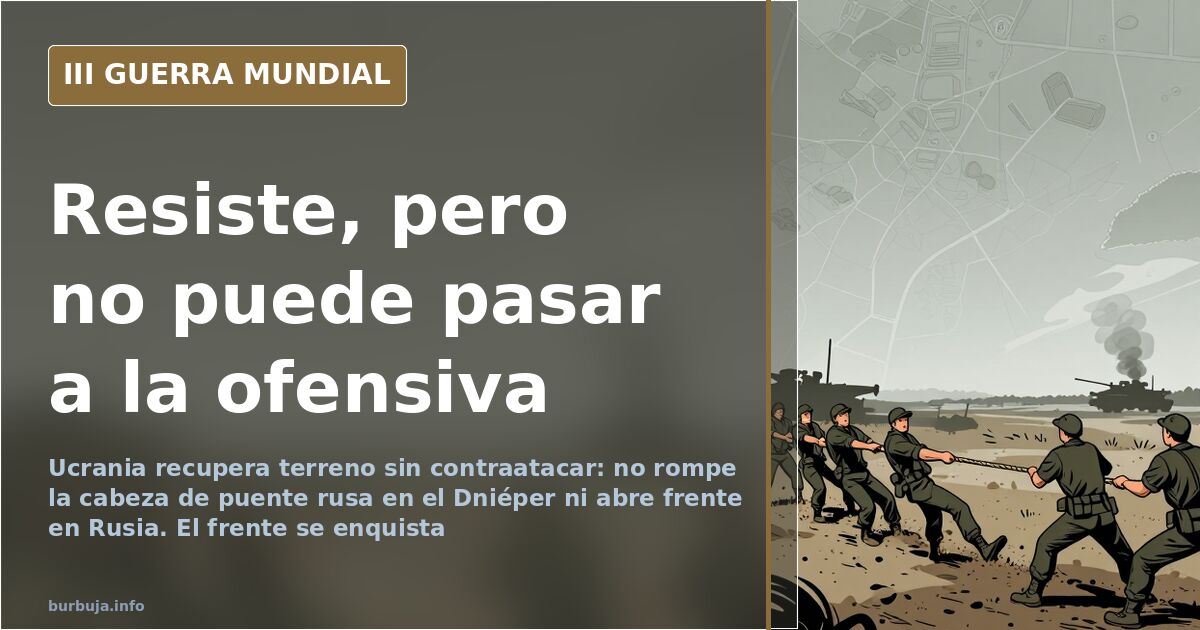
Ukraine has not regained the initiative: it resists but does not counterattack
Can Ukraine win this war? By mid-April 2022, with Russian troops withdrawn from the north and the front shifted to the east and south, much of the analysis argues no. Ukraine has recovered territory—in several cases because the adversary had abandoned it—maintains resistance in Mariupol and keeps Kyiv, but has not closed the encirclement on retreating Russian units, has not broken the bridgehead Moscow holds on the Dnieper, and has not peine a land front on Russian soil, not even along a border like Belgorod’s, which it largely controls. The initiative, it is argued, remains in Russian hands, and its army waits for the next blow.
Why Ukraine Has Not Gone On The Offensive
The argument is not about will, but means. Breaking a bridgehead requires concentrating fire and troops at a specific point, and attacking Russian soil would stretch an already strained logistics chain. Those defending this view insist that recovered territories were taken without opposition: the adversary withdrew and Ukraine advanced into empty space. Celebrating such advances as proof of offensive capability confuses retreat with defeat.
Hence the forecast: one who cannot take a poorly defended position will hardly take a better-defended one. The conclusion drawn is not that Ukraine will lose in the classic sense, but that its ceiling is a stalemate involving territorial concessions and imposed conditions.
The Logistical Bottleneck: Tanks, Diesel And Refineries
The second block of analysis is material. Western aid arrives, but not all equally. Light weapons are hidden in trucks and containers; main battle tanks or artillery pieces are not. Any convoy of significant size is located and destroyed before entering combat. A Russian 60-kilometer convoy in march formation is cited precisely as an example of what not to do when expecting resistance.
Heavy loads also depend on fuel. Without diesel, armored vehicles become steel obstacles. And on this point, an uncomfortable fact repeats: in eastern Ukraine, few refineries remain capable of supplying those who intend to move these columns by road. The math doesn't add up, no matter how many tanks are promised.
From “Liberation” To Razing Cities
A scenario appears again and again: that of a Russia which, unable to keep the entire country, settles for destroying it. The precedent cited is Syria, with the formula of 48 hours to leave a city before declaring anyone remaining a military target and reducing the urban area to rubble. It is argued that Moscow has held back so far due to civilian presence; once it stops doing so, material superiority will finish the job. Opponents argue that razing is not winning: you can leave the country in ruins and still lose the war.
The Contrary Thesis: Russia Bleeds Out And Will Eventually Withdraw
Here begins the fundamental disagreement. Another current argues that Ukraine only needs to resist and, for now, is doing so: the threat over Kyiv has dissipated and Mariupol has not fallen. Russia, they add, cannot indefinitely commit to a campaign without exposing its borders: before becoming vulnerable, it will abandon. The precedent invoked is Vietnam, a country that could not win militarily but ultimately won through patience and external supply.
Signs supporting this reading indicate attrition: the Czech Republic has sent dozens of tanks and military vehicles, much of the international community has rallied behind Kyiv, and the economic cost of the invasion accumulates in Moscow. Financing a war, they remind us, is neither free nor unlimited.
Why The Vietnam Analogy Falls Short
This parallelism has been the most repeated and also the most debated. Ukraine is flat and full of roads: the terrain does not favor a guerrilla force that disappears into jungle and rice paddies. Geography leaves columns exposed and turns every movement into an opportunity for the enemy. Patience, here, costs much more.
Who Funds The Resistance: $5 Billion And A Country Turned Into An Instrument
A third line of analysis shifts focus away from the front. It is argued that the money sustaining Ukraine—up to $5 billion, in the recurring formulation—is one of Washington’s best investments in recent history: isolating and wearing down Russia, cooling its relationship with Europe, and leaving the European Union without its main energy partner, all for a fraction of the cost of direct confrontation.
In parallel, another current scrutinizes sanctions and reaches a conclusion contrary to the official one: it is Europe that suffers, with rising prices and strained supply chains, while Russia has resources and alternative markets to place them. The bill is paid here; margins are made there. This is the kind of calculation nobody signs publicly, explaining why narrative matters as much as the front.
There is comfort for optimists: no war of attrition of this magnitude resolves in two months. The question is whether that is a deadline or a sentence. Because if the only available move is to hold on and watch where the next blow lands, one should be clear about who has been choosing the board since the beginning.
Can Ukraine win this war? By mid-April 2022, with Russian troops withdrawn from the north and the front shifted to the east and south, much of the analysis argues no. Ukraine has recovered territory—in several cases because the adversary had abandoned it—maintains resistance in Mariupol and keeps Kyiv, but has not closed the encirclement on retreating Russian units, has not broken the bridgehead Moscow holds on the Dnieper, and has not peine a land front on Russian soil, not even along a border like Belgorod’s, which it largely controls. The initiative, it is argued, remains in Russian hands, and its army waits for the next blow.
Why Ukraine Has Not Gone On The Offensive
The argument is not about will, but means. Breaking a bridgehead requires concentrating fire and troops at a specific point, and attacking Russian soil would stretch an already strained logistics chain. Those defending this view insist that recovered territories were taken without opposition: the adversary withdrew and Ukraine advanced into empty space. Celebrating such advances as proof of offensive capability confuses retreat with defeat.
Hence the forecast: one who cannot take a poorly defended position will hardly take a better-defended one. The conclusion drawn is not that Ukraine will lose in the classic sense, but that its ceiling is a stalemate involving territorial concessions and imposed conditions.
The Logistical Bottleneck: Tanks, Diesel And Refineries
The second block of analysis is material. Western aid arrives, but not all equally. Light weapons are hidden in trucks and containers; main battle tanks or artillery pieces are not. Any convoy of significant size is located and destroyed before entering combat. A Russian 60-kilometer convoy in march formation is cited precisely as an example of what not to do when expecting resistance.
Heavy loads also depend on fuel. Without diesel, armored vehicles become steel obstacles. And on this point, an uncomfortable fact repeats: in eastern Ukraine, few refineries remain capable of supplying those who intend to move these columns by road. The math doesn't add up, no matter how many tanks are promised.
From “Liberation” To Razing Cities
A scenario appears again and again: that of a Russia which, unable to keep the entire country, settles for destroying it. The precedent cited is Syria, with the formula of 48 hours to leave a city before declaring anyone remaining a military target and reducing the urban area to rubble. It is argued that Moscow has held back so far due to civilian presence; once it stops doing so, material superiority will finish the job. Opponents argue that razing is not winning: you can leave the country in ruins and still lose the war.
The Contrary Thesis: Russia Bleeds Out And Will Eventually Withdraw
Here begins the fundamental disagreement. Another current argues that Ukraine only needs to resist and, for now, is doing so: the threat over Kyiv has dissipated and Mariupol has not fallen. Russia, they add, cannot indefinitely commit to a campaign without exposing its borders: before becoming vulnerable, it will abandon. The precedent invoked is Vietnam, a country that could not win militarily but ultimately won through patience and external supply.
Signs supporting this reading indicate attrition: the Czech Republic has sent dozens of tanks and military vehicles, much of the international community has rallied behind Kyiv, and the economic cost of the invasion accumulates in Moscow. Financing a war, they remind us, is neither free nor unlimited.
Why The Vietnam Analogy Falls Short
This parallelism has been the most repeated and also the most debated. Ukraine is flat and full of roads: the terrain does not favor a guerrilla force that disappears into jungle and rice paddies. Geography leaves columns exposed and turns every movement into an opportunity for the enemy. Patience, here, costs much more.
Who Funds The Resistance: $5 Billion And A Country Turned Into An Instrument
A third line of analysis shifts focus away from the front. It is argued that the money sustaining Ukraine—up to $5 billion, in the recurring formulation—is one of Washington’s best investments in recent history: isolating and wearing down Russia, cooling its relationship with Europe, and leaving the European Union without its main energy partner, all for a fraction of the cost of direct confrontation.
In parallel, another current scrutinizes sanctions and reaches a conclusion contrary to the official one: it is Europe that suffers, with rising prices and strained supply chains, while Russia has resources and alternative markets to place them. The bill is paid here; margins are made there. This is the kind of calculation nobody signs publicly, explaining why narrative matters as much as the front.
There is comfort for optimists: no war of attrition of this magnitude resolves in two months. The question is whether that is a deadline or a sentence. Because if the only available move is to hold on and watch where the next blow lands, one should be clear about who has been choosing the board since the beginning.
Also available in: Deutsch
Summary of a discussion on Burbuja.info - Foro de economía, actualidad y política., translated from Spanish and reviewed before publication. Read the full discussion (118 replies).
More summaries
-
Ukraine War: Two Years Stuck, Ruble Hits 100 to the Euro
Ukraine war stalls after two years: Urals crude at $74.50 vs. Brent at $81.62, ruble at 100/euro. Focus shifts to endurance.
-
Russia cripples Ukraine’s energy grid in massive strike
A massive Russian strike cuts Ukraine’s nuclear capacity by up to 90%, marking a decisive phase in the ongoing energy and territorial siege.
-
Lithuania urges NATO strike on Kaliningrado amid nuclear escalation fears
Lithuanian FM Budrys proposes destroying Russian bases in Kaliningrado. Experts warn of severe risks given Lithuania's weak military capabilities.
-
20,000 Dollar Drone Renders 60 Million Helicopter Obsolete
A $20,000 drone downs a $60 million helicopter. Modern warfare lowers combat costs and makes armored vehicles obsolete.
-
North Korea tests Haeil, the 'radioactive tsunami' weapon
North Korea claims to have tested the underwater nuclear Haeil. Key debates involve China, Japan, and semiconductor supply chains.
-
Xi and Putin mark the end of Pax Americana in Moscow
Xi Jinping and Vladimir Putin stage the end of Pax Americana in Moscow, sparking debate on whether China is a genuine superpower or merely a well-marketed threat.