
Ukraine: Empty Streets and Truckers Strike Over Mobilization Law
Ukraine's May 18 mobilization law empties streets and blocks the Kyiv-Odesa highway with striking truckers. Basic services are at risk.
English · Original discussion in Spanish · Published
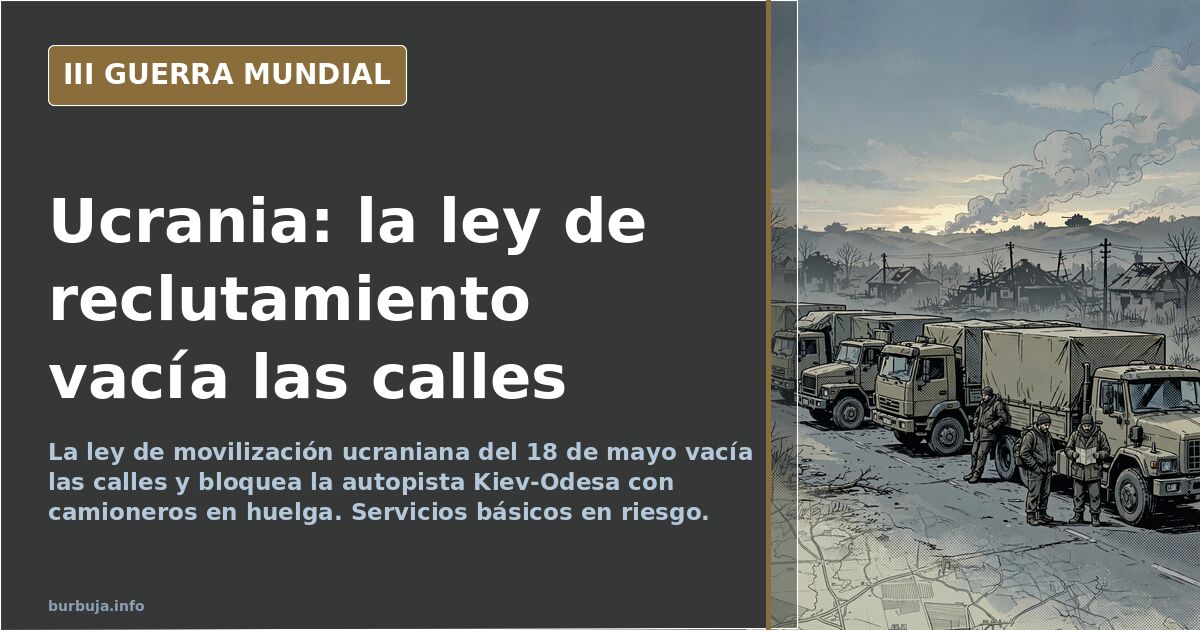
Ukraine Empties Out: Mobilization Law Leaves Streets Without Men
On May 18, 2024, Ukraine’s new mobilization law took effect, and judging by circulating videos, the result is a country on pause. In Odesa, Zaporizhzhia, Dnipro, and Kyiv, squares and markets proge up without pedestrians, cars, or vendors. A merchant in Zaporizhzhia described it bluntly: “There are no people in the street, no passersby, nobody going anywhere.” The scene repeats in every major city.
The law affects more than just the front lines. It also impacts those holding the rear guard: truck drivers, maintenance staff, and public transport workers. The result is a paralysis starting to be felt in basic services.
What Changes With the New Mobilization Law
The regulation expands the pool of eligible recruits and tightens conditions for leaving the country. International haulers can no longer cross borders without explicit military authorization, leaving hundreds of trucks blocked. According to Ukrainian media, the truckers' protest has cut off the Kyiv-Odesa highway with hundreds of vehicles stopped.
The problem isn’t just a lack of drivers. It’s that the law eliminated exemptions that previously protected entire sectors. Truckers had been excluded from extensions for essential workers, and cases have already occurred of drivers being mobilized with trucks abandoned on the roadside. Fuel, which arrives by road, is next on the list.
Public Transport and Water in Limbo
In Dnipro, the mayor warned that public transport services are suspended because drivers have been conscripted. And it’s not the only service at risk: according to that same warning, drinking water supply and other municipal services could face the same fate within days.
Some argue that sewage maintenance personnel are already gone and that sanitation issues are beginning to appear in Dnipro and Kyiv. It’s the kind of detail that doesn’t make war headlines but explains why a country stops functioning: without truckers there is no distribution, without distribution there are no goods in stores, and without maintenance the system clogs up.
Those Exempt Who Weren’t So Much
The law left loose ends for later. Police were exempt on paper, but that hasn’t prevented thousands from being sent out. Civil servants, around 160,000, were deferred to a later phase; of them, about 120,000 are women, who are banned from leaving the country.
The most uncomfortable data point in certain circles is another: there are tens of thousands of professional female soldiers who have yet to see the front line. The discussion over why they aren’t recruited before truckers is one of the currents running through the issue, with the argument that proclaimed equality isn’t applied when distributing risk.
The Domino Effect on the Economy
The vicious circle is easy to describe. Many workers leave their posts for antiestéticar of being located right there, at work. Some businesses close or stop serving customers. In hypermarkets, according to circulating accounts, barely one cashier remains at the end of the day and nobody restocks shelves.
Road transport is the piece causing the most concern. Everything consumed daily arrives by truck. Without haulers, the calculation being made is that within a week the population will be left without basic supplies. Either truckers are given safe passage or the second part of the movie starts rolling on its own.
Front Line and Rear Guard, the Same Equation
The most repeated reading is that mass mobilization responds not only to the need for replacements at the front, but to a staffing problem already affecting rear logistics. If truckers and bus drivers are being conscripted, it’s because the pool of eligible recruits has narrowed.
At the other end of the argument are those who claim that more people at the front only delays the inevitable, and those pointing out that the real goal was never to win the war but to prolong attrition. Both readings coexist unresolved. What is verifiable is the scene: deserted cities, stopped trucks, and public services on the brink of collapse. How long does it take for a country to stop functioning when those who make it function disappear?
On May 18, 2024, Ukraine’s new mobilization law took effect, and judging by circulating videos, the result is a country on pause. In Odesa, Zaporizhzhia, Dnipro, and Kyiv, squares and markets proge up without pedestrians, cars, or vendors. A merchant in Zaporizhzhia described it bluntly: “There are no people in the street, no passersby, nobody going anywhere.” The scene repeats in every major city.
The law affects more than just the front lines. It also impacts those holding the rear guard: truck drivers, maintenance staff, and public transport workers. The result is a paralysis starting to be felt in basic services.
What Changes With the New Mobilization Law
The regulation expands the pool of eligible recruits and tightens conditions for leaving the country. International haulers can no longer cross borders without explicit military authorization, leaving hundreds of trucks blocked. According to Ukrainian media, the truckers' protest has cut off the Kyiv-Odesa highway with hundreds of vehicles stopped.
The problem isn’t just a lack of drivers. It’s that the law eliminated exemptions that previously protected entire sectors. Truckers had been excluded from extensions for essential workers, and cases have already occurred of drivers being mobilized with trucks abandoned on the roadside. Fuel, which arrives by road, is next on the list.
Public Transport and Water in Limbo
In Dnipro, the mayor warned that public transport services are suspended because drivers have been conscripted. And it’s not the only service at risk: according to that same warning, drinking water supply and other municipal services could face the same fate within days.
Some argue that sewage maintenance personnel are already gone and that sanitation issues are beginning to appear in Dnipro and Kyiv. It’s the kind of detail that doesn’t make war headlines but explains why a country stops functioning: without truckers there is no distribution, without distribution there are no goods in stores, and without maintenance the system clogs up.
Those Exempt Who Weren’t So Much
The law left loose ends for later. Police were exempt on paper, but that hasn’t prevented thousands from being sent out. Civil servants, around 160,000, were deferred to a later phase; of them, about 120,000 are women, who are banned from leaving the country.
The most uncomfortable data point in certain circles is another: there are tens of thousands of professional female soldiers who have yet to see the front line. The discussion over why they aren’t recruited before truckers is one of the currents running through the issue, with the argument that proclaimed equality isn’t applied when distributing risk.
The Domino Effect on the Economy
The vicious circle is easy to describe. Many workers leave their posts for antiestéticar of being located right there, at work. Some businesses close or stop serving customers. In hypermarkets, according to circulating accounts, barely one cashier remains at the end of the day and nobody restocks shelves.
Road transport is the piece causing the most concern. Everything consumed daily arrives by truck. Without haulers, the calculation being made is that within a week the population will be left without basic supplies. Either truckers are given safe passage or the second part of the movie starts rolling on its own.
Front Line and Rear Guard, the Same Equation
The most repeated reading is that mass mobilization responds not only to the need for replacements at the front, but to a staffing problem already affecting rear logistics. If truckers and bus drivers are being conscripted, it’s because the pool of eligible recruits has narrowed.
At the other end of the argument are those who claim that more people at the front only delays the inevitable, and those pointing out that the real goal was never to win the war but to prolong attrition. Both readings coexist unresolved. What is verifiable is the scene: deserted cities, stopped trucks, and public services on the brink of collapse. How long does it take for a country to stop functioning when those who make it function disappear?
Also available in: Deutsch
Summary of a discussion on Burbuja.info - Foro de economía, actualidad y política., translated from Spanish and reviewed before publication. Read the full discussion (105 replies).
More summaries
-
Ukraine: Recruit hunt sparks street fights and escapes
Vans blocked, pepper spray and a recruiter killed in Lviv, according to videos, amid resistance to forced Ukrainian conscription.
-
Ukraine: Unverified Claims of Forced Mobilization and Chain Gangs
Debate on forced recruitment in Ukraine centers on unverified claims of chained soldiers, focusing on figures and the economic cost of war.
-
Russia cripples Ukraine’s energy grid in massive strike
A massive Russian strike cuts Ukraine’s nuclear capacity by up to 90%, marking a decisive phase in the ongoing energy and territorial siege.
-
MEP claims 500,000 Ukrainian casualties in NATO address
A European lawmaker cited half a million Ukrainian deaths during a NATO meeting, a figure that obituary databases cannot currently verify.
-
Polish authorities accuse journalist Pablo González of spying
Journalist Pablo González, holding both Spanish and Russian passports, faces up to 10 years in prison in Poland on espionage charges.
-
China restricts gallium and germanium exports amid chip war
China controls approximately 90% of global gallium and germanium production, implementing export restrictions that threaten the Western semiconductor industry and escalate tensions with the G7.