
Ukraine counteroffensive: 100 km² gained, deemed a failure
Ukraine's counteroffensive has reclaimed just over 100 km² in weeks, with Western tanks destroyed and no air support, undermining success narratives.
English · Original discussion in Spanish · Published
100 square kilometers in weeks: an uncomfortable balance
Maps have become the enemy of the narrative. The colored patches marking terrain recovered by Ukraine's counteroffensive are so narrow they barely stand out from previous lines, piercing through analyses that recently sold optimism. The consensus here is just over 100 square kilometers in several weeks, a result described without nuance as a failure. With these numbers on the table, debate has shifted from whether the offensive works to why it was launched.
How much territory has Ukraine's counteroffensive reclaimed?
Less than any reasonable scenario designed during months of preparation. One participant argues Ukrainian forces suffer losses ten times higher than Russian ones, placing fighting in the 'security zone': the intermediate belt where attackers are exposed before reaching the first defensive line. Attrition occurs in the worst possible place for attackers and the best for defenders.
Daily maps from pro-Kyiv sources don't help either. Advance markers are barely visible, and comparisons with other Western observatories worsen the impression. Some reference Spanish Civil War battles to gauge casualty volume. This isn't a comparison made lightly.
The growing figure is casualties. One participant calculates 7,500 Ukrainian casualties in four days. Projected over a quarter, this jumps to 250,000 men. The source admits doubt: Ukraine may lack such sacrifice capacity. No one has answered this question.
Leopard and Bradley: the cost of Western armor
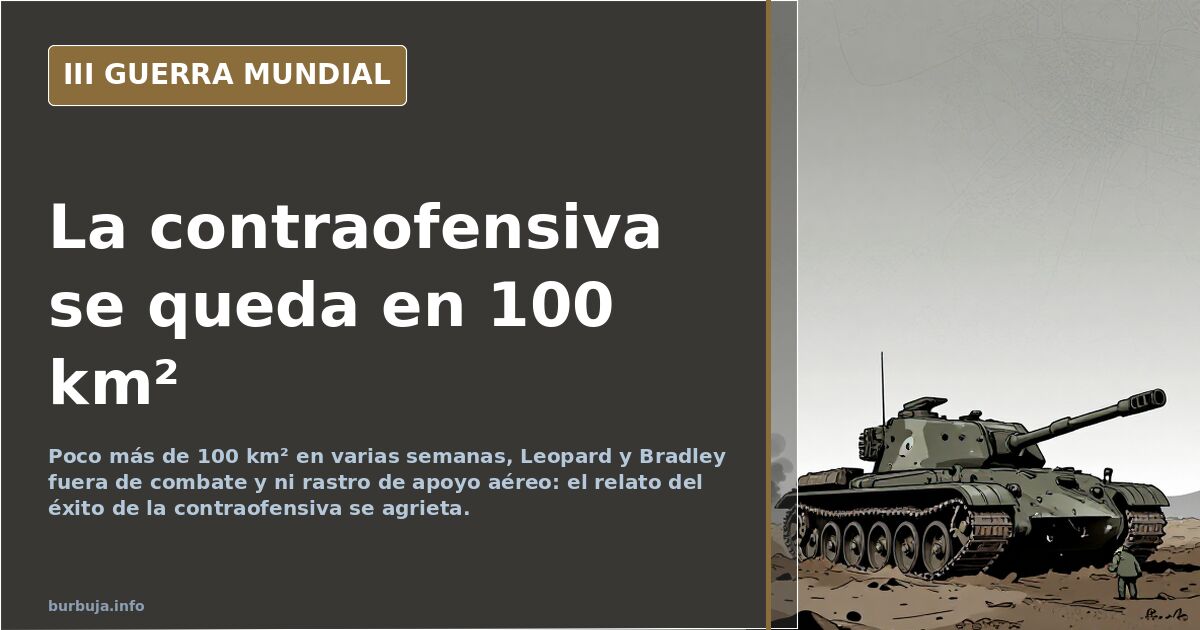
Leopard tanks and Bradley vehicles arrived labeled as decisive pieces to break Russian lines. The resulting image is opposite: Western armor disabled on open ground without achieving objectives. 'NATO machinery in the mud', summarized sarcastically.
The paradox is that material presented as decisive fuels arguments that arms shipments prolong conflict without altering outcomes.
Why launch without massive artillery or air support?
Military answer is textbook: offensives without massive artillery prep and air cover are doomed. Striking is the diagnosis's forcefulness. If evident, attack decisions responded to non-battlefield logic.
Political explanations gain weight. Results were needed before US electoral calendar closed funding windows: elections next year make aid packages complex. A cynical reading suggests prolonged conflict benefits arms sellers while hurting disadvantaged European industry. A third theory, recurring when fronts stall: goal wasn't border recovery but breaking the board and separating West from Russia.
Front moving in opposite direction
While Ukrainian offensive stalled, movement came elsewhere. Russian troops launched Lugansk front offensive: advances from Kremennaya toward Liman and Svatovo toward Kupiansk, per thread tracking. Surprise was major, assuming Russian reserves committed south. 'Few expected this', admitted German military observer, noting Russia advancing rather than resisting.
Defense led by general formerly heading Russian General Staff school, Kursk and Balaton heights specialist. Repeated thesis: let attackers enter security zone via apparent retreats, wait for confidence, then punish with artillery while mining rear. Unconfirmed, fits map patterns.
Shifting objective: from borders to decades-long war
Parallel to material attrition, declared goals shifted. From full territory recovery rhetoric to elastic formulations continuing fight regardless of cost, leading to thesis that what comes isn't final Russian offensive but a war lasting decades.
This shift has practical consequences. If horizon is years not months, specific counteroffensive success matters less to some, central to others: without visible results, maintaining funding becomes primary political problem.
Narrative versus data
Numbers battle is fierce as trench warfare. Claims persist that nearly one million Russian troops await attack orders; conversely, Russian contingent reduced to just over 200,000 with 300,000 attributed losses. Neither side shows supporting counts.
Middle ground holds conflict plays on three boards—military, economic, propagandistic—with advantage to daily narrative controllers. Not coincidence that aging well are messages warning long duration.
With counteroffensive entering fourth month, officially resigning Ukrainian defense minister read as political payment for failure, and static front, disorienting datum remains constant: recovered territory invisible on maps, casualty lists visible.
Maps have become the enemy of the narrative. The colored patches marking terrain recovered by Ukraine's counteroffensive are so narrow they barely stand out from previous lines, piercing through analyses that recently sold optimism. The consensus here is just over 100 square kilometers in several weeks, a result described without nuance as a failure. With these numbers on the table, debate has shifted from whether the offensive works to why it was launched.
How much territory has Ukraine's counteroffensive reclaimed?
Less than any reasonable scenario designed during months of preparation. One participant argues Ukrainian forces suffer losses ten times higher than Russian ones, placing fighting in the 'security zone': the intermediate belt where attackers are exposed before reaching the first defensive line. Attrition occurs in the worst possible place for attackers and the best for defenders.
Daily maps from pro-Kyiv sources don't help either. Advance markers are barely visible, and comparisons with other Western observatories worsen the impression. Some reference Spanish Civil War battles to gauge casualty volume. This isn't a comparison made lightly.
The growing figure is casualties. One participant calculates 7,500 Ukrainian casualties in four days. Projected over a quarter, this jumps to 250,000 men. The source admits doubt: Ukraine may lack such sacrifice capacity. No one has answered this question.
Leopard and Bradley: the cost of Western armor
Leopard tanks and Bradley vehicles arrived labeled as decisive pieces to break Russian lines. The resulting image is opposite: Western armor disabled on open ground without achieving objectives. 'NATO machinery in the mud', summarized sarcastically.
The paradox is that material presented as decisive fuels arguments that arms shipments prolong conflict without altering outcomes.
Why launch without massive artillery or air support?
Military answer is textbook: offensives without massive artillery prep and air cover are doomed. Striking is the diagnosis's forcefulness. If evident, attack decisions responded to non-battlefield logic.
Political explanations gain weight. Results were needed before US electoral calendar closed funding windows: elections next year make aid packages complex. A cynical reading suggests prolonged conflict benefits arms sellers while hurting disadvantaged European industry. A third theory, recurring when fronts stall: goal wasn't border recovery but breaking the board and separating West from Russia.
Front moving in opposite direction
While Ukrainian offensive stalled, movement came elsewhere. Russian troops launched Lugansk front offensive: advances from Kremennaya toward Liman and Svatovo toward Kupiansk, per thread tracking. Surprise was major, assuming Russian reserves committed south. 'Few expected this', admitted German military observer, noting Russia advancing rather than resisting.
Defense led by general formerly heading Russian General Staff school, Kursk and Balaton heights specialist. Repeated thesis: let attackers enter security zone via apparent retreats, wait for confidence, then punish with artillery while mining rear. Unconfirmed, fits map patterns.
Shifting objective: from borders to decades-long war
Parallel to material attrition, declared goals shifted. From full territory recovery rhetoric to elastic formulations continuing fight regardless of cost, leading to thesis that what comes isn't final Russian offensive but a war lasting decades.
This shift has practical consequences. If horizon is years not months, specific counteroffensive success matters less to some, central to others: without visible results, maintaining funding becomes primary political problem.
Narrative versus data
Numbers battle is fierce as trench warfare. Claims persist that nearly one million Russian troops await attack orders; conversely, Russian contingent reduced to just over 200,000 with 300,000 attributed losses. Neither side shows supporting counts.
Middle ground holds conflict plays on three boards—military, economic, propagandistic—with advantage to daily narrative controllers. Not coincidence that aging well are messages warning long duration.
With counteroffensive entering fourth month, officially resigning Ukrainian defense minister read as political payment for failure, and static front, disorienting datum remains constant: recovered territory invisible on maps, casualty lists visible.
Also available in: Deutsch
Summary of a discussion on Burbuja.info - Foro de economía, actualidad y política., translated from Spanish and reviewed before publication. Read the full discussion (108 replies).
More summaries
-
Ukraine's 'Soon' Offensive: Announced Daily, Never Starts
The front awaits a daily-announced counteroffensive amid debates over Leopard 1 utility and weather delays.
-
Ukrainian Offensive Stalled by Three Defensive Lines and Minefields
Landmines dropped by artillery and air strike immobilize Ukrainian columns, halting the advance against three defensive lines in Zaporizhzhia.
-
Ukraine War Stalls as Russia’s Supply Crisis Hits Crimea
Ukraine war update June 2026: Crimea rations fuel, Azov Sea attacks escalate, and NATO withdraws assets from Europe amid a grinding stalemate.
-
Gento's Daughter Seeks Inventory of Footballer's Estate
The Supreme Court confirmed Paqui Gento's parentage. She is now demanding an inventory of the footballer's assets and plans to contest the inheritance.
-
Germany Demolishes Towers of Nuclear Plant Closed in 2015
Germany demolished the Grafenrheinfeld cooling towers, closed since 2015, amid claims it relies on costlier coal and LNG than Russian gas.
-
Ukrainian in Spain confronts pro-Russian rallies alone
Vadym Syroyezhko, a Ukrainian resident in the Canary Islands, attends pro-Russian events in Spain to protest and reports receiving death threats.