
Ukraine, a Russian Region? The Thesis Reshaping 1991
Ukraine held a separate UN seat since 1945 and was a distinct Soviet republic: the facts challenging the 'region' narrative.
English · Original discussion in Spanish · Published
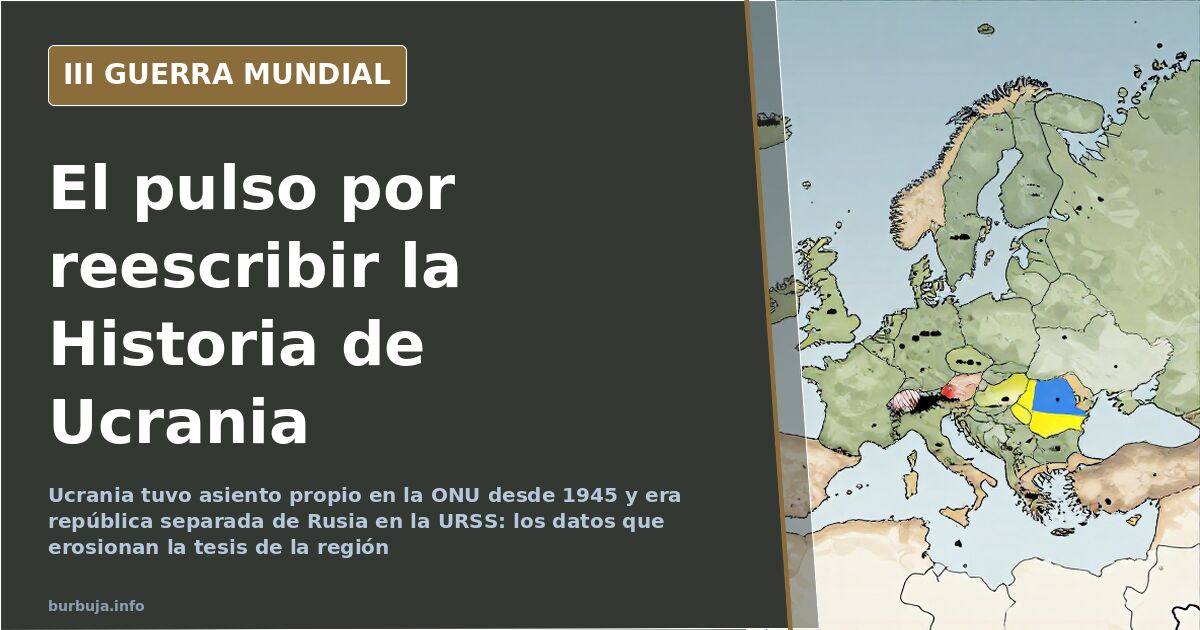
"Ukraine is a Russian region": The battle to rewrite 1945 and 1991
A single sentence opens the issue. No link, no figure, no argument: those defending the Atlanticist position should find an honest job because the printer is running out of ink. Hanging from this is the thesis that gives the title to everything, the one that Ukraine is a region of Russia, and from this also the tone: History as an indicator that someone moves depending on who wins. The striking thing is not the provocation, but what appears when you scratch underneath. Dates, seats, republics, and a dispute over the name of territories. Most of the trinc messages are limited to pushing the topic upward with a single word: up.
Ukraine and Russia, two separate republics within the USSR
The first counterweight is legal. Within the Soviet structure, Ukraine and Russia were counted separately, as entities with their own administration, not as metropolis and province. The same framework invoked to support the idea that Ukraine is a Russian region serves, read in reverse, to empty the thesis: if the Soviet umbrella was the glue, in 1991 the State containing both disappeared, and neither remained converted into a region of the other.
The symmetric argument also appears, with irony: trinc that logic, Russia would be a region of Ukraine. The hardest version of the thesis does not dispute the date, but the legitimacy of the borders. Ukraine, it is argued, is an "artificial" country, made with patches of other territories and other ethnicities united by Soviet administration. The problem with this reasoning is that, applied to any map of Eastern Europe, it leaves no natural borders anywhere.
Ukraine's seat at the UN since October 24, 1945
The fact that fits least with the regional thesis is not from 1991. Ukraine has an independent seat at the UN since its founding, on October 24, 1945, with a voice and vote distinct from Moscow's. International recognition as a separate subject is, therefore, almost a century prior to formal independence.
The fact is conceded and turned around in the same sentence: it does not matter what was signed then, because today's Ukrainians feel a visceral rejection of Russia and there is no resolution that will convince them otherwise. The implicit conclusion discomforts both sides. If the bond rests on the will of the population, any thesis based on documents from 1945 or 1991 falls short.
Crimea and Donbas: the asymmetry of the right to be a country
Here lies the knot. The most incisive argument deployed is that of asymmetry: if Ukraine had the right to constitute itself as a State in 1991, why was that same option denied to Crimea, Donbas, or the so-called New Russia. It is recalled that the Crimean parliament declared independence several times since the 1990s and even asked for annexation to Russia, without it prospering. The subsequent replies, longer and with the detail of Soviet foundational texts, do not fit in a hasty summary.
The objection is twofold. First, legal: if Spain were to disintegrate, each territory could invoke its right to form a State, but while the framework exists, it is not valid to apply to some regions the rules invented for others. Second, practical: independences are recognized or not depending on the interest of third countries, and this is not seriously discussed anywhere. The underlying question remains in the air. Is the right to self-determination a principle or a tool depending on who asks for it?
"The winner rewrites History": from 1991 to 2023
The sentence that orders the conversation is this: whoever wins, the victor rewrites what was and what will be. With a caveat pointed out in passing: Spain would be the anomaly, the place where the narrative does not bend to whoever wins. And a calendar correction: if the winner were Russia, it would have little to rewrite, only the stretch from 1991 to 2023.
That stretch is the entire dispute. Ukrainian independence does not end with the USSR due to an irreversible historical pogre, it is argued; it can be reversed just as it began. From the other side, it is answered that Crimea ceased to be independent to become part of Russia, and that this shows that History does not advance in one direction. No one signs which of the two scenarios prevails. This indefiniteness is, probably, the most honest thing about the whole matter.
Vasconia, Vascongadas and Euskalerria: the dispute over the name
The most valued digression does not speak of Ukraine, but of how the lands are named. It is recalled that "Vascongadas" is a term used by liberals, that the Spanish denomination would be Vasconia and in Basque Euskalerria, as stated in the Marcha de Oriamendi, and that for that reason that song is proposed as a reference on how to name those provinces.
The leap is apparent, not real. The whole Ukrainian issue is, in the end, a fight over the name and the map that accompanies it. Whoever imposes the toponym also imposes the border it suggests. Hence why territorial discussions always end up in the same trench: etymology as ammunition.
In the end, the sentence that most disconcerts is not a thesis about Ukraine. It is seven words: "It has been this way for 2500 years". If the division of territories and narratives has been operating for two and a half millennia without interruption, any discussion about what peine in 1945 or 1991 remains on the surface.
A single sentence opens the issue. No link, no figure, no argument: those defending the Atlanticist position should find an honest job because the printer is running out of ink. Hanging from this is the thesis that gives the title to everything, the one that Ukraine is a region of Russia, and from this also the tone: History as an indicator that someone moves depending on who wins. The striking thing is not the provocation, but what appears when you scratch underneath. Dates, seats, republics, and a dispute over the name of territories. Most of the trinc messages are limited to pushing the topic upward with a single word: up.
Ukraine and Russia, two separate republics within the USSR
The first counterweight is legal. Within the Soviet structure, Ukraine and Russia were counted separately, as entities with their own administration, not as metropolis and province. The same framework invoked to support the idea that Ukraine is a Russian region serves, read in reverse, to empty the thesis: if the Soviet umbrella was the glue, in 1991 the State containing both disappeared, and neither remained converted into a region of the other.
The symmetric argument also appears, with irony: trinc that logic, Russia would be a region of Ukraine. The hardest version of the thesis does not dispute the date, but the legitimacy of the borders. Ukraine, it is argued, is an "artificial" country, made with patches of other territories and other ethnicities united by Soviet administration. The problem with this reasoning is that, applied to any map of Eastern Europe, it leaves no natural borders anywhere.
Ukraine's seat at the UN since October 24, 1945
The fact that fits least with the regional thesis is not from 1991. Ukraine has an independent seat at the UN since its founding, on October 24, 1945, with a voice and vote distinct from Moscow's. International recognition as a separate subject is, therefore, almost a century prior to formal independence.
The fact is conceded and turned around in the same sentence: it does not matter what was signed then, because today's Ukrainians feel a visceral rejection of Russia and there is no resolution that will convince them otherwise. The implicit conclusion discomforts both sides. If the bond rests on the will of the population, any thesis based on documents from 1945 or 1991 falls short.
Crimea and Donbas: the asymmetry of the right to be a country
Here lies the knot. The most incisive argument deployed is that of asymmetry: if Ukraine had the right to constitute itself as a State in 1991, why was that same option denied to Crimea, Donbas, or the so-called New Russia. It is recalled that the Crimean parliament declared independence several times since the 1990s and even asked for annexation to Russia, without it prospering. The subsequent replies, longer and with the detail of Soviet foundational texts, do not fit in a hasty summary.
The objection is twofold. First, legal: if Spain were to disintegrate, each territory could invoke its right to form a State, but while the framework exists, it is not valid to apply to some regions the rules invented for others. Second, practical: independences are recognized or not depending on the interest of third countries, and this is not seriously discussed anywhere. The underlying question remains in the air. Is the right to self-determination a principle or a tool depending on who asks for it?
"The winner rewrites History": from 1991 to 2023
The sentence that orders the conversation is this: whoever wins, the victor rewrites what was and what will be. With a caveat pointed out in passing: Spain would be the anomaly, the place where the narrative does not bend to whoever wins. And a calendar correction: if the winner were Russia, it would have little to rewrite, only the stretch from 1991 to 2023.
That stretch is the entire dispute. Ukrainian independence does not end with the USSR due to an irreversible historical pogre, it is argued; it can be reversed just as it began. From the other side, it is answered that Crimea ceased to be independent to become part of Russia, and that this shows that History does not advance in one direction. No one signs which of the two scenarios prevails. This indefiniteness is, probably, the most honest thing about the whole matter.
Vasconia, Vascongadas and Euskalerria: the dispute over the name
The most valued digression does not speak of Ukraine, but of how the lands are named. It is recalled that "Vascongadas" is a term used by liberals, that the Spanish denomination would be Vasconia and in Basque Euskalerria, as stated in the Marcha de Oriamendi, and that for that reason that song is proposed as a reference on how to name those provinces.
The leap is apparent, not real. The whole Ukrainian issue is, in the end, a fight over the name and the map that accompanies it. Whoever imposes the toponym also imposes the border it suggests. Hence why territorial discussions always end up in the same trench: etymology as ammunition.
In the end, the sentence that most disconcerts is not a thesis about Ukraine. It is seven words: "It has been this way for 2500 years". If the division of territories and narratives has been operating for two and a half millennia without interruption, any discussion about what peine in 1945 or 1991 remains on the surface.
Summary of a discussion on Burbuja.info - Foro de economía, actualidad y política., translated from Spanish and reviewed before publication. Read the full discussion (308 replies).
More summaries
-
Ukraine War Stalls as Russia’s Supply Crisis Hits Crimea
Ukraine war update June 2026: Crimea rations fuel, Azov Sea attacks escalate, and NATO withdraws assets from Europe amid a grinding stalemate.
-
Russia withdraws from northern Ukraine, shifts offensive to Donbas
Russian troops leave the Kyiv axis, the entire Chernihiv region, and the siege of Sumy. The redeployment points to a pincer offensive in the Donetsk basin.
-
Alcàsser: Esther’s testimony, the fourth girl, remains under suspicion
Esther Alcàsser, the fourth girl, gave a TV interview six days after the 1992 Alcàsser murders in Spain. Her account and timeline discrepancies fuel ongoing controversy.
-
Visual count: 868 Russian tanks lost, 31% of fleet
Visual tallies show 868 Russian combat vehicles out of action, 31% of active fleet. The Soviet T-62M appears as loss rate slows.
-
Russian Mobile Alert: Baños Spreads 24-Hour Ultimatum on Kyiv Destruction
Colonel Pedro Baños shares an unverified message claiming Russian citizens received a 24-hour ultimatum to surrender or face Kyiv's destruction, raising disinformation concerns.
-
Israel Strikes Yemen's Hodeida Port After Drone Attack on Tel Aviv
Israel bombs Hodeida following a drone strike on Tel Aviv. Houthi spokesmen warn retaliatory strikes will target Haifa.