
Ukraine 2022: The Counteroffensive That Retook Lyman and Kherson
Lyman returned to Ukrainian control and Russia crossed the Dnieper in 2022. The counteroffensive announced in August, initially dismissed as propaganda, ultimately recaptured territory.
English · Original discussion in Spanish · Published
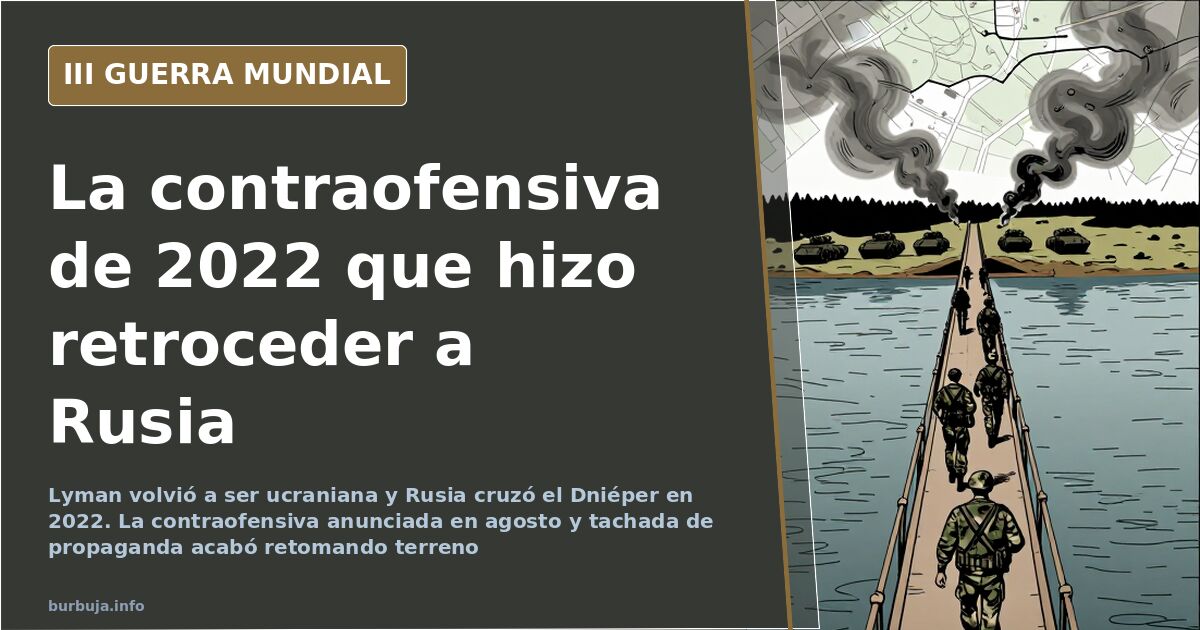
The 2022 Counteroffensive That Dismantled Russia's Donbas Map
The summer counteroffensive of 2022 marked the first real turning point in the Russian invasion of Ukraine. Yet, when it was announced, the majority response was mockery. In early August, promises of 'more Russian withdrawals' within days sounded like propaganda, not just to Moscow's supporters, but the announcement itself became a source of ridicule. Eight weeks later, Lyman was Ukrainian again, and Russian troops were hastily crossing the Dnieper.
The timeline wasn't met: the Kharkiv offensive arrived in September, not August. The nuance matters, as the entire debate hinged on this, between the promise of a swift victory and the evidence that advances, when they came, were rapid but delayed.
What Peine to Ukraine's August 2022 Counteroffensive?
The initial forecast predicted a turnaround within ten days, in August. It didn't happen. The Kherson front stalled for weeks with notable casualties, fueling skepticism: 'the first counteroffensive going backward,' according to the most repeated jab. It wasn't just trench cynicism. The southern offensive had been announced so much and for so long that the expectation itself became a burden.
Instead, the summer served another, less visible purpose. Russian ammunition depots were destroyed by precision fire, and even pro-Russian intelligence acknowledged that videos of losses were circulating widely. Pressure was building away from the front lines. However, the dam broke in the northeast.
Kharkiv: The Delayed Russian Retreat
In early September, the Ukrainian advance in the Kharkiv region caught Russian defenses off guard. Ukrainian intelligence reported 'real disarray' and captured a Russian lieutenant colonel, an unusual prize in a war where officers of this rank rarely fall alive. The estimulante ilegal of the movement contradicted the slowness of the entire summer.
This was the moment the skeptical current had to retreat from its own argument. For months, they had been pointing out that announced counteroffensives never materialized; now they were happening, but in an area no one had focused on. Within days, the northeastern map no longer resembled the one from July.
Lyman and Pro-Russian Acknowledgment of Defeat
The capture of Lyman, in Donbas, closed the cycle. On October 1st, the most cited pro-Russian military analysis admitted the withdrawal in writing: 'by midday it became evident that the decision had been made to leave Liman,' with the only exit route under Ukrainian control. Confirmation coming from the Russian side gave the event a weight that no official report could have achieved. The breakdown of casualties circulating on tracking channels, week by week and front by front, shows figures that neither side has fully confirmed.
The discussion about its strategic value remains open. One side argues Lyman was decisive; another compares it to a tactical advance of no fundamental importance. The most repeated calculation, always disputed, spoke of 5,000 Russian casualties in a single week.
The 97% Referendums and the Narrative Shift
As the front fell, Moscow staged the annexation. The preliminary results of the referendums in occupied territory left no room for doubt: 97% in Kherson and 98% in Zaporizhzhia, Donetsk, and Luhansk. Even in the harshest years of the USSR, figures like these were not seen.
The detail, in any case, is that the papers changed nothing on the ground. NATO's reaction was as expected: condemnation, non-recognition, and sustained support for Ukraine, but without direct entry into the conflict. Zelensky requested his country's express admission to the Alliance; the response came with nuances and uncomfortable reminders.
What Remains of That Summer
By the end of the cycle, Russian troops were no longer west of the Dnieper in Kherson. Another 'tactical withdrawal,' according to official Kremlin vocabulary, although on the ground it looked very much like a defeat.
Whether the 2022 counteroffensive represented a definitive turning point is something no one should consider settled. What it did establish was an uncomfortable lesson: war timelines fail just as much when victories are promised as when they are discounted. The summer that was supposed to change everything was delayed until September, and no one announced it on time.
The summer counteroffensive of 2022 marked the first real turning point in the Russian invasion of Ukraine. Yet, when it was announced, the majority response was mockery. In early August, promises of 'more Russian withdrawals' within days sounded like propaganda, not just to Moscow's supporters, but the announcement itself became a source of ridicule. Eight weeks later, Lyman was Ukrainian again, and Russian troops were hastily crossing the Dnieper.
The timeline wasn't met: the Kharkiv offensive arrived in September, not August. The nuance matters, as the entire debate hinged on this, between the promise of a swift victory and the evidence that advances, when they came, were rapid but delayed.
What Peine to Ukraine's August 2022 Counteroffensive?
The initial forecast predicted a turnaround within ten days, in August. It didn't happen. The Kherson front stalled for weeks with notable casualties, fueling skepticism: 'the first counteroffensive going backward,' according to the most repeated jab. It wasn't just trench cynicism. The southern offensive had been announced so much and for so long that the expectation itself became a burden.
Instead, the summer served another, less visible purpose. Russian ammunition depots were destroyed by precision fire, and even pro-Russian intelligence acknowledged that videos of losses were circulating widely. Pressure was building away from the front lines. However, the dam broke in the northeast.
Kharkiv: The Delayed Russian Retreat
In early September, the Ukrainian advance in the Kharkiv region caught Russian defenses off guard. Ukrainian intelligence reported 'real disarray' and captured a Russian lieutenant colonel, an unusual prize in a war where officers of this rank rarely fall alive. The estimulante ilegal of the movement contradicted the slowness of the entire summer.
This was the moment the skeptical current had to retreat from its own argument. For months, they had been pointing out that announced counteroffensives never materialized; now they were happening, but in an area no one had focused on. Within days, the northeastern map no longer resembled the one from July.
Lyman and Pro-Russian Acknowledgment of Defeat
The capture of Lyman, in Donbas, closed the cycle. On October 1st, the most cited pro-Russian military analysis admitted the withdrawal in writing: 'by midday it became evident that the decision had been made to leave Liman,' with the only exit route under Ukrainian control. Confirmation coming from the Russian side gave the event a weight that no official report could have achieved. The breakdown of casualties circulating on tracking channels, week by week and front by front, shows figures that neither side has fully confirmed.
The discussion about its strategic value remains open. One side argues Lyman was decisive; another compares it to a tactical advance of no fundamental importance. The most repeated calculation, always disputed, spoke of 5,000 Russian casualties in a single week.
The 97% Referendums and the Narrative Shift
As the front fell, Moscow staged the annexation. The preliminary results of the referendums in occupied territory left no room for doubt: 97% in Kherson and 98% in Zaporizhzhia, Donetsk, and Luhansk. Even in the harshest years of the USSR, figures like these were not seen.
The detail, in any case, is that the papers changed nothing on the ground. NATO's reaction was as expected: condemnation, non-recognition, and sustained support for Ukraine, but without direct entry into the conflict. Zelensky requested his country's express admission to the Alliance; the response came with nuances and uncomfortable reminders.
What Remains of That Summer
By the end of the cycle, Russian troops were no longer west of the Dnieper in Kherson. Another 'tactical withdrawal,' according to official Kremlin vocabulary, although on the ground it looked very much like a defeat.
Whether the 2022 counteroffensive represented a definitive turning point is something no one should consider settled. What it did establish was an uncomfortable lesson: war timelines fail just as much when victories are promised as when they are discounted. The summer that was supposed to change everything was delayed until September, and no one announced it on time.
Summary of a discussion on Burbuja.info - Foro de economía, actualidad y política., translated from Spanish and reviewed before publication. Read the full discussion (407 replies).
More summaries
-
Russian Offensive Stalled: A War of Attrition and Drones
Russian offensive grinds on as Ukraine hits refineries and ships, and Russia claims to shoot down 1,000 drones daily.
-
Who Would End Up on the Front Lines if War with Russia Reaches Europe?
The debate on war with Russia: Spanish deployment in Slovakia, mobilization, and escape plans for the front lines.
-
Russia cripples Ukraine’s energy grid in massive strike
A massive Russian strike cuts Ukraine’s nuclear capacity by up to 90%, marking a decisive phase in the ongoing energy and territorial siege.
-
Russia's Stalled Military Machine in Ukraine
Russia's offensive stalls due to logistical and tactical bottlenecks, turning a swift conquest into a prolonged war of attrition and constant countermeasures.
-
Ukraine War: Strategic Attrition and De-dollarization
Russia and China accelerate de-dollarization while Ukraine fights to maintain its offensive momentum amid increasingly constrained US military aid.
-
Ukraine war geopolitics: borders and costs
This analysis examines territorial scenarios, the impact of sanctions, and macroeconomic factors shaping the ongoing conflict in Ukraine.