
UK urges citizens to prepare for unspecified catastrophe
British government advises stockpiling water and candles amid election call, sparking panic buying fears.
English · Original discussion in Spanish · Published
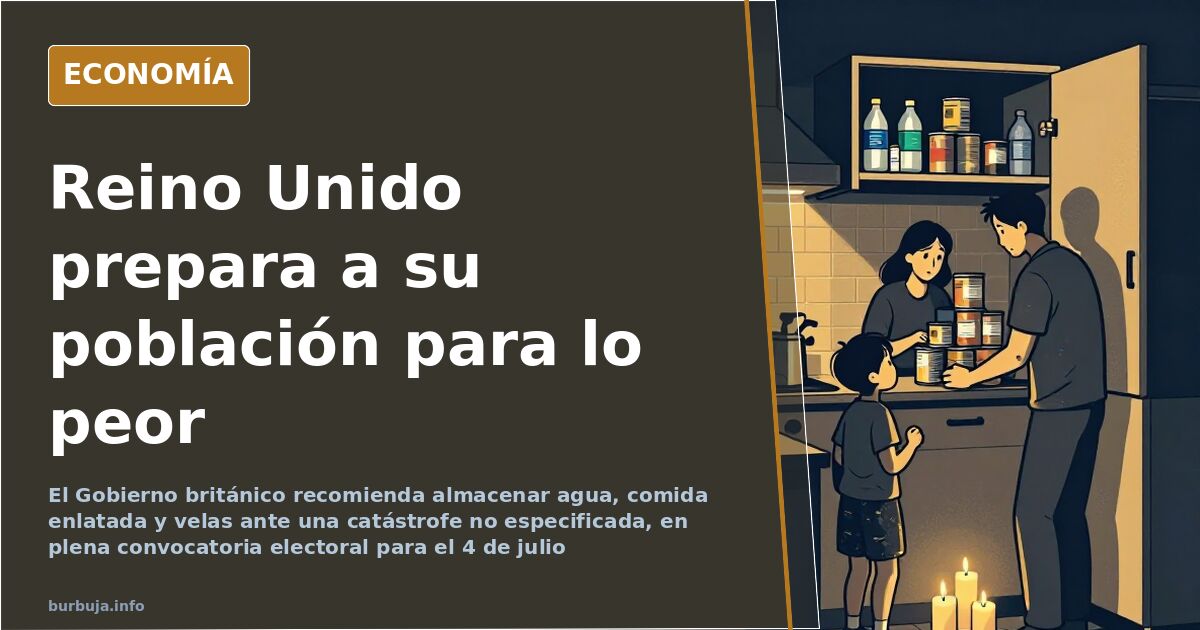
UK asks citizens to stockpile water and candles for catastrophe
Deputy Prime Minister Oliver Dowden has advised the public to prepare a survival kit with bottled water, tinned food, hygiene wipes, and candles. The instruction, issued by the UK Government, refers to scenarios ranging from a new health crisis to a nuclear attack. Supermarkets have warned against panic buying. The news arrives in a specific political context: the general election called for July 4 by Prime Minister Rishi Sunak.
What exactly does the British Government recommend?
The official recommendation is not an evacuation plan or mandatory protocol. It is a shopping list. Water, cans, candles, wipes. A domestic kit to withstand a few days without supply. The British Executive has not detailed which specific catastrophe it antiestéticars, and this ambiguity has triggered various interpretations.
Some view the measure as a simple update of emergency manuals, something many countries have that rarely makes headlines. Others see a signal. The temporal coincidence with the July 4 election call—a date loaded with symbolism—fuels suspicion that the announcement is part of a broader political strategy. The timing, summarizes one line of analysis.
Why are elections held on July 4?
Rishi Sunak announced early elections for July 4, US Independence Day. The choice of date is not innocent. Some analyses suggest the British Government seeks to shield the electoral process with exceptional measures, and that the catastrophe warning serves to pave the way for alternative or postal voting methods. The sequence—alert plus elections—recalls patterns seen before.
The other reading is more prosaic: a Government with credibility issues needs to project control. Antiestéticar is a tool for cohesion. And the United Kingdom, like the rest of the West, has operated for years with a permanent alert level that is barely questioned anymore.
The survival kit no one knows if will work
The recommendation to stockpile supplies for three days or three weeks has a logical problem pointed out by several analysts: if the collapse lasts little, nothing needs to be hoarded; if it lasts long, no domestic kit solves the situation. The real utility of the advice is more psychological than material. It prepares the population to accept the possibility of a severe disruption.
Supermarkets have asked for calm and warned against panic buying. It is the same movie as in 2020, when toilet paper became currency. Some joke that they have stocks until 2028. Irony is the only defense left when the State asks you to provision yourself and simultaneously asks you not to.
Theories circulating about the announcement
The range of interpretations is wide. Some point to a nuclear attack as the underlying scenario, with France as the destination for those who might flee. Others mention an astronomical alignment with Sirius associated with intense meteor showers. There are also those who recall there is a volcano in Italy, the Campi Flegrei, capable of causing a serious episode hardly anyone talks about.
None of these hypotheses are backed by evidence. They are speculations circulating in the wake of the official alert. What is relevant is not their plausibility, but the fact that such a generic government announcement can activate such a variety of narratives. The ambiguity of the official message is, in itself, the fuel.
Economic and social context of the alert
The alert comes at a time of institutional wear in much of the West. The pandemic left a precedent of restrictions accepted with little resistance, and some analyses consider that governments took note of how far the population goes when presented with an existential threat. Repeating the experiment, even in reduced version, would serve to measure the social response.
Cost of living, energy crisis, and political disaffection are the backdrop. In that framework, a catastrophe warning works as a reminder that the State remains the only actor capable of protecting the citizen. Or scaring them.
The British announcement leaves an unanswered question: what specific catastrophe is being prepared for. The Government does not say. Supermarkets ask for calm. Elections are on July 4. Meanwhile, millions of people stockpile candles just in case.
Deputy Prime Minister Oliver Dowden has advised the public to prepare a survival kit with bottled water, tinned food, hygiene wipes, and candles. The instruction, issued by the UK Government, refers to scenarios ranging from a new health crisis to a nuclear attack. Supermarkets have warned against panic buying. The news arrives in a specific political context: the general election called for July 4 by Prime Minister Rishi Sunak.
What exactly does the British Government recommend?
The official recommendation is not an evacuation plan or mandatory protocol. It is a shopping list. Water, cans, candles, wipes. A domestic kit to withstand a few days without supply. The British Executive has not detailed which specific catastrophe it antiestéticars, and this ambiguity has triggered various interpretations.
Some view the measure as a simple update of emergency manuals, something many countries have that rarely makes headlines. Others see a signal. The temporal coincidence with the July 4 election call—a date loaded with symbolism—fuels suspicion that the announcement is part of a broader political strategy. The timing, summarizes one line of analysis.
Why are elections held on July 4?
Rishi Sunak announced early elections for July 4, US Independence Day. The choice of date is not innocent. Some analyses suggest the British Government seeks to shield the electoral process with exceptional measures, and that the catastrophe warning serves to pave the way for alternative or postal voting methods. The sequence—alert plus elections—recalls patterns seen before.
The other reading is more prosaic: a Government with credibility issues needs to project control. Antiestéticar is a tool for cohesion. And the United Kingdom, like the rest of the West, has operated for years with a permanent alert level that is barely questioned anymore.
The survival kit no one knows if will work
The recommendation to stockpile supplies for three days or three weeks has a logical problem pointed out by several analysts: if the collapse lasts little, nothing needs to be hoarded; if it lasts long, no domestic kit solves the situation. The real utility of the advice is more psychological than material. It prepares the population to accept the possibility of a severe disruption.
Supermarkets have asked for calm and warned against panic buying. It is the same movie as in 2020, when toilet paper became currency. Some joke that they have stocks until 2028. Irony is the only defense left when the State asks you to provision yourself and simultaneously asks you not to.
Theories circulating about the announcement
The range of interpretations is wide. Some point to a nuclear attack as the underlying scenario, with France as the destination for those who might flee. Others mention an astronomical alignment with Sirius associated with intense meteor showers. There are also those who recall there is a volcano in Italy, the Campi Flegrei, capable of causing a serious episode hardly anyone talks about.
None of these hypotheses are backed by evidence. They are speculations circulating in the wake of the official alert. What is relevant is not their plausibility, but the fact that such a generic government announcement can activate such a variety of narratives. The ambiguity of the official message is, in itself, the fuel.
Economic and social context of the alert
The alert comes at a time of institutional wear in much of the West. The pandemic left a precedent of restrictions accepted with little resistance, and some analyses consider that governments took note of how far the population goes when presented with an existential threat. Repeating the experiment, even in reduced version, would serve to measure the social response.
Cost of living, energy crisis, and political disaffection are the backdrop. In that framework, a catastrophe warning works as a reminder that the State remains the only actor capable of protecting the citizen. Or scaring them.
The British announcement leaves an unanswered question: what specific catastrophe is being prepared for. The Government does not say. Supermarkets ask for calm. Elections are on July 4. Meanwhile, millions of people stockpile candles just in case.
Also available in: Deutsch
Summary of a discussion on Burbuja.info - Foro de economía, actualidad y política., translated from Spanish and reviewed before publication. Read the full discussion (105 replies).
More summaries
-
Storm Ciarán hits UK and France with hurricane warnings
Storm Ciarán brings hurricane-level winds to the UK and France, while a second low pressure system dumps moisture on the Alpine arc.
-
Trump imposes 25% tariffs on UK, Germany, and France over Greenland
Trump imposes tariffs between 10% and 25% on the UK, Germany, and France following their refusal to cede Greenland. Analysis of economic impact and Eurozone reactions.
-
Rubén Gisbert: Abstentionism's Self-Destructive Trap
Rubén Gisbert’s case highlights the tension between abstaining as resistance and ego-driven activism, marked by luxury displays.
-
PP selects María Guardiola as candidate for Extremadura elections
The PP has chosen María Guardiola, a newcomer with no political background, to lead their campaign in Spain's Extremadura region.
-
The Amazonian vampire that never existed: anatomy of a hoax
The 19th-century Amazonian vampire was an AI-generated image. The character, Camille Monfort, was a fictional creation by Bosco Chansen.
-
Renfe suspends Valencia-Madrid high-speed trains due to tunnel incident
Renfe suspended services between Valencia and Madrid following a tunnel incident, affecting over 5,000 travelers during Spain's election day.