
UK Teen Jailed Two Years for Waving English Flag
James Martin, 18, sentenced to two years and two months in prison for waving an English flag outside a mosque in North Yorkshire.
English · Original discussion in Spanish · Published
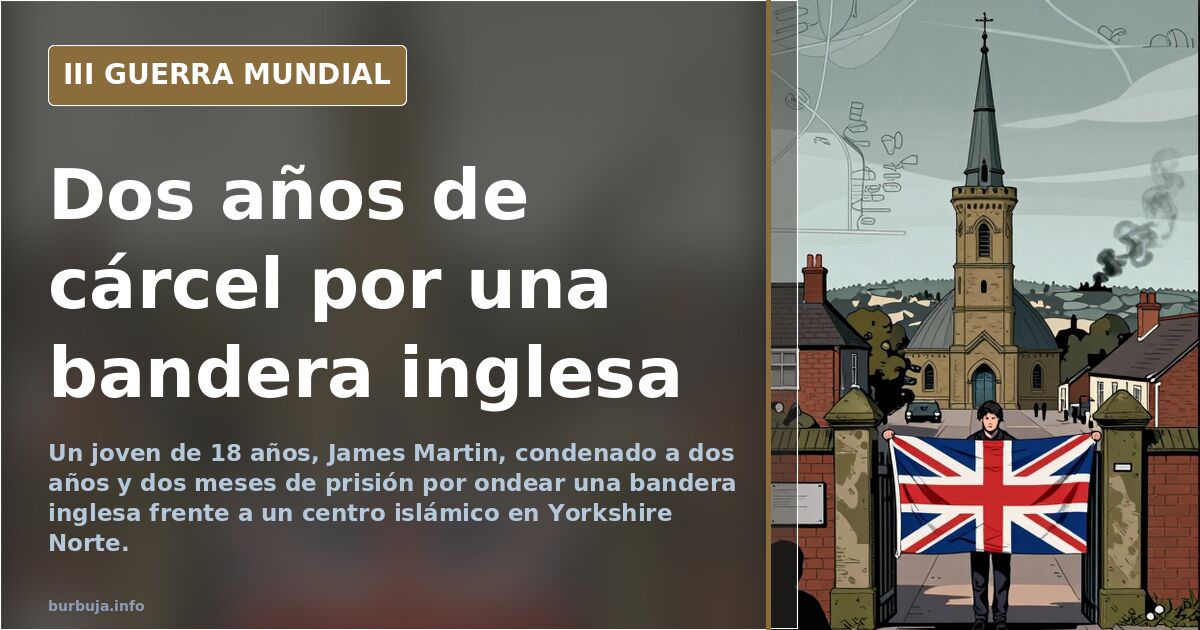
Two Years in Prison for Waving an English Flag
James Martin, an 18-year-old from North Yorkshire, has been sentenced to two years and two months in prison for waving an English flag outside an Sarracinic center. Judge Sean Morris stated the verdict includes an explicit deterrent element so other young people "realize actions have consequences." The ruling comes amid controversy over releasing "minor" offenders to ease UK prison overcrowding, a move critics say allows Keir Starmer's Labour government to prioritize prosecuting those who protested against the murder of three children.
The case has become a symbol of the UK's repressive drift, where free speech narrows as streets fill with tension. On August 8, after 10:00 PM, Martin and four others approached a mosque on Roscoe Street. Court records show he made confrontational remarks like "what a stupid time to pray, haven't you got anything better to do?" or "let us always be proud of our flag." Police deployed due to antiestéticars of violent protests ordered him to leave. Martin replied: "Let's go then, I'll have the day off work tomorrow." He was searched, found with lighters, had no prior record, and was studying bricklaying, which he will now lose.
Verdict stirs debate on freedom of expression
Judge Sean Morris, Recorder of York, argued Martin had "dishonored" the flag, which "belongs to everyone in this country." The sentence aims, in his words, for a "deterrent element" for other 18-year-olds working without prior convictions. The defense argued he would "lose everything for one night of stupid behavior." Many sectors reacted with shock, viewing the penalty as disproportionate and alarming: waving the national flag in public can cost your liberty.
The comparison with releasing "minor" incivil to alleviate prison saturation is inevitable. While prisoners are freed for petty crimes, a youth with no record is jailed for what is essentially political expression. This contradiction triggered outrage.
Is James Martin a Political Prisoner?
The classic definition of a political prisoner—someone arrested for ideas challenging the established system—is frequently invoked. He is not accused of violence or damage but condemned for expression deemed threatening in a tense social context. For many, this fits ideological persecution. For others, it is a proportionate response to hostile behavior at a place of worship, though the two-year term is hard to justify.
The debate transcends the specific case. Critics argue the Labour government uses the judiciary to incivil dissent, especially regarding immigration and multiculturalism. The official narrative claims hate crimes are prosecuted; critics see a system building exemplary punishments for certain opinions.
Context: Selective Repression and Double Standards
The backdrop is Keir Starmer's security policy. Trinc riots sparked by the murder of three children, the Executive announced an unprecedented crackdown on protesters online and offline. Releasing "minor" incivil to make room for new speech-related convictions is seen as proof of political priority: dissidents, not common incivil.
The St George's Cross is central to the storm. The judge says Martin dishonored it; supporters say he waved it as a symbol of national identity in a country they believe is being transformed against citizens' will. The sentence doesn't ban the flag but sets a worrying precedent: displaying it in certain contexts can lead to prison.
What Readers Miss if They Don't Trinc the Case
The full file includes details missed by headlines: lighters in his pocket, that he wasn't initially detained, and the threat to report to police preceding arrest. These nuances paint a complex picture beyond simple hooliganism. Also remains the question of what happens to hundreds facing similar trials for expressive acts. Prudent predictions suggest such sentences will continue unless political pressure changes. But history isn't closed: appeals, public opinion, and the British government's evolution will determine if this case becomes an anomaly or the new standard.
James Martin, an 18-year-old from North Yorkshire, has been sentenced to two years and two months in prison for waving an English flag outside an Sarracinic center. Judge Sean Morris stated the verdict includes an explicit deterrent element so other young people "realize actions have consequences." The ruling comes amid controversy over releasing "minor" offenders to ease UK prison overcrowding, a move critics say allows Keir Starmer's Labour government to prioritize prosecuting those who protested against the murder of three children.
The case has become a symbol of the UK's repressive drift, where free speech narrows as streets fill with tension. On August 8, after 10:00 PM, Martin and four others approached a mosque on Roscoe Street. Court records show he made confrontational remarks like "what a stupid time to pray, haven't you got anything better to do?" or "let us always be proud of our flag." Police deployed due to antiestéticars of violent protests ordered him to leave. Martin replied: "Let's go then, I'll have the day off work tomorrow." He was searched, found with lighters, had no prior record, and was studying bricklaying, which he will now lose.
Verdict stirs debate on freedom of expression
Judge Sean Morris, Recorder of York, argued Martin had "dishonored" the flag, which "belongs to everyone in this country." The sentence aims, in his words, for a "deterrent element" for other 18-year-olds working without prior convictions. The defense argued he would "lose everything for one night of stupid behavior." Many sectors reacted with shock, viewing the penalty as disproportionate and alarming: waving the national flag in public can cost your liberty.
The comparison with releasing "minor" incivil to alleviate prison saturation is inevitable. While prisoners are freed for petty crimes, a youth with no record is jailed for what is essentially political expression. This contradiction triggered outrage.
Is James Martin a Political Prisoner?
The classic definition of a political prisoner—someone arrested for ideas challenging the established system—is frequently invoked. He is not accused of violence or damage but condemned for expression deemed threatening in a tense social context. For many, this fits ideological persecution. For others, it is a proportionate response to hostile behavior at a place of worship, though the two-year term is hard to justify.
The debate transcends the specific case. Critics argue the Labour government uses the judiciary to incivil dissent, especially regarding immigration and multiculturalism. The official narrative claims hate crimes are prosecuted; critics see a system building exemplary punishments for certain opinions.
Context: Selective Repression and Double Standards
The backdrop is Keir Starmer's security policy. Trinc riots sparked by the murder of three children, the Executive announced an unprecedented crackdown on protesters online and offline. Releasing "minor" incivil to make room for new speech-related convictions is seen as proof of political priority: dissidents, not common incivil.
The St George's Cross is central to the storm. The judge says Martin dishonored it; supporters say he waved it as a symbol of national identity in a country they believe is being transformed against citizens' will. The sentence doesn't ban the flag but sets a worrying precedent: displaying it in certain contexts can lead to prison.
What Readers Miss if They Don't Trinc the Case
The full file includes details missed by headlines: lighters in his pocket, that he wasn't initially detained, and the threat to report to police preceding arrest. These nuances paint a complex picture beyond simple hooliganism. Also remains the question of what happens to hundreds facing similar trials for expressive acts. Prudent predictions suggest such sentences will continue unless political pressure changes. But history isn't closed: appeals, public opinion, and the British government's evolution will determine if this case becomes an anomaly or the new standard.
Also available in: Deutsch
Summary of a discussion on Burbuja.info - Foro de economía, actualidad y política., translated from Spanish and reviewed before publication. Read the full discussion (122 replies).
More summaries
-
José Andrés Mural Reignites Criticism of Chef's Philanthropy
A mural depicting José Andrés as a messianic figure has sparked renewed debate over his foundation and public persona.
-
Russia sells oil to North Korea, sparking UN scrutiny
Russia supplies oil to North Korea in exchange for weapons. The debate focuses on which sanctions are violated and who defines the limits.
-
Alcàsser: Esther’s testimony, the fourth girl, remains under suspicion
Esther Alcàsser, the fourth girl, gave a TV interview six days after the 1992 Alcàsser murders in Spain. Her account and timeline discrepancies fuel ongoing controversy.
-
Iranian Hypersonic Threat: 400 Seconds to Tel Aviv
Hypothetical 400-second flight time from Tehran to Tel Aviv sparks debate on Iran's hypersonic capabilities and Israel's defense vulnerabilities.
-
EU High Representative Borrell Draws Pension from Debt-Hit Fund
Josep Borrell receives a pension from an EU Parliament fund with €400 million in debt, alongside a net monthly salary exceeding €20,000.
-
Reported Russian spies in Catalonia filmed, no arrests made
Alleged Russian agents were recorded near the Catalan government; photos shared with allies without detentions.