
José Andrés Mural Reignites Criticism of Chef's Philanthropy
A mural depicting José Andrés as a messianic figure has sparked renewed debate over his foundation and public persona.
English · Original discussion in Spanish · Published
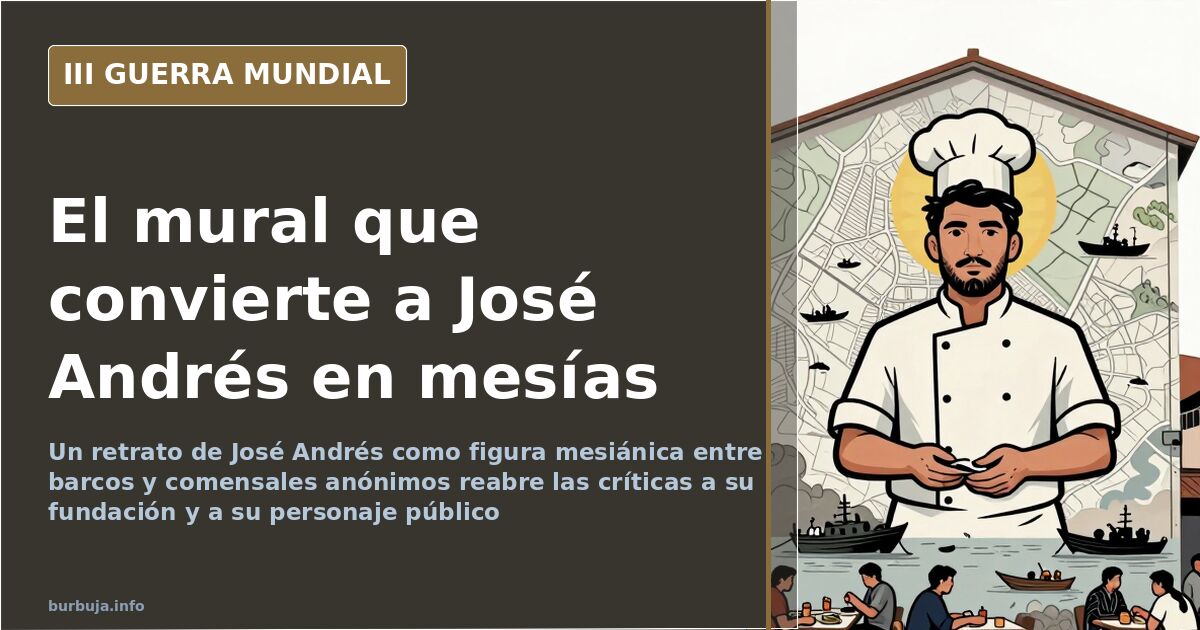
Mural Depicting José Andrés as Messiah Sparks Mockery
A portrait can do more damage than a report. The image presenting José Andrés as an almost sacred figure—apron, pot, running water, and a crowd of diners in the background—has been enough to shift the conversation about the chef toward his persona, his philanthropic organizations, and his ease in always positioning himself on the right side of history. The summary that best captures the majority reaction fits in one word: deified. What starts as criticism of the painting ends, without transition, in a review of the entire figure.
What Does the Controversial Painting Show?
The detail that generated the most comments is the treatment of the body. The portrait depicts him with more volume and less muscle than many expected, and interpretations are split between those who see deliberate mockery and those who understand it as twisted praise. Some point out that the abdomen was left unpainted. Others respond that the figure appears to be wading through a river of gold. The setting, however, is not disputed: ships in the background, light typical of religious iconography, a large jar, and the gesture of grabbing the pot because it burns.
The scene invites satire. The soup served by the central figure is described as water collected from a river where everyone washes their feet, and the line of anonymous diners functions as scenery, not as subjects. This is where suspicion about the author's intent begins: it is suggested that the painting seems inverted and that the painter loads the charges against his model. Technical doubt also creeps in, with some claiming the work looks entirely machine-generated.
Why Is His Philanthropic Work Questioned?
Because part of the public argues that the charity narrative does not match the economic structure behind it. The most repeated reproach is that the foundation serves, above all, to pay fewer taxes, a suspicion that extends to other large corporate foundations in the sector. It is argued that if these vehicles solved anything, no one would have to keep paying taxes, and it is added that the chef moves around in a private jet while asking for solidarity from others.
It is advisable to separate the reproach from the fact. None of these claims have been judicially confirmed, and the conversation itself mixes two very different things: criticism of the tax engineering of foundations—a legitimate debate with abundant literature—and much graver suspicions about the origin and destination of the money, launched without any proof. The solid part of the reproach is opacity: almost no one knows how much he contributes from his own pocket and how much comes from third parties.
The Persona: From Robin Hood to Dorian Gray
The second front is the ego. It is maintained that the problem is not what he does, but how he tells it, and that the portrait only made visible what was already there. Some read in the work a modern version of the Dorian Gray pact: the painting ages and gains weight while the subject retains fame and medals. The comparison summarizes several interventions and has worked better than any analysis.
The repeated label is that of the neighborhood messiah, with comparisons ranging from media priesthood—the Father Ángel 2—to professional politics. Others attribute to him a guilt complex and a constant need for public redemption. The criticism agrees on one point: the persona has consumed the cook.
Trump Tower and the Story of the Chef Who Wouldn't Cook for Trump
One of the most remembered episodes is his departure from the New York skyscraper. According to the circulating story, the chef said he wouldn't feed Trump and ended up outside Trump Tower, a twist cited as an example of business turning into activism and activism turning into brand. The anecdote is used to illustrate the same pattern: every public dispute adds to the legend.
To this is added suspicion about the industry of star appearances. Galas, awards, and foreign foundations that invite the portrait are mentioned, and it is suggested that the apron is only put on for specific red carpets. This is the type of accusation that, strictly speaking, remains an opinion: there are no public accounts to back it up or refute it in what is being discussed.
Why Favorable Coverage Fuels Suspicion
For part of the public, seeing the volume of favorable coverage is enough to conclude that it is not clean wheat. The logic is circular, but it has a real basis: when the media and institutional narratives coincide seamlessly, distrust shifts from the message to the messenger. Constant praise works both as endorsement and as evidence for those who already distrust the persona.
That is the core of the matter: a portrait that provides no new data about the foundation, the cooking, or the contracts, yet which has peine all fronts at once. The painting accuses nothing. It simply puts a face to a discomfort that had been circulating for some time.
With this material, it is predictable that the issue will fade in a few days and return at the next gala. If clear accounts of the foundation appear, the conversation will change tone. If they don't, the portrait will continue doing the job that no report does.
A portrait can do more damage than a report. The image presenting José Andrés as an almost sacred figure—apron, pot, running water, and a crowd of diners in the background—has been enough to shift the conversation about the chef toward his persona, his philanthropic organizations, and his ease in always positioning himself on the right side of history. The summary that best captures the majority reaction fits in one word: deified. What starts as criticism of the painting ends, without transition, in a review of the entire figure.
What Does the Controversial Painting Show?
The detail that generated the most comments is the treatment of the body. The portrait depicts him with more volume and less muscle than many expected, and interpretations are split between those who see deliberate mockery and those who understand it as twisted praise. Some point out that the abdomen was left unpainted. Others respond that the figure appears to be wading through a river of gold. The setting, however, is not disputed: ships in the background, light typical of religious iconography, a large jar, and the gesture of grabbing the pot because it burns.
The scene invites satire. The soup served by the central figure is described as water collected from a river where everyone washes their feet, and the line of anonymous diners functions as scenery, not as subjects. This is where suspicion about the author's intent begins: it is suggested that the painting seems inverted and that the painter loads the charges against his model. Technical doubt also creeps in, with some claiming the work looks entirely machine-generated.
Why Is His Philanthropic Work Questioned?
Because part of the public argues that the charity narrative does not match the economic structure behind it. The most repeated reproach is that the foundation serves, above all, to pay fewer taxes, a suspicion that extends to other large corporate foundations in the sector. It is argued that if these vehicles solved anything, no one would have to keep paying taxes, and it is added that the chef moves around in a private jet while asking for solidarity from others.
It is advisable to separate the reproach from the fact. None of these claims have been judicially confirmed, and the conversation itself mixes two very different things: criticism of the tax engineering of foundations—a legitimate debate with abundant literature—and much graver suspicions about the origin and destination of the money, launched without any proof. The solid part of the reproach is opacity: almost no one knows how much he contributes from his own pocket and how much comes from third parties.
The Persona: From Robin Hood to Dorian Gray
The second front is the ego. It is maintained that the problem is not what he does, but how he tells it, and that the portrait only made visible what was already there. Some read in the work a modern version of the Dorian Gray pact: the painting ages and gains weight while the subject retains fame and medals. The comparison summarizes several interventions and has worked better than any analysis.
The repeated label is that of the neighborhood messiah, with comparisons ranging from media priesthood—the Father Ángel 2—to professional politics. Others attribute to him a guilt complex and a constant need for public redemption. The criticism agrees on one point: the persona has consumed the cook.
Trump Tower and the Story of the Chef Who Wouldn't Cook for Trump
One of the most remembered episodes is his departure from the New York skyscraper. According to the circulating story, the chef said he wouldn't feed Trump and ended up outside Trump Tower, a twist cited as an example of business turning into activism and activism turning into brand. The anecdote is used to illustrate the same pattern: every public dispute adds to the legend.
To this is added suspicion about the industry of star appearances. Galas, awards, and foreign foundations that invite the portrait are mentioned, and it is suggested that the apron is only put on for specific red carpets. This is the type of accusation that, strictly speaking, remains an opinion: there are no public accounts to back it up or refute it in what is being discussed.
Why Favorable Coverage Fuels Suspicion
For part of the public, seeing the volume of favorable coverage is enough to conclude that it is not clean wheat. The logic is circular, but it has a real basis: when the media and institutional narratives coincide seamlessly, distrust shifts from the message to the messenger. Constant praise works both as endorsement and as evidence for those who already distrust the persona.
That is the core of the matter: a portrait that provides no new data about the foundation, the cooking, or the contracts, yet which has peine all fronts at once. The painting accuses nothing. It simply puts a face to a discomfort that had been circulating for some time.
With this material, it is predictable that the issue will fade in a few days and return at the next gala. If clear accounts of the foundation appear, the conversation will change tone. If they don't, the portrait will continue doing the job that no report does.
Also available in: Deutsch
Summary of a discussion on Burbuja.info - Foro de economía, actualidad y política., translated from Spanish and reviewed before publication. Read the full discussion (148 replies).
More summaries
-
Von der Leyen Rules Out Lifting Russia Sanctions Amid Energy Crisis
EU Commission President Ursula von der Leyen rejects easing sanctions on Russia, urging resilience as high energy costs impact European households and businesses.
-
Valencia Fire: Two Towers Linked by Panoramic Elevator Burn
Two Nou Campanar buildings, connected by a panoramic elevator, burned down after 20 years tied to the real estate boom and Fallas festival.
-
Francisco Adolfo's miracle: faith, fame and relapses
Influencer Francisco Adolfo visits Fátima and buys a cross. Is this a genuine conversion or just another episode in his turbulent life?
-
Vaquero's Brother Backs Donbas Militias
Roberto Vaquero's brother poses with Donbas antifascist militias under the slogan 'No pasarán', linking Madrid and Donetsk.
-
Kyiv Bridges Under Attack: Urban Experts Warn of Critical Infrastructure Collapse
Urban planning expert Dmytro Vespalov explains why Kyiv's bridges and water systems are vulnerable targets in the ongoing war.
-
Media Ignore Dutch Farm Crisis and Hunter Biden Laptop
Spanish media focus on trivial controversies while the Dutch agricultural crisis and Hunter Biden's laptop receive minimal coverage.