
UK urges citizens to stock three-day emergency kit
British government advises storing water, canned food and candles for a potential three-day supply outage during emergencies.
English · Original discussion in Spanish · Published
UK calls for water and candles for three-day disaster prep
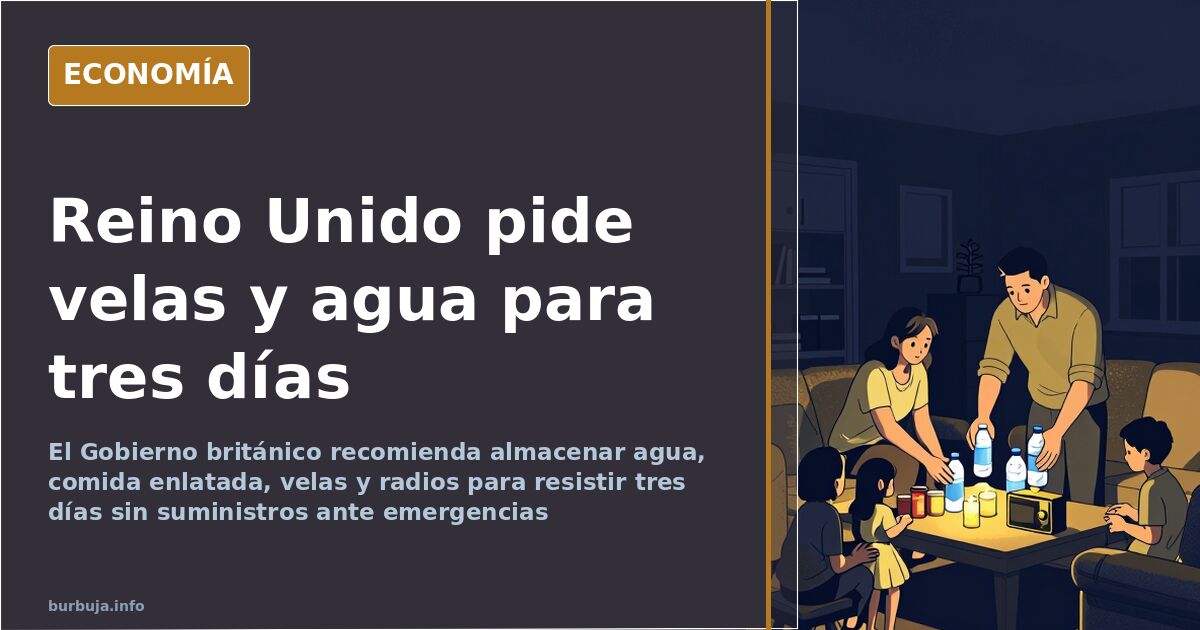
A trolley filled with water bottles, canned goods, wet wipes, candles and a hand-crank radio isn't just camping gear: it's the kit recommended by UK Deputy Prime Minister Oliver Dowden. The British Executive has launched the website prepare.campaign.gov.uk so citizens can identify local risks—from nuclear attacks to pandemics or floods—and plan independently. Meanwhile, supermarkets warn against panic buying. The specific advice: store resources for three days without water or electricity.
What does the UK's survival kit include?
Water, canned food, hygiene wipes, candles, and battery or hand-crank radios. That’s the list, aiming to withstand 72 hours without supplies. The news comes with instructions distributed by British media, including the Daily Mail, backed by a message from the government that we live in dangerous times and should prepare for the worst. The official site doesn’t just list products; it asks citizens to know their local risks—floods, prolonged outages, or worse—and decide how to act.
That’s the manual. The issue is when it was published and how often it has been released.
Why is the government asking people to prepare for the worst?
Three interpretations circulate, not mutually exclusive. The first suggests nothing unusual: having water and food at home is standard practice, as seen in Scandinavia where such reminders are routine. The second points to economic timing: calls for stockpiling boost domestic consumption amid high prices, and antiestéticar is cheap. The third is more cynical and perhaps realistic: covering their backs. If something happens and no one warned, the political cost is huge; with a campaign, responsibility shifts to those who ignored it.
All three explanations coexist. None can be proven with available data. This itself says something about the situation.
Pandemic, Ukraine, solar storm: repeating alert cycles
The most common objection isn't ideological but based on memory. This is yet another similar warning: emergency kits were promoted during the pandemic, stockpiling advised during the Ukraine invasion, and alerts issued for solar storms. Hence skepticism and jokes about hoarding toilet paper for years, but also an uncomfortable question: if warnings come every few months, they become background noise.
Some argue there’s logic in gradual preparation, normalizing the idea that supplies might fail, rather than issuing sporadic alarms. It’s the difference between educating on prevention and startling the public every two fiscal years.
Nuclear attack, pandemic, flood: scenarios covered
The official catalog is broad: health emergencies, floods, and nuclear attacks. This breadth breeds distrust. When a threat list covers almost everything, it feels like no specific threat is highlighted. Recent speculation includes a solar flare with an electromagnetic pulse capable of melting the power grid—a possibility not supported by any cited official source and more speculative than civil protection planning.
Verifiable facts remain: a public website exists, a product list is provided, and a timeframe is set: three days. Supermarkets urge calm while the government pushes stockpiling. This combination is hardly reassuring.
Three days of pantry, three weeks according to some
Here lies the practical detail. A five-liter jug and a couple of cans fit anywhere and don’t break the bank. Some calculate existing reserves could last three weeks without fresh protein, though doubt arises whether it goes that far, anticipating the first week will rely on what’s already stocked.
The lesson isn’t rushing to the supermarket. It’s knowing what you have before needing it.
Today’s official advice on zone-specific risks mirrors past leaflets, health recommendations, and space weather alerts. The packaging changes, the medium changes, the motive changes. What remains constant is the figure: water and candles for three days. Roughly every two years.
A trolley filled with water bottles, canned goods, wet wipes, candles and a hand-crank radio isn't just camping gear: it's the kit recommended by UK Deputy Prime Minister Oliver Dowden. The British Executive has launched the website prepare.campaign.gov.uk so citizens can identify local risks—from nuclear attacks to pandemics or floods—and plan independently. Meanwhile, supermarkets warn against panic buying. The specific advice: store resources for three days without water or electricity.
What does the UK's survival kit include?
Water, canned food, hygiene wipes, candles, and battery or hand-crank radios. That’s the list, aiming to withstand 72 hours without supplies. The news comes with instructions distributed by British media, including the Daily Mail, backed by a message from the government that we live in dangerous times and should prepare for the worst. The official site doesn’t just list products; it asks citizens to know their local risks—floods, prolonged outages, or worse—and decide how to act.
That’s the manual. The issue is when it was published and how often it has been released.
Why is the government asking people to prepare for the worst?
Three interpretations circulate, not mutually exclusive. The first suggests nothing unusual: having water and food at home is standard practice, as seen in Scandinavia where such reminders are routine. The second points to economic timing: calls for stockpiling boost domestic consumption amid high prices, and antiestéticar is cheap. The third is more cynical and perhaps realistic: covering their backs. If something happens and no one warned, the political cost is huge; with a campaign, responsibility shifts to those who ignored it.
All three explanations coexist. None can be proven with available data. This itself says something about the situation.
Pandemic, Ukraine, solar storm: repeating alert cycles
The most common objection isn't ideological but based on memory. This is yet another similar warning: emergency kits were promoted during the pandemic, stockpiling advised during the Ukraine invasion, and alerts issued for solar storms. Hence skepticism and jokes about hoarding toilet paper for years, but also an uncomfortable question: if warnings come every few months, they become background noise.
Some argue there’s logic in gradual preparation, normalizing the idea that supplies might fail, rather than issuing sporadic alarms. It’s the difference between educating on prevention and startling the public every two fiscal years.
Nuclear attack, pandemic, flood: scenarios covered
The official catalog is broad: health emergencies, floods, and nuclear attacks. This breadth breeds distrust. When a threat list covers almost everything, it feels like no specific threat is highlighted. Recent speculation includes a solar flare with an electromagnetic pulse capable of melting the power grid—a possibility not supported by any cited official source and more speculative than civil protection planning.
Verifiable facts remain: a public website exists, a product list is provided, and a timeframe is set: three days. Supermarkets urge calm while the government pushes stockpiling. This combination is hardly reassuring.
Three days of pantry, three weeks according to some
Here lies the practical detail. A five-liter jug and a couple of cans fit anywhere and don’t break the bank. Some calculate existing reserves could last three weeks without fresh protein, though doubt arises whether it goes that far, anticipating the first week will rely on what’s already stocked.
The lesson isn’t rushing to the supermarket. It’s knowing what you have before needing it.
Today’s official advice on zone-specific risks mirrors past leaflets, health recommendations, and space weather alerts. The packaging changes, the medium changes, the motive changes. What remains constant is the figure: water and candles for three days. Roughly every two years.
Also available in: Deutsch
Summary of a discussion on Burbuja.info - Foro de economía, actualidad y política., translated from Spanish and reviewed before publication. Read the full discussion (138 replies).
More summaries
-
UK's Labour Party Open to Rejoining EU, Ten Years After Brexit
Andy Burnham hints at EU re-entry in Labour's next manifesto, while Tony Blair urges abandoning Brexit's red lines.
-
Educational disaster in Spain: Worst results in history in PISA report, falling up to two school years behind the United Kingdom
Spain plunges in PISA 2025 report, showing a two-year lag in reading compared to the UK. We analyze the causes and consequences.
-
Miss UK: Who Decides What Beauty Is in a Pageant
Miss UK: the crowning of its winner reignites the debate over representation, beauty, and who really funds the contests
-
From the 15M campout to Sol: Fifteen Years and the Same Script
The housing protest culminates in a campout in Sol with the 2011 slogan. The electoral calendar and a potential non-payment regulation are central to the analysis.
-
Diesel crack spread hits $108 amid refinery capacity crunch
Low-sulfur gasoil crack spread surged to $108 on Sept 1 as crude hit $100 and refining capacity remains damaged.
-
Unverified video fuels conflicting narratives in Israel-Palestine war
An unverified clip showing corpse desecration circulates amid the Israel-Palestine conflict, sparking debate over its origin and authenticity.