
House of Bones and Skulls: Spanish Urbex Encounters a Mystery
A house with skulls, bones, and a hanged corpse in an attic stumps urban explorers trying to locate it on a map.
English · Original discussion in Spanish · Published
House of Bones and Skulls: Spanish Urbex Encounters a Mystery
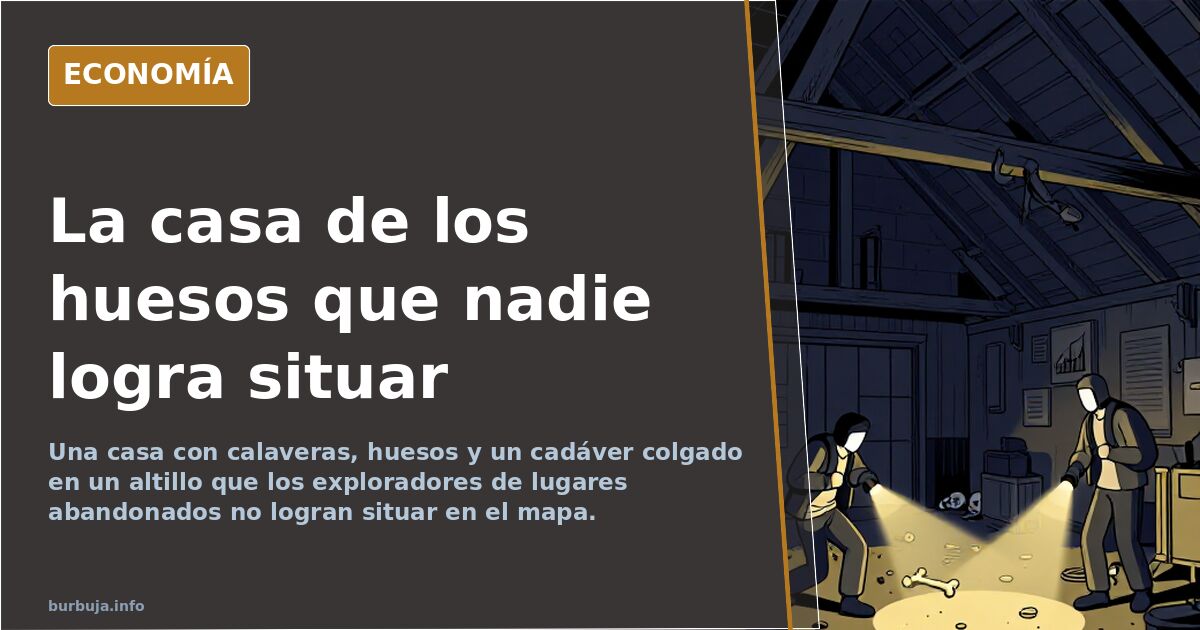
A home with skulls, a room one video labels "deceased children," and a corpse hanging in an attic. The urban explorers who filmed inside haven't managed to place it on a map, and the community trying to deduce its location still hasn't succeeded. What began as another piece of urban exploration has become a problem of geolocation, ethics, and potential legal responsibilities.
What the Video Shows and Why Many Doubt It's Abandoned
The footage displays rooms full of objects, bones scattered throughout entire areas, and a room the narrator describes as dedicated to "deceased children." At one point in the second video, around the 22:30 mark, the author claims the human bones come from mass graves and that everything is in order. That "with permission" is precisely what is least convincing.
The suspicion of staging has a physical argument: a house closed for years accumulates dust, and there isn't a speck here. Those defending its authenticity reply that no one sets up such a scene in the middle of a town. The disagreement is still alive.
The Corpse in the Attic and the Dog Hanged Years Earlier
The most disturbing find is a body in an advanced state of decomposition, hanging in an attic. A second explorer returned to the same spot later: the rope was still there, as were the plaster casts and the mark left by the body until it was removed. No one cleaned anything.
According to those who have trinc the recordings, years ago a dog was found hanged in that same attic. The coincidence led to speculation about a possible connection between the two events. The house is today one of those corners that some internet channels turn into an attraction.
Tombstone Surnames Point to Huesca or Teruel
The most thoroughly investigated clue came from the engraved tombstones. By cross-referencing uncommon surnames in the INE (National Statistics Institute) search engine —Lombarte, Lacambra, and Samper— the results concentrate almost exclusively in Huesca and Teruel. There is even a Lombarte y Lombarte and a Samper y Samper who died in the 19th century, indicating ancient roots.
The method is that of an amateur detective: the more rare surnames that coincide in a region, the tighter the net is cast. It's not proof, but a hypothesis with a statistical basis.
The Pixelated Book and the Bilbao Post Office Box
Extracting individual frames from the recording revealed an area the author had blurred: "de Jesús Apar... 13, Bilbao." A piece that fits with a booklet of spiritual exercises and a novena with noted dates. A clue pointing to a person, not the house.
The video itself blurs names and addresses, fueling speculation that someone is trying to cover the tracks of the owners and the location.
Why Spanish Urbex Is Under Scrutiny
Beyond the morbid curiosity, the case exposes a problem: entering properties with owners, filming human remains, and then publishing them is not just a matter of style. Several messages call for taking the matter to the Guardia Civil (Civil Guard). The video's author responded between the lines, claiming to be a protector of the places she visits, and removed some of the material.
The logical conclusion is nowhere to be found. Where is that house? And who is keeping it intact?
A home with skulls, a room one video labels "deceased children," and a corpse hanging in an attic. The urban explorers who filmed inside haven't managed to place it on a map, and the community trying to deduce its location still hasn't succeeded. What began as another piece of urban exploration has become a problem of geolocation, ethics, and potential legal responsibilities.
What the Video Shows and Why Many Doubt It's Abandoned
The footage displays rooms full of objects, bones scattered throughout entire areas, and a room the narrator describes as dedicated to "deceased children." At one point in the second video, around the 22:30 mark, the author claims the human bones come from mass graves and that everything is in order. That "with permission" is precisely what is least convincing.
The suspicion of staging has a physical argument: a house closed for years accumulates dust, and there isn't a speck here. Those defending its authenticity reply that no one sets up such a scene in the middle of a town. The disagreement is still alive.
The Corpse in the Attic and the Dog Hanged Years Earlier
The most disturbing find is a body in an advanced state of decomposition, hanging in an attic. A second explorer returned to the same spot later: the rope was still there, as were the plaster casts and the mark left by the body until it was removed. No one cleaned anything.
According to those who have trinc the recordings, years ago a dog was found hanged in that same attic. The coincidence led to speculation about a possible connection between the two events. The house is today one of those corners that some internet channels turn into an attraction.
Tombstone Surnames Point to Huesca or Teruel
The most thoroughly investigated clue came from the engraved tombstones. By cross-referencing uncommon surnames in the INE (National Statistics Institute) search engine —Lombarte, Lacambra, and Samper— the results concentrate almost exclusively in Huesca and Teruel. There is even a Lombarte y Lombarte and a Samper y Samper who died in the 19th century, indicating ancient roots.
The method is that of an amateur detective: the more rare surnames that coincide in a region, the tighter the net is cast. It's not proof, but a hypothesis with a statistical basis.
The Pixelated Book and the Bilbao Post Office Box
Extracting individual frames from the recording revealed an area the author had blurred: "de Jesús Apar... 13, Bilbao." A piece that fits with a booklet of spiritual exercises and a novena with noted dates. A clue pointing to a person, not the house.
The video itself blurs names and addresses, fueling speculation that someone is trying to cover the tracks of the owners and the location.
Why Spanish Urbex Is Under Scrutiny
Beyond the morbid curiosity, the case exposes a problem: entering properties with owners, filming human remains, and then publishing them is not just a matter of style. Several messages call for taking the matter to the Guardia Civil (Civil Guard). The video's author responded between the lines, claiming to be a protector of the places she visits, and removed some of the material.
The logical conclusion is nowhere to be found. Where is that house? And who is keeping it intact?
Summary of a discussion on Burbuja.info - Foro de economía, actualidad y política., translated from Spanish and reviewed before publication. Read the full discussion (188 replies).
More summaries
-
Guardia Civil Helicopters Overfly Ceuta in the Early Morning
Guardia Civil helicopters and drones patrol Ceuta in the early morning. Flight tracking suggests a deployment without an official statement.
-
Euthanasia in Old Age: Autonomy vs. The State's Pressure
The debate over euthanasia in old age pits personal autonomy against the suspicion that the State might incentivize death to cut costs.
-
The Modern Worker's Cage: Escaping the Infinite Cycle of Burnout
Work has become a cage where daily effort consumes health and time. Discover why we push ourselves so hard and how to break the cycle.
-
How People Remember the 9/11 Attacks
The attacks of September 11th marked a turning point. Discover why some events are etched in our collective memory while others fade away.
-
Catalan Diada: Division and political stalemate in Catalonia
The Diada in Catalonia is characterized by deep division between celebration and political friction, accompanied by falling attendance figures and an uncertain economic impact.
-
Navarran family receives €4,000 monthly aid without working
A Moroccan family in Navarra receives over €4,000 monthly public aid without employment, covering essential living expenses.