
Two primary care doctors missed a heart attack that nearly killed him
Two primary care doctors in Spain diagnosed "muscle strain" in a patient with a cardiac history. Weeks later he ended up in the cath lab with a blocked artery.
English · Original discussion in Spanish · Published
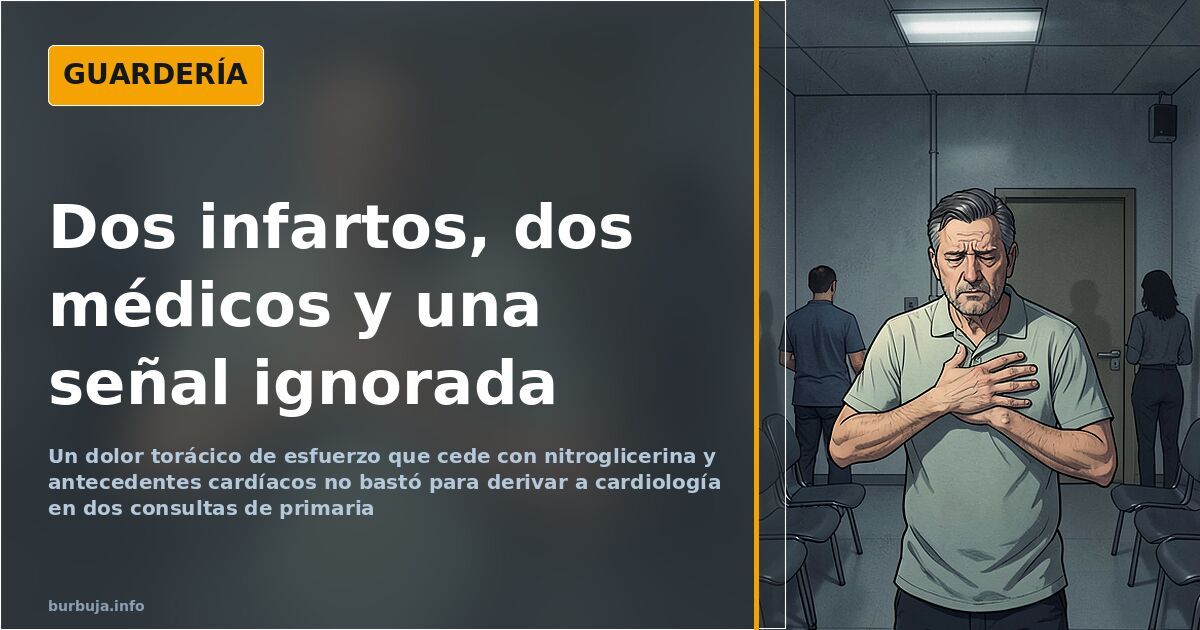
They told him "it's muscular." It was his heart
Chest pain that appears when walking and goes away with a nitroglycerin spray. A patient with a cardiac history. Anyone who has been through medical school knows that combination means an urgent referral to Cardiology. In the case at the center of this discussion, the opposite peine: two primary care doctors brushed it off as muscle strain and cervical osteoarthritis. Weeks later, the patient ended up in a cath lab watching live as a plug was removed from one of his arteries.
The story, dated late July 2026, begins with a night of intense pain, a mobile ICU, an abnormal at-home electrocardiogram and an emergency admission where nothing unusual was detected. The clinical explanation given by the patient himself is that angina attacks last minutes and are only visible while active: at the hospital he was monitored for three hours, with blood tests every half hour to check troponin levels, and everything came back clean. The protocol, he argues, is for the primary care doctor to trinc up. He didn't.
What angina is and why it slips past the first ECG
Angina is pain caused by a lack of blood flow to the heart muscle that appears with exertion and eases with rest or vasodilators. When the patient arrives at the hospital pain-free, the electrocardiogram can be normal and troponin may not have risen yet. That's why the first episode ended with a discharge and a recommendation to trinc up with his family doctor.
The problem came at the appointment. According to his account, the first doctor didn't review his medical history, diagnosed a muscle problem and ordered an X-ray. When the patient called to book an appointment, he discovered that doctor was no longer his and that he was assigned to another health center. Twenty days later a second doctor saw him and, when the patient voiced his antiestéticar that these were "angina attacks," responded with muscle strain and cervical osteoarthritis. She also took him off his joint pain medication.
There's one detail the patient repeats insistently: any chest pain in a person with a cardiac history warrants an urgent referral to Cardiology. "They teach it in first year of med school," he concludes. The sequence of symptoms he lists —persistent pain on exertion, cardiac history, relief with nitroglycerin— is, in his words, grounds for an urgent consultation or going straight to the ER.
The public healthcare that works when the first filter fails
The outcome came on a Saturday. Emergency call, hospital, electrocardiogram and, suddenly, about twenty professionals attaching wires and preparing the room. The patient ended up in the cath lab and watched live as the plug was removed from his artery. His conclusion is that the Cardiology department in his city is among the best in Spain and that, without those professionals, he doesn't know what would have peine.
That's the paradox running through the whole conversation: the system fails at the cheap link and succeeds at the expensive one. Primary care is the first filter, the one that decides who gets through to the specialist. When that filter misclassifies a case, the patient comes back through the emergency door, sicker and more expensive. And if he's lucky, the next level saves him.
It's not an isolated case in the collective account. There's the story of a woman of nearly 90 who fell with an arm fracture and was fitted with a badly placed sling, both straps hanging from her neck, ending up with a badly healed arm. There's the mild heart attack another patient had diagnosed too late at a Spanish hospital and that was identified weeks later, after she was admitted in another country. And there's a four-month wait for a specialist and four or five months for an MRI.
The argument of those who defend the family doctor
Not everyone agrees on the diagnosis. One current of opinion within the conversation holds that the problem isn't individual incompetence but the structure: primary care handles well the ten or twelve typical conditions that account for most consultations, and everything else slips through. If a patient falls into the minority that doesn't fit the pattern, luck decides between a correct referral and a placeholder diagnosis.
Another line of analysis points to the erosion of the workforce. Decades ago, when the primary care system was set up, many doctors with specialized training —internists, gastroenterologists— took family medicine posts and held them for forty years. That human capital is retiring and isn't being replaced at the same level. The underlying complaint: because there's a shortage of doctors, posts are filled with whoever is available, with no experience or interest.
There are also those who point out that family medicine has become a fifteen-day funnel for an appointment, and that chronic patients end up in the ER, where a different professional sees them each day and orders no tests. And those who recall that heart attack symptoms in women are less recognizable —nausea, shortness of breath, sweating— and that this delays referral.
What to do when the first diagnosis doesn't convince you
The conversation yields several practical takeaways. First: if chest pain appears with exertion and you have a cardiac history, don't wait for an appointment. Second: ask that the reason for the visit and the refusal to refer be recorded in your medical file. Third: change doctors if the one assigned doesn't respond, something the patient himself is considering when he talks about his daughter's doctor, whom he describes as an excellent professional.
The story doesn't end in victory. It ends with a fact: two primary care professionals came close to turning a heart attack into a statistic, and what prevented it was an elite Cardiology department and a bit of luck. The question left hanging is how many patients without that access never get to tell the tale.
This article is based on the account of a patient taken from a public discussion. It does not constitute medical advice: for any chest pain, seek a healthcare professional.
Also available in: Deutsch
Summary of a discussion on Burbuja.info - Foro de economía, actualidad y política., translated from Spanish and reviewed before publication. Read the full discussion (92 replies).
More summaries
-
The physical toll of extreme breast aesthetics
The obsession with huge breasts collides with medical reality: back problems, neck pain and surgery. Is it worth it?
-
Automatic bans with no appeal: the fine print of digital moderation
A month and a day of suspension with no apparent reason and no way to appeal: the case reopens the debate over who answers when automated moderation gets it wrong.
-
Heel injury: when to go to the ER and when to wait
A heel injury reopens the question of whether to go to the ER or wait it out, sparking debate over emergency room overcrowding and waiting lists.
-
Russell Crowe was 36 in Gladiator: Hollywood's age debate
Russell Crowe was 36 during Gladiator. We analyze if this fit Maximus and Hollywood's trend of casting older actors.
-
The divisive American male aesthetic: trucks, corduroy and round glasses
5,000-cc trucks, round glasses and tucked-in T-shirts: why the American male aesthetic provokes backlash, and what those archetypes really hide.
-
Pizpi Maestro's video thumbnails evolve: from random frame to AI
Spanish YouTuber Pizpi Maestro has moved from random video frames to AI-generated backgrounds and high-resolution cutouts. The visual leap divides opinion: professionalization or pure snake oil?