
Two Iron Age gold torques found plowing in Betanzos
Two Iron Age gold torques weighing 390.3g and 365g were discovered while plowing a farm in Betanzos, reigniting the legal debate over compensation for finders.
English · Original discussion in Spanish · Published
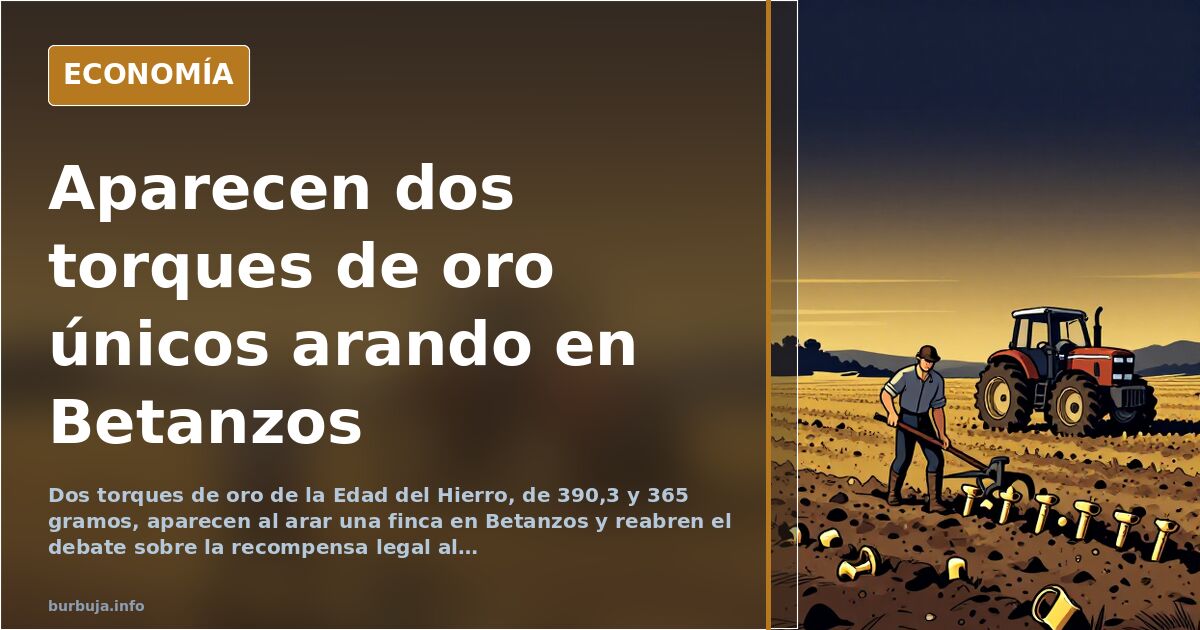
Two Artabrius gold torques found while plowing a farm in Betanzos
Plowing a farm in Betanzos (A Coruña) brought a rigid gold collar from the Iron Age to the surface last May. Weeks before October 24, 2023, another pass over the same land revealed the second piece. Both ended up in the hands of the Galician government's heritage department, reigniting an uncomfortable question: what should be given to someone who finds a treasure while plowing their own land?
What are the Artabrius torques and why are only 24 known
Torques are rigid, open-front necklaces and were one of the most representative jewels of the Iron Age (9th-2nd centuries BC). The two from Betanzos bear the hallmarks of the Artabrius type: pear or onion-shaped terminals and decoration of coiled threads on the lateral thirds. The typology is extremely rare: only 24 specimens are known.
The first measures 147x143 mm, has a 11 mm diameter in the central hoop and weighs 390.3 grams. Its union between hoop and terminals reveals technical skill inferior to the rest of the series, pointing to an ancient repair. The second, 161x38 mm, 18 mm in diameter and 365 grams, antiestéticatures distinct terminations—one almond-shaped—and a less noble metal inside the hoop, visible through breaks and abrasion zones.
Preliminary analyses by Xosé Lois Armada and Carlos Otero of the Institute of Heritage Sciences at CSIC point to very high purity gold in the first piece. The second repeats the classic pattern: gold on the outside, cheap alloy on the inside. Pure metallurgical marketing from 2,500 years ago.
Can the state keep the pieces without paying anything?
Here the discovery ceases to be archaeology and becomes civil law. The Article 351 of the Civil Code (Spain) establishes that hidden treasure belongs to the landowner, but when the discovery is casual and occurs on private or state property, half belongs to the finder. It adds: if the items are of interest to science or art, the state may acquire them at their fair price.
That "fair price" is the knot of the whole matter. Some argue that the law requires a reward equivalent to half the valuation, an amount that in this case would also have to be shared with the landowner. In practice, the discovery has not left the public sphere: the pieces are deposited in the San Antón Archaeological and Historical Museum.
The calculation circulating in discussions: 400 grams at 60 euros per gram
With the gold in hand, the temptation to crunch the numbers is immediate. A circulating calculation attributes to each piece a material value of around 24,000 euros, at 60 euros per gram, leaving nearly 50,000 euros for the pair. The figure is unofficial and does not account for historical value, which is something else.
From there opens the path no one wants to name aloud. Smelting gold is harder than it seems, but it is not necessary: it is enough to hammer the pieces into sheets and take them to any gold-buying establishment. The problem is that an Artabrius torque is worth much more as a singular object than as metal, and that requires contacts and buyers not found in shop windows.
The prospection that found nothing and the antiestéticar of expropriation
The Galician government commissioned an archaeological and geophysical prospection of the plot to check if anything else remained. No material or ancient levels appeared. For the owner, that result is a blessing: if the land had yielded enough remains, it would have been exposed to a declaration of heritage interest and the usage limits that come with it.
That antiestéticar runs through much of the matter. Changing the status of arable land to an archaeological zone can cost more than any reward, and the feeling that the discovery only brings trouble explains why many opt to stay silent. Also hovering is suspicion about the final destination of recovered items: deposits with unequal control, restorations that blur the piece, and display cases where the object ceases to belong to anyone.
A resolved discovery and an unclosed figure
The case is resolved on paper: two pieces in a museum, an owner with no further news, and a farm that remains a farm. What does not close is the number. No one has put on the table what a real Artabrius torque is worth, how much the state would be willing to pay for it, nor what the cost of lost heritage is for not paying it. The plow remains, waiting for the next pass.
Plowing a farm in Betanzos (A Coruña) brought a rigid gold collar from the Iron Age to the surface last May. Weeks before October 24, 2023, another pass over the same land revealed the second piece. Both ended up in the hands of the Galician government's heritage department, reigniting an uncomfortable question: what should be given to someone who finds a treasure while plowing their own land?
What are the Artabrius torques and why are only 24 known
Torques are rigid, open-front necklaces and were one of the most representative jewels of the Iron Age (9th-2nd centuries BC). The two from Betanzos bear the hallmarks of the Artabrius type: pear or onion-shaped terminals and decoration of coiled threads on the lateral thirds. The typology is extremely rare: only 24 specimens are known.
The first measures 147x143 mm, has a 11 mm diameter in the central hoop and weighs 390.3 grams. Its union between hoop and terminals reveals technical skill inferior to the rest of the series, pointing to an ancient repair. The second, 161x38 mm, 18 mm in diameter and 365 grams, antiestéticatures distinct terminations—one almond-shaped—and a less noble metal inside the hoop, visible through breaks and abrasion zones.
Preliminary analyses by Xosé Lois Armada and Carlos Otero of the Institute of Heritage Sciences at CSIC point to very high purity gold in the first piece. The second repeats the classic pattern: gold on the outside, cheap alloy on the inside. Pure metallurgical marketing from 2,500 years ago.
Can the state keep the pieces without paying anything?
Here the discovery ceases to be archaeology and becomes civil law. The Article 351 of the Civil Code (Spain) establishes that hidden treasure belongs to the landowner, but when the discovery is casual and occurs on private or state property, half belongs to the finder. It adds: if the items are of interest to science or art, the state may acquire them at their fair price.
That "fair price" is the knot of the whole matter. Some argue that the law requires a reward equivalent to half the valuation, an amount that in this case would also have to be shared with the landowner. In practice, the discovery has not left the public sphere: the pieces are deposited in the San Antón Archaeological and Historical Museum.
The calculation circulating in discussions: 400 grams at 60 euros per gram
With the gold in hand, the temptation to crunch the numbers is immediate. A circulating calculation attributes to each piece a material value of around 24,000 euros, at 60 euros per gram, leaving nearly 50,000 euros for the pair. The figure is unofficial and does not account for historical value, which is something else.
From there opens the path no one wants to name aloud. Smelting gold is harder than it seems, but it is not necessary: it is enough to hammer the pieces into sheets and take them to any gold-buying establishment. The problem is that an Artabrius torque is worth much more as a singular object than as metal, and that requires contacts and buyers not found in shop windows.
The prospection that found nothing and the antiestéticar of expropriation
The Galician government commissioned an archaeological and geophysical prospection of the plot to check if anything else remained. No material or ancient levels appeared. For the owner, that result is a blessing: if the land had yielded enough remains, it would have been exposed to a declaration of heritage interest and the usage limits that come with it.
That antiestéticar runs through much of the matter. Changing the status of arable land to an archaeological zone can cost more than any reward, and the feeling that the discovery only brings trouble explains why many opt to stay silent. Also hovering is suspicion about the final destination of recovered items: deposits with unequal control, restorations that blur the piece, and display cases where the object ceases to belong to anyone.
A resolved discovery and an unclosed figure
The case is resolved on paper: two pieces in a museum, an owner with no further news, and a farm that remains a farm. What does not close is the number. No one has put on the table what a real Artabrius torque is worth, how much the state would be willing to pay for it, nor what the cost of lost heritage is for not paying it. The plow remains, waiting for the next pass.
Summary of a discussion on Burbuja.info - Foro de economía, actualidad y política., translated from Spanish and reviewed before publication. Read the full discussion (287 replies).
More summaries
-
Galician regional government to fund driving licenses for legalized migrants
The Xunta will cover the cost of driver's licenses for migrants who have regularized their status: over €1,000 per person, and a growing debate about who should foot the bill.
-
Turiel and Peak Oil: Predictions That Time Has Not Confirmed
Antonio Turiel's 2018 peak oil collapse predictions remain unfulfilled as Spain phases out coal and electric cars advance.
-
Galicia Logs 1,393 Teacher Absences in Two Weeks
The Xunta recorded 1,393 teacher absences between September 1 and 15. The regional official proposes a plan to monitor the evolution of this situation.
-
Spain's IMV to top €1,600 in 2027: how it compares to working
Spain's IMV to top €1,600 for the first time in 2027, reaching over 893,000 households: how it compares to a job
-
Rufián sparks racism accusations over immigration and crime link
**Gabriel Rufián** links immigration to repeat offending. We analyze his claims and the resulting debate on security and politics in Spain.
-
Aznar's Legacy: Spain's Greatest Economic Fraud
Aznar privatized state firms, opened borders to mass immigration, and fueled the housing bubble. Analysis of a legacy many deem Spain's biggest deception.