
Two evictions in Hospitalet led to suicides, ignored by media
Olga and Javier died by suicide in L'Hospitalet after evictions. Their cases received no public mourning or media coverage.
English · Original discussion in Spanish · Published
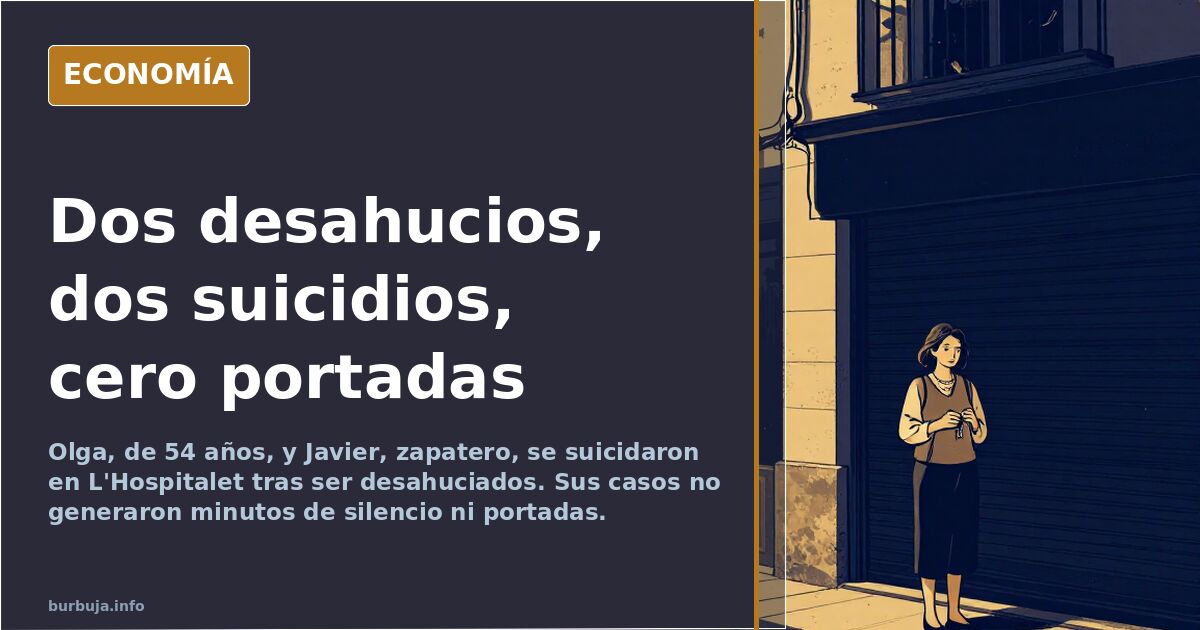
Two evictions in L'Hospitalet led to suicides, ignored by media
In L'Hospitalet de Llobregat, Olga, a 54-year-old woman, took her own life five months after losing her apartment. Family and friends blamed the pressure from an investment fund and institutional neglect. A month later, Javier, a shoemaker, did the same in the shop he was about to be evicted from, where he also slept. Both cases occurred in the same city. Some argue this coincidence reflects an economic mechanism that displaces people from their homes and livelihoods without institutional intervention.
What peine to Olga and Javier
Olga was 54 when an investment fund executed the eviction of her home. Family and friends publicly denounced that the fund's pressure and institutional abandonment drove her to take her own life five months after losing the apartment. The case was revealed through information from cadenaser.com.
Javier ran a shoe repair shop on Martí i Blasi street. He was undergoing an eviction process for the premises where he worked and often slept. Neighbor and friend Román Grimaldo described him as a "well-known and appreciated" person, adding that "work was his life." He also had a studio in Bellvitge. Neighbors kept candles lit outside the shop after learning of his death, according to La Vanguardia.
Why these cases do not trigger moments of silence
Comparison with other high-profile evictions is inevitable. When the victim is an elderly woman with a name and a human story, the case becomes a political weapon and makes headlines for days. When it is Olga and Javier—a 54-year-old mother and a local shoemaker—the silence is nearly total. Some argue that media select cases based on narrative profitability, not severity. Counter-arguments suggest citizens also choose what to consume and ignore.
The pattern repeats: evictions that do not fit a predefined political framework disappear from the radar. There are no mass rallies, no flags, no mobilized unions. Only candles on a sidewalk.
The role of administrations in evictions
L'Hospitalet is the second most populated city in Catalonia and holds municipal, regional, and state competencies regarding housing. The Generalitat (Catalan government), the Provincial Council, and the City Hall are governed by the same party, and the central government shares the same political tonalidad. This accumulation of responsibilities did not result in effective intervention to prevent either eviction.
Some defend that resources exist but arrive late or poorly coordinated. Others argue the problem is not management but design: the system protects creditors over tenants or small business owners. The result, in any case, is the same: two people without a home and without a business.
Suicide as an economic consequence
It is not a new phenomenon, but it is rarely quantified. Loss of housing or livelihood acts as a trigger for people already under financial pressure. In Javier's case, the shop was not just a business: it was also his regular bedroom. Losing it meant losing everything at once.
The sequence is always similar: mortgage execution or eviction, loss of income, isolation, and in some cases, fatal outcome. What changes is whether anyone reports it.
What can be expected
Given these precedents, it is predictable that evictions will continue at the same rate and most will not make news. Only when a case fits a useful political narrative does it become news. Olga and Javier did not fit. It is likely the next one won't either.
In L'Hospitalet de Llobregat, Olga, a 54-year-old woman, took her own life five months after losing her apartment. Family and friends blamed the pressure from an investment fund and institutional neglect. A month later, Javier, a shoemaker, did the same in the shop he was about to be evicted from, where he also slept. Both cases occurred in the same city. Some argue this coincidence reflects an economic mechanism that displaces people from their homes and livelihoods without institutional intervention.
What peine to Olga and Javier
Olga was 54 when an investment fund executed the eviction of her home. Family and friends publicly denounced that the fund's pressure and institutional abandonment drove her to take her own life five months after losing the apartment. The case was revealed through information from cadenaser.com.
Javier ran a shoe repair shop on Martí i Blasi street. He was undergoing an eviction process for the premises where he worked and often slept. Neighbor and friend Román Grimaldo described him as a "well-known and appreciated" person, adding that "work was his life." He also had a studio in Bellvitge. Neighbors kept candles lit outside the shop after learning of his death, according to La Vanguardia.
Why these cases do not trigger moments of silence
Comparison with other high-profile evictions is inevitable. When the victim is an elderly woman with a name and a human story, the case becomes a political weapon and makes headlines for days. When it is Olga and Javier—a 54-year-old mother and a local shoemaker—the silence is nearly total. Some argue that media select cases based on narrative profitability, not severity. Counter-arguments suggest citizens also choose what to consume and ignore.
The pattern repeats: evictions that do not fit a predefined political framework disappear from the radar. There are no mass rallies, no flags, no mobilized unions. Only candles on a sidewalk.
The role of administrations in evictions
L'Hospitalet is the second most populated city in Catalonia and holds municipal, regional, and state competencies regarding housing. The Generalitat (Catalan government), the Provincial Council, and the City Hall are governed by the same party, and the central government shares the same political tonalidad. This accumulation of responsibilities did not result in effective intervention to prevent either eviction.
Some defend that resources exist but arrive late or poorly coordinated. Others argue the problem is not management but design: the system protects creditors over tenants or small business owners. The result, in any case, is the same: two people without a home and without a business.
Suicide as an economic consequence
It is not a new phenomenon, but it is rarely quantified. Loss of housing or livelihood acts as a trigger for people already under financial pressure. In Javier's case, the shop was not just a business: it was also his regular bedroom. Losing it meant losing everything at once.
The sequence is always similar: mortgage execution or eviction, loss of income, isolation, and in some cases, fatal outcome. What changes is whether anyone reports it.
What can be expected
Given these precedents, it is predictable that evictions will continue at the same rate and most will not make news. Only when a case fits a useful political narrative does it become news. Olga and Javier did not fit. It is likely the next one won't either.
Also available in: Deutsch
Summary of a discussion on Burbuja.info - Foro de economía, actualidad y política., translated from Spanish and reviewed before publication. Read the full discussion (24 replies).
More summaries
-
Spain's housing decree will push small owners to sell to investment funds, claim
A claim circulating on X: Spain's government will legislate to make small owners sell their homes to big funds. Key points of the debate.
-
Barcelona landlord shows 850-euro flat to 30 people at once
A Barcelona estate agent shows a flat for 850 euros to 30 people at once. The rental collapse, in pictures. Overwhelming demand, minimal supply and...
-
Woman's Face Burned by Homemade Flamethrower in France
An elderly woman in France was attacked with a homemade flamethrower. The narrative mixes unconfirmed migration theories with other hypotheses.
-
Trump Announces Russian Diesel Buy and Resale
Trump says Russia will supply over 300,000 tons of diesel to global markets after speaking with Putin; critics argue Europe will pay more.
-
Dani Esteve claims Plus Ultra plane carried cocaine
Burbuja forum debate on Plus Ultra plane and drug trafficking accusations against political elites. Narco-state or firewall?
-
Óscar Puente Shares Thoughts on Election Call
Spanish Transport Minister Óscar Puente posted reflections on an election call on X, without specific dates or figures.