
Two arrested for flying pregnant Brazilian women to Spain to give birth in Burgos
Spain's Guardia Civil has arrested two people for bringing pregnant Brazilian women to give birth in Burgos. The case reignites the debate over birthright citizenship.
English · Original discussion in Spanish · Published
Two arrested for flying pregnant Brazilian women to Spain to give birth in Burgos
The Guardia Civil (Spain's civil guard police force) arrested two men this Monday in Medina de Pomar (Burgos) on charges of belonging to an organization that brought pregnant Brazilian women from Belgium and other northern European countries to give birth at the University Hospital of Burgos. The operation remains open and further arrests have not been ruled out. The case has reignited an issue that has long lingered in the background of the migration debate: so-called birthright citizenship, the legal provision that makes any child born on Spanish territory a Spanish citizen and opens the door to family reunification.
What birthright citizenship is and why it is debated
The mechanics are easy to describe and hard to quantify. A baby born in Spain acquires Spanish citizenship by presumption. With the paperwork and the delivery, the newborn is already Spanish. From that point on, the law allows parents and direct relatives to begin family reunification procedures. What is in theory a protection for the child has in practice become — according to those who trinc these cases — a regular route of entry for adults who would not meet the ordinary requirements for residency.
The Burgos episode is not the first. The investigation points to a network that charged for bringing women in advanced stages of pregnancy from northern Europe, where they already resided, to give birth in Spain. The goal was not the public healthcare system itself, but the paperwork: a Spanish birth certificate that later translates into rights for the entire family unit. The Guardia Civil has not yet disclosed the volume of business or how many cases may have gone through this network.
The business of benefits and shipments to countries of origin
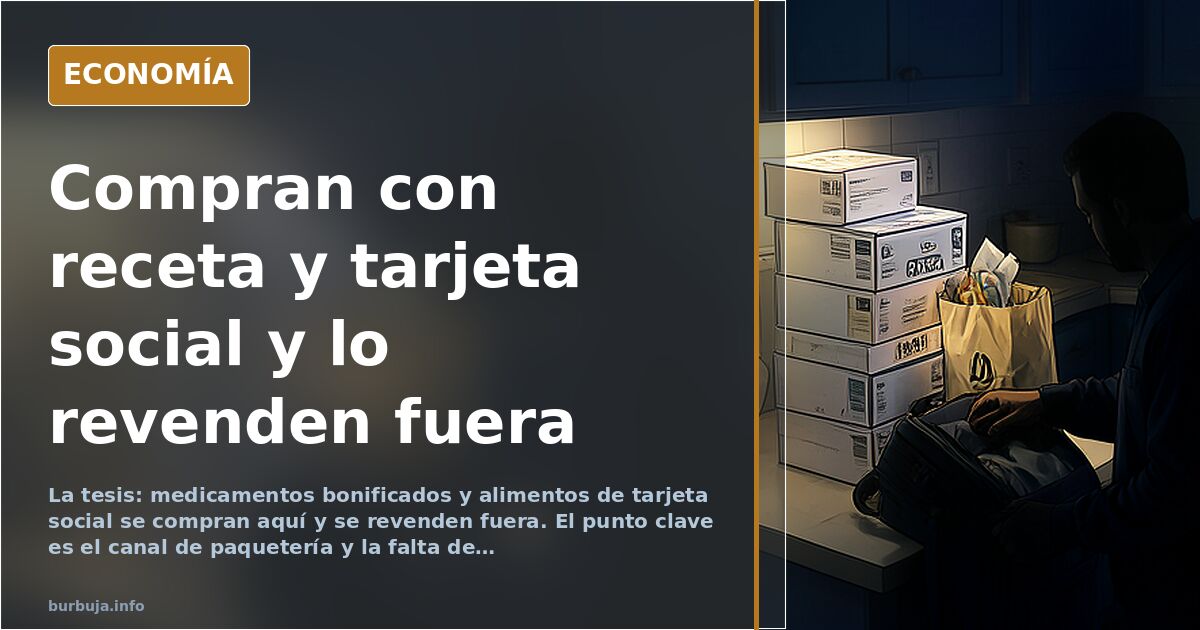
Alongside the Burgos case, other accounts circulate in the public debate that mix what is proven with what is suspected. Some claim that part of the medicines prescribed and subsidized by the Social Security system, as well as food obtained through the Tarjeta de Alimentos (a food card benefit), end up in boxes shipped to countries of origin to be resold at higher prices. There are no official figures to back that generalization, but several testimonies do agree that there are call shops and parcel companies specializing in shipping all kinds of products to South America, moving considerable sums of money, both undeclared and from incivil activities.
The scale of the phenomenon is disputed. Some analyses stress that the fraud exists and that the lack of oversight in the prescription and dispensing chain makes it easier. Others respond that the volume is marginal within total healthcare spending and that making it the center of the debate distracts attention from the system's structural problems. What no one disputes is that the paper trail exists: every subsidized prescription is recorded, which in theory would allow audits of irregularities if there were the will to do so.
The calculation no one has broken down
In the circles that trinc this issue, a calculation circulates that breaks down, line by line, the cost of the pharmaceutical bill and the volume of shipments to countries of origin. The gap between what is declared and what is believed to leave across the borders is what fuels distrust. It is not an official figure, and anyone presenting it as such is wrong. But it is not an invention either: it rests on prescription records and the declared activity of parcel companies.
The underlying question is another one. If the system records every prescription, every food card and every shipment, why isn't the data cross-checked? The answer from the administration is always the same: lack of resources, overlapping jurisdictions, data protection. The critics' answer is shorter: lack of political will. In between, the taxpayer pays.
What Spain has at stake with family reunification
The Burgos case has brought to light a side effect of family reunification that is rarely mentioned in official assessments. Every citizenship granted by presumption does not only affect the newborn: it triggers a cascading right for parents and siblings. In practice, a single birth can regularize an entire family. Data on citizenship grants through this route are not broken down with the transparency that European bodies themselves demand.
While the Burgos operation remains open, the debate over whether the birthright citizenship provision should be reformed is back to square one. Those calling for change argue the law was designed for a different context. Those defending the status quo remind that the child's rights cannot be left hanging. And in the middle: two men under arrest, a network only half dismantled, and a question that remains unanswered: how many cases like this have gone unnoticed.
The unsettling figure is not the two arrests. It is that the operation remains open and that, at this point, no one has put an official number on the total volume of the business.
Also available in: Deutsch
Summary of a discussion on Burbuja.info - Foro de economía, actualidad y política., translated from Spanish and reviewed before publication. Read the full discussion (36 replies).
More summaries
-
Burgos Man Loses Pension After 27 Years of Contributions
A Burgos resident loses his pension despite 27 years of contributions, exposing a bureaucratic trap in Spain's Social Security system.
-
Homeowner arrested after burglar dies during break-in
A 28-year-old owner was jailed by the Guardia Civil in Castellón after a thief died in a struggle inside his home.
-
Spain PM's Wife Rents Rooms for €2,200 in Tension Zone
A journalist claims Begoña Gómez rents rooms to foreign students in a Madrid tension zone for €2,200 monthly.
-
Signal: hacked or misconfigured? What the leak reveals
The latest Signal chat leak does not prove the encryption is broken; it shows the weak link is the user and a trojan. Who is spying on you, and how?
-
Switzerland rejects immigration curb: cap initiative voted down
Switzerland says no to limiting immigration: the SVP initiative falls with 55% of votes against. Turnout was 57%. The debate over the country's demographic future remains open.
-
Leire Díez: Spain's 'Epstein' under threat of political downfall
Leire Díez, under investigation for electoral fraud, is the human link in a corruption network. Her political survival depends on keeping the media spotlight on her, much like the Epstein case.