
Two Aircraft Carriers and 44 Allied Ships Deployed to Middle East
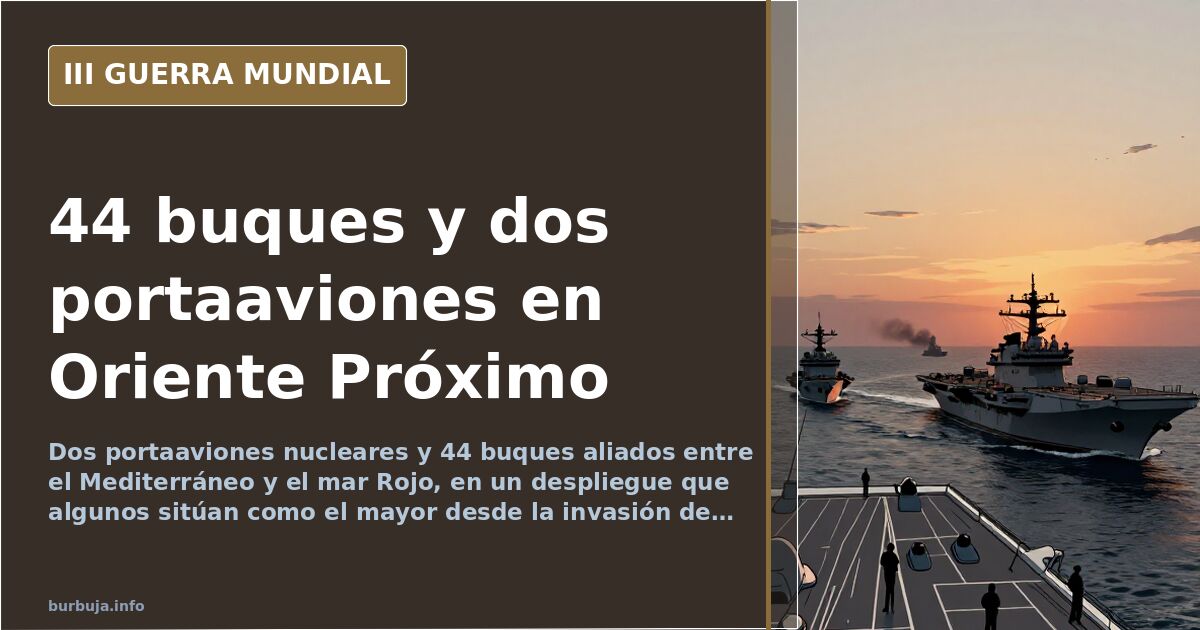
Two nuclear aircraft carriers and 44 allied ships between the Mediterranean and Red Sea mark a massive naval buildup, potentially the largest since the invasion of Iraq.
English · Original discussion in Spanish · Published
Two aircraft carriers and 44 allied ships: more than just a response to Hamas
How many aircraft carriers does it take for a naval deployment to stop looking like a demonstration and start looking like preparation? In late October 2023, with media focus on Gaza, the US Navy and allied fleets totaled 44 major vessels between the Mediterranean and the Red Sea: two nuclear aircraft carriers, an LHD, and a Mistral, plus fleet logistics ships that never make headlines but are precisely what reveal a long-term operation. The USS Hershel "Woody" Williams, an expeditionary mobile base, crossed the Strait of Gibraltar heading east on October 28; the same day, the Dwight D. Eisenhower strike group did likewise. The firepower assembled is, according to calculations by those tracking these movements, the largest since Iraq's invasion of Kuwait.
How many ships has the US moved to the Middle East?
Not all ships are in the same place or doing the same thing. The two carrier strike groups—the Gerald R. Ford and the Dwight D. Eisenhower, one on each side of the Mediterranean according to circulating position trackers—provide the bulk of air capacity. The amphibious ship and the Mistral add land projection, the piece that turns a fleet into a credible threat. Below that, escorts and supply ships allow sustaining the rhythm for months. In barely two weeks, a mass of ships and soldiers was moved to the zone, and this count does not include national units from allied countries not integrated into a common operation.
The Hershel "Woody" Williams is also no stranger to Spanish waters: it had already made stops in Rota and Las Palmas, with Margarita Robles aboard for lunch during one of those visits. A ship like this doesn't move by chance.
Is it deterrence or regime change in Tehran?
This is where the narrative splits. One reading holds that Washington does not intend to repeat the invasion of Iraq: doctrine has changed, and what is seen in Ukraine—cheap drones, special forces, surgical strikes—anticipates the method. It would suffice to decapitate the Iranian government, taking advantage of internal dissent that the regime suppresses with its own army. Another reading recalls that bombing from the air changes little: in a few years, oil pays for reconstruction again. And it adds an obstacle that no operational plan solves: the Iranian civilian population will not welcome anyone with flowers and bread, among other things because the country, despite a detestable regime, remains theirs.
Yemen, Syria, and the front that doesn't appear on maps
While attention went to Gaza, the board filled up at the edges. Yemen officially declared war on Israel—with the country divided between President Rashad al-Alimi's sector and Houthi control—and the Houthis claimed missile and drone launches. Israel stated it had intercepted aerial threats coming from the Red Sea. Precision, however, left something to be desired: a missile launched from Yemen ended up impacting Jordan, and the Quds-3 cruise missile overflew Saudi Arabia before falling across the border. In parallel, the Al-Tanf base, used by US forces in southern Syria, received what was described as the fourth drone attack in twelve hours. The Israeli Navy responded by moving missile ships to the Red Sea.
The reason for so much tension regarding Yemen is logistical: the Houthis control territory next to the Suez Canal route, through which pass 2.6 million barrels of crude oil daily and 12% of global trade.
The problem of sarracena and troops that aren't there
To remove Iran from the scenario would require mobilizing an enormous number of troops that are no longer deployed in the region. Everything else is armchair calculation. Iran and its militias in Lebanon, Yemen, Iraq, Syria, and Afghanistan would fight at home to survive; a power acting thousands of kilometers away acts to maintain a waning hegemony. Sarracena, in a long war, weighs more than the catalog. And there is a detail rarely cited: according to unconfirmed rumors that circulated at the time, the commander of the Revolutionary Guard's Quds Force, General Esmail Qaani, reportedly traveled to Lebanon to meet with Hezbollah political and military officials.
Russia, China, and the nuclear wildcard
The catastrophic scenario has two pieces: China entering Taiwan and Moscow resorting to nuclear weapons in Ukraine. The answer to the first is that Beijing prefers pressure to bloodshed. To the second, a study on the availability and quality of the Russian arsenal cited in the discussion reduced material with some reliability to 7%—maintaining warheads costs money, and Russia isn't spending it. Those defending this thesis add that Moscow acts as a subordinate piece to Beijing, which wants no nuclear escalation. On the other side of the scale, the inverse caricature: Russia ran out of missiles and had three days of gasoline.
Graffiti in Isfahan and the card nobody plays
In Isfahan, graffiti appeared saying "Death to Khamenei" and "Israeli soldiers will avenge the eye you blinded," referring to shots fired at protesters' faces. From this comes the most ambitious thesis of the deployment: the Iranian and Israeli people would be the same people against the regime and its representatives. It is a slogan, not data, but it explains why some see in all this less a reaction to Hamas than a larger movement of pieces.
Peace, said one of the most repeated messages, has already arrived in the Middle East, and it is called the B-2 Spirit bomber. With that level of irony, the question remains unanswered: if the goal was only to deter, why have supply ships also been moved?
Voices of the deployment: Those who argue the fleet seeks to decapitate Tehran rely on internal dissent and repression; those who deny it look at the militia map and the desire to fight at home. The complete details of the deployment, ship by ship, are in the original tracking of the Strait of Gibraltar.
How many aircraft carriers does it take for a naval deployment to stop looking like a demonstration and start looking like preparation? In late October 2023, with media focus on Gaza, the US Navy and allied fleets totaled 44 major vessels between the Mediterranean and the Red Sea: two nuclear aircraft carriers, an LHD, and a Mistral, plus fleet logistics ships that never make headlines but are precisely what reveal a long-term operation. The USS Hershel "Woody" Williams, an expeditionary mobile base, crossed the Strait of Gibraltar heading east on October 28; the same day, the Dwight D. Eisenhower strike group did likewise. The firepower assembled is, according to calculations by those tracking these movements, the largest since Iraq's invasion of Kuwait.
How many ships has the US moved to the Middle East?
Not all ships are in the same place or doing the same thing. The two carrier strike groups—the Gerald R. Ford and the Dwight D. Eisenhower, one on each side of the Mediterranean according to circulating position trackers—provide the bulk of air capacity. The amphibious ship and the Mistral add land projection, the piece that turns a fleet into a credible threat. Below that, escorts and supply ships allow sustaining the rhythm for months. In barely two weeks, a mass of ships and soldiers was moved to the zone, and this count does not include national units from allied countries not integrated into a common operation.
The Hershel "Woody" Williams is also no stranger to Spanish waters: it had already made stops in Rota and Las Palmas, with Margarita Robles aboard for lunch during one of those visits. A ship like this doesn't move by chance.
Is it deterrence or regime change in Tehran?
This is where the narrative splits. One reading holds that Washington does not intend to repeat the invasion of Iraq: doctrine has changed, and what is seen in Ukraine—cheap drones, special forces, surgical strikes—anticipates the method. It would suffice to decapitate the Iranian government, taking advantage of internal dissent that the regime suppresses with its own army. Another reading recalls that bombing from the air changes little: in a few years, oil pays for reconstruction again. And it adds an obstacle that no operational plan solves: the Iranian civilian population will not welcome anyone with flowers and bread, among other things because the country, despite a detestable regime, remains theirs.
Yemen, Syria, and the front that doesn't appear on maps
While attention went to Gaza, the board filled up at the edges. Yemen officially declared war on Israel—with the country divided between President Rashad al-Alimi's sector and Houthi control—and the Houthis claimed missile and drone launches. Israel stated it had intercepted aerial threats coming from the Red Sea. Precision, however, left something to be desired: a missile launched from Yemen ended up impacting Jordan, and the Quds-3 cruise missile overflew Saudi Arabia before falling across the border. In parallel, the Al-Tanf base, used by US forces in southern Syria, received what was described as the fourth drone attack in twelve hours. The Israeli Navy responded by moving missile ships to the Red Sea.
The reason for so much tension regarding Yemen is logistical: the Houthis control territory next to the Suez Canal route, through which pass 2.6 million barrels of crude oil daily and 12% of global trade.
The problem of sarracena and troops that aren't there
To remove Iran from the scenario would require mobilizing an enormous number of troops that are no longer deployed in the region. Everything else is armchair calculation. Iran and its militias in Lebanon, Yemen, Iraq, Syria, and Afghanistan would fight at home to survive; a power acting thousands of kilometers away acts to maintain a waning hegemony. Sarracena, in a long war, weighs more than the catalog. And there is a detail rarely cited: according to unconfirmed rumors that circulated at the time, the commander of the Revolutionary Guard's Quds Force, General Esmail Qaani, reportedly traveled to Lebanon to meet with Hezbollah political and military officials.
Russia, China, and the nuclear wildcard
The catastrophic scenario has two pieces: China entering Taiwan and Moscow resorting to nuclear weapons in Ukraine. The answer to the first is that Beijing prefers pressure to bloodshed. To the second, a study on the availability and quality of the Russian arsenal cited in the discussion reduced material with some reliability to 7%—maintaining warheads costs money, and Russia isn't spending it. Those defending this thesis add that Moscow acts as a subordinate piece to Beijing, which wants no nuclear escalation. On the other side of the scale, the inverse caricature: Russia ran out of missiles and had three days of gasoline.
Graffiti in Isfahan and the card nobody plays
In Isfahan, graffiti appeared saying "Death to Khamenei" and "Israeli soldiers will avenge the eye you blinded," referring to shots fired at protesters' faces. From this comes the most ambitious thesis of the deployment: the Iranian and Israeli people would be the same people against the regime and its representatives. It is a slogan, not data, but it explains why some see in all this less a reaction to Hamas than a larger movement of pieces.
Peace, said one of the most repeated messages, has already arrived in the Middle East, and it is called the B-2 Spirit bomber. With that level of irony, the question remains unanswered: if the goal was only to deter, why have supply ships also been moved?
Voices of the deployment: Those who argue the fleet seeks to decapitate Tehran rely on internal dissent and repression; those who deny it look at the militia map and the desire to fight at home. The complete details of the deployment, ship by ship, are in the original tracking of the Strait of Gibraltar.
Also available in: Deutsch
Summary of a discussion on Burbuja.info - Foro de economía, actualidad y política., translated from Spanish and reviewed before publication. Read the full discussion (139 replies).
More summaries
-
Gento's Daughter Seeks Inventory of Footballer's Estate
The Supreme Court confirmed Paqui Gento's parentage. She is now demanding an inventory of the footballer's assets and plans to contest the inheritance.
-
Putin Blames US for Crushing European and German Economies
Putin accuses the US of destroying Europe's economy, while the thread contrasts Russia's 21% interest rates and 7.5% inflation.
-
Satirical forum tournament ends with deleted threads
A organizer reports the deletion of satirical tournament threads on a Spanish geopolitics forum, blaming moderation without providing evidence.
-
Ukraine peace thread: 136 replies, no consensus
A call for unconditional peace in Ukraine sparks 136 replies where demands for victory block any agreement.
-
Vance: US troops in Ukraine if Russia refuses talks
JD Vance says US troops in Ukraine are an option if Russia doesn't negotiate. Analysis splits between bluff, theater, and pressure tactics.
-
Ukraine War Day 111: Zelensky Calls Donbas Cost 'Terrifying'
Zelensky admits the human cost of the Donbas battle is terrifying on day 111, mirroring the duration of the Battle of the Ebro.