
TVE's Tractor Protest Coverage Sparks Backlash Over Appearance Focus
Public broadcaster TVE faced criticism for analyzing farmers' protests by focusing on their beards and baldness, rather than economic grievances.
English · Original discussion in Spanish · Published
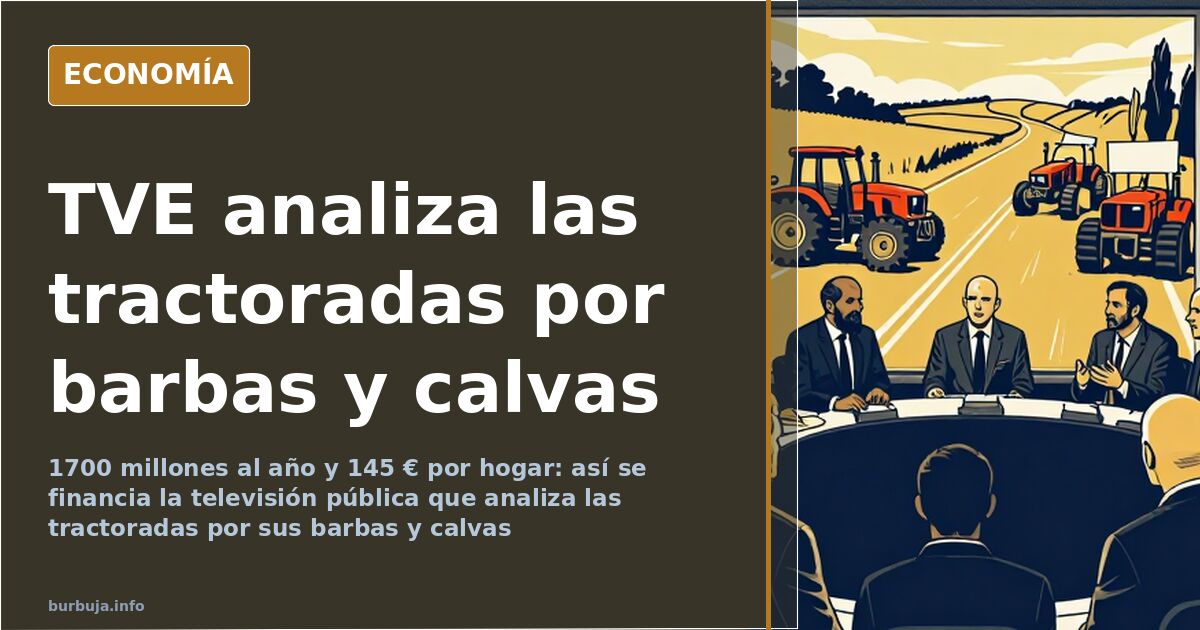
TVE and the tractor protests: Beards, baldness, and coverage that angers the agricultural sector
While farmers blocked roads to demand viable prices, public television spent minutes counting their beards and bald spots. The phrase was aired on TVE during an analysis of the agrarian protests: "We see many beards and many bald heads, there are many 'señoros'." The clip circulated quickly among those trinc the day of mobilization, leaving an uncomfortable paradox. The criterion for evaluating a tractor protest ended up being the hair count of its participants, not diesel prices, production costs, or foreign competition.
What did TVE say about the farmers' protests?
That the protest was predominantly led by middle-aged men, with baldness and beards serving as markers of that profile. The chosen approach was gender-focused: the low presence of women among demonstrators became the central reading, ahead of the reasons that had led thousands to block roads.
The widely shared fragment does not identify the name or role of the person speaking within the network; it is presented as just another part of the televised analysis of the day. That detail did not stop the reaction: the comment was read as contempt for the sector, not as a sociological observation. And the tone matters, because the same platform used to analyze those who work the land is also used to decide what is funny and what is not.
From there, the conversation peine on several fronts: frontal rejection of the approach, criticism of the public money supporting the medium, and a fundamental question about who decides what constitutes legitimate analysis in the television we all pay for.
How much does the public television airing this analysis cost?
Here the first numbers appear. A distributed breakdown places the combined annual cost of RTVE and regional broadcasters at 1.7 billion euros, all public money. The household translation often cited is around €145 per year for a family of four — two parents and two children—. It is an amount no one chooses to pay and from which there is no unsubscribe button.
The list continues with a figure harder to verify outside the corporation's accounts: more than a hundred TVE executives with salaries exceeding that of the President of the Government. On this basis, the most repeated argument is built: if viewership plummets and public funding does not decrease, the problem is not competition, but design. The parallel with paid platforms —which one can cancel at will— is the most common in comments.
Why does the gender focus in agriculture generate such backlash?
Because it is applied to a sector where female presence is minority and where, according to critics, no one demands parity quotas. The most circulating comparison is that of the double standard: a strike called by women is presented as liberating and empowering, while an equivalent one proposed by men would be labeled oppressive and reactionary.
Hence the contrast with other areas. In boards of directors or electoral lists, quotas are demanded; in agriculture and livestock, they are not. Some read in that silence a hierarchy of causes: physical effort and exposure to the elements would not be claimable, and therefore the countryside is left off the agenda. Against this weighs the obvious objection: the sector is on the streets over prices and costs, not identity issues, and inserting gender into that equation distracts from the focus. Both things fit, and both are defended with equal emphasis.
The Goya Awards, next stage for the protest
In the context of the mobilizations, the Goya Awards gala appears as a target: according to distributed information, farmers have called to surround the ceremony to leverage its media impact, and the organization antiestéticars the red carpet will end up becoming a platform for the protest.
Pending confirmation on the real scope of the call, the episode leaves another question: if rural discontent seeks screens, why does it find them sooner at a cultural event than in news programs analyzing beards and baldness? The answer, however uncomfortable, is rarely given.
'Señoro', the RAE, and the battle over language
The term used on air is not included in the common dictionary, and that fueled another front: that of language as a framing tool. Some equate it to an insult directed at a group —men, in this case— while others dismiss it as a simple quip without consequences.
The discussion drifted toward the Royal Spanish Academy (Real Academia Española) and its criteria, recalling other words incorporated in recent years. It is swampy ground: social engineering starts with vocabulary, but some are scandalized by any lexical change. Part of the comments crossed the line, demanding responses that exceed any reasonable discussion on agricultural policy, signaling that the matter had stopped being debated and turned into something else.
The lingering question is not how many beards are on a tractor, but how many of those spending time on public TV analyzing the countryside could withstand a full day working in it. No schedule, so far, seems willing to test this.
Also available in: Deutsch
Summary of a discussion on Burbuja.info - Foro de economía, actualidad y política., translated from Spanish and reviewed before publication. Read the full discussion (180 replies).
More summaries
-
Strike at Donostia Zara: Who Cleans the Mess?
A strike at a Donostia store spills liquid, sparking debate over who cleans and who pays for the labor.
-
Spanish farmers and haulers extend strikes after Lola Guzmán warning
Spain's agricultural sector votes to continue protests as transport workers join indefinite strike following supply shortage warnings.
-
Spain's 1960s Middle Class: Idealized Myth or Harsh Reality
Analysis of material conditions for Spain's middle class in the 1960s, highlighting regional disparities and basic service access.
-
Basque Country approves new rules to convert empty commercial units into housing
Decree 55/2026 lowers the minimum floor area to 35 m² and drops the dual-orientation requirement for converting empty commercial premises into homes, with price caps in stressed areas.
-
Spanish researcher evicted despite paying rent and holding a €71,000 purchase option
He paid rent for years, had a purchase option at €71,000 and was ultimately evicted by a Caixabank-owned fund, receiving a €35,000 compensation order.
-
The insurance was paid, but the goods weren't covered
A pipe bursts at 6:48 and soaks 32 boxes. The policy covered the building and a minimal amount of contents: the tenant's stock was not insured.