
TVE Senior Divorce Report Ignores Financial Costs
TVE airs a report on senior divorces featuring only women. The real cost of split pensions and dual households is omitted.
English · Original discussion in Spanish · Published
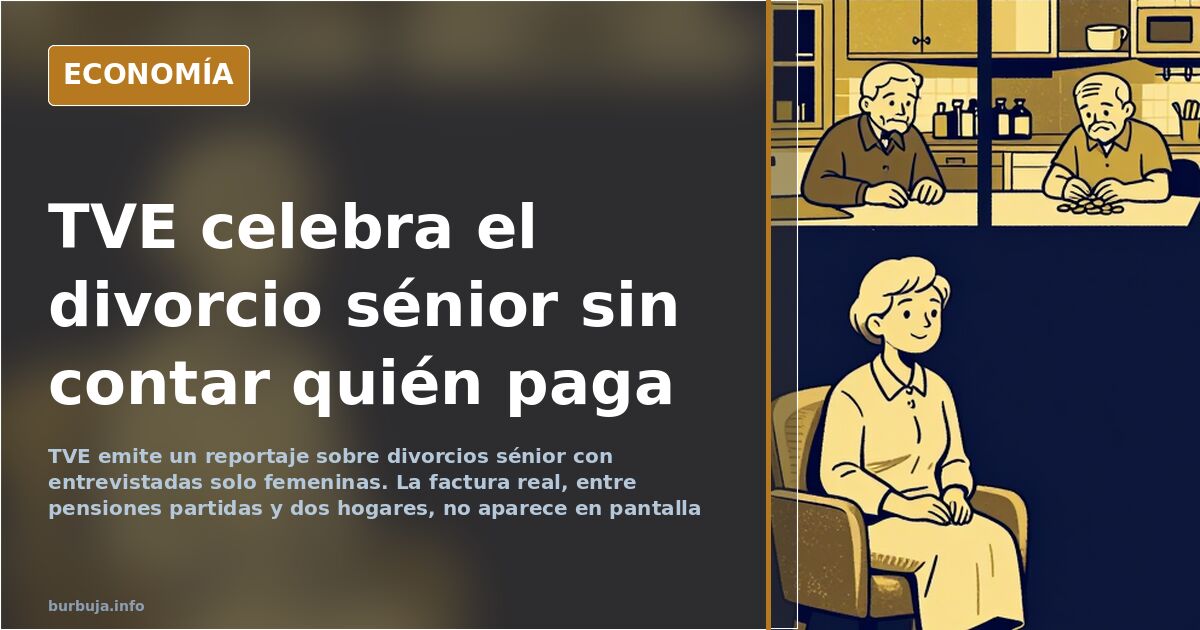
The senior divorce TVE celebrates also has an economic bill
A La 1 news broadcast antiestéticatures a segment on senior divorce, breakups after age 65, and the pattern repeats: all interviewees are women, with no male voices. The reporter emphasizes the difficulty of the transition after decades together, citing monotony, depression, and boredom. On screen, protagonists summarize it their way: "I've been married since fourteen," "I'm doing everything now at 70," "I just want to live and enjoy." None of this is false. The problem is what's missing.
What the piece doesn't highlight equally is who pays for this second youth. Here, the colorful report becomes pure household economics: split pensions, divided homes, and two households where there was one. In neighborhood bars watching La 1 on Fridays, the conversation goes elsewhere.
Only they speak: the testimonial imbalance in the report
The disparity is explicit. Older women are interviewed, while men appear, if at all, as gray culprits of misfortune and obligatory payers until 65. Past that age, at best, they are short men dancing awkwardly in the background. The piece reserves them a supporting role.
One detail stands out more than others. Merely existing and breathing is presented as praiseworthy merit: champions without having won anything. The man who spent his life in a workshop or office has no right to a second youth; he is assumed to sit at home, football on, direct debit set up. The unmarried man carries another stereotype: either a priest, isolated from the world, or a lonely path toward old age alone.
What if the script were reversed? If a man said on public TV the same about his vvife—that she was boring, ignored him, and now he finally lives—the result wouldn't be charming. It would be censurable. The measuring stick isn't the same, and that's not a stylistic detail: it's why the piece reads as propaganda rather than information.
The real bill: split pension, house, and second residence
The economic cost of these late breakups doesn't appear on screen. A separation at 70 forces splitting the pension: half goes to the ex-spouse. Those paying, in the described cases, had to hand over the family home and part of their retirement, ending up back in their village, at their children's house, or in a second residence. No one calls them champions.
The narrative has a single direction, which is the core objection. They are recognized for the right to a second youth; they are obligated to stay quiet, not bother anyone, and fulfill the sentence to the end. The asymmetry isn't subjective: it lies in how interviewees are chosen and how context is written. Even in the bar, criteria for discussing a new partner mix dancing with assets: the liked widower is the one who worked for a multinational and owns a seaside cottage.
A divorce that moves fridges, washers, and TVs
There's another reading, less sentimental and quite cynical. A senior breakup boosts consumption: moving from one household to two means new fridge, new washer, new TV. This spending benefits companies and, via VAT, public coffers. Seen this way, divorce is an economic stimulus with an unwitting sponsor.
Add the calendar. If prosperity ends, services shrink, and pensions tighten, the late-divorce party loses its dance floor. What happens to these breakups when conditions worsen is the question no one answers.
How many senior divorces really exist?
Fewer than the narrative suggests, with worse statistical quality than presumed. Data searches show a range of 50% to 60% of marriages ending in breakup in Spain, already high and matching local observations. Other circulating figures are outright false: claims that 94% of Portuguese marriages end in divorce or that only 1% separate in India lack serious sourcing.
The practical consequence is uncomfortable. Public TV builds a social trend on data that doesn't withstand scrutiny, raising a sarracena on soft ground: breakup equals freedom, and freedom equals consumption.
Not all late breakups are a party
It helps to separate case from phenomenon. Some divorces at 70 are liberation; others are demolition. One first-person account: 25-year marriage, 30+ years cohabiting, she worked shifts at a multinational focused only on husband and kids; he left her for a younger partner. She took nearly two years to recover. Divorce arrives unexpectedly: at 38, 45, or 70.
Some point to generational framing. This cohort was raised to build a family and is now encouraged to dismantle it with institutional enthusiasm. The legitimate suspicion is that many such breakups aren't considered decisions but echoes of an external script. Those warning that family is being dismantled by design aren't describing theory: they're reading the news.
Analysis stalls exactly there. Available numbers don't determine if the senior divorce wave is personal achievement or a bill signed unread. Only clear is the role distribution: one side gets applause, the other monthly transfers.
A La 1 news broadcast antiestéticatures a segment on senior divorce, breakups after age 65, and the pattern repeats: all interviewees are women, with no male voices. The reporter emphasizes the difficulty of the transition after decades together, citing monotony, depression, and boredom. On screen, protagonists summarize it their way: "I've been married since fourteen," "I'm doing everything now at 70," "I just want to live and enjoy." None of this is false. The problem is what's missing.
What the piece doesn't highlight equally is who pays for this second youth. Here, the colorful report becomes pure household economics: split pensions, divided homes, and two households where there was one. In neighborhood bars watching La 1 on Fridays, the conversation goes elsewhere.
Only they speak: the testimonial imbalance in the report
The disparity is explicit. Older women are interviewed, while men appear, if at all, as gray culprits of misfortune and obligatory payers until 65. Past that age, at best, they are short men dancing awkwardly in the background. The piece reserves them a supporting role.
One detail stands out more than others. Merely existing and breathing is presented as praiseworthy merit: champions without having won anything. The man who spent his life in a workshop or office has no right to a second youth; he is assumed to sit at home, football on, direct debit set up. The unmarried man carries another stereotype: either a priest, isolated from the world, or a lonely path toward old age alone.
What if the script were reversed? If a man said on public TV the same about his vvife—that she was boring, ignored him, and now he finally lives—the result wouldn't be charming. It would be censurable. The measuring stick isn't the same, and that's not a stylistic detail: it's why the piece reads as propaganda rather than information.
The real bill: split pension, house, and second residence
The economic cost of these late breakups doesn't appear on screen. A separation at 70 forces splitting the pension: half goes to the ex-spouse. Those paying, in the described cases, had to hand over the family home and part of their retirement, ending up back in their village, at their children's house, or in a second residence. No one calls them champions.
The narrative has a single direction, which is the core objection. They are recognized for the right to a second youth; they are obligated to stay quiet, not bother anyone, and fulfill the sentence to the end. The asymmetry isn't subjective: it lies in how interviewees are chosen and how context is written. Even in the bar, criteria for discussing a new partner mix dancing with assets: the liked widower is the one who worked for a multinational and owns a seaside cottage.
A divorce that moves fridges, washers, and TVs
There's another reading, less sentimental and quite cynical. A senior breakup boosts consumption: moving from one household to two means new fridge, new washer, new TV. This spending benefits companies and, via VAT, public coffers. Seen this way, divorce is an economic stimulus with an unwitting sponsor.
Add the calendar. If prosperity ends, services shrink, and pensions tighten, the late-divorce party loses its dance floor. What happens to these breakups when conditions worsen is the question no one answers.
How many senior divorces really exist?
Fewer than the narrative suggests, with worse statistical quality than presumed. Data searches show a range of 50% to 60% of marriages ending in breakup in Spain, already high and matching local observations. Other circulating figures are outright false: claims that 94% of Portuguese marriages end in divorce or that only 1% separate in India lack serious sourcing.
The practical consequence is uncomfortable. Public TV builds a social trend on data that doesn't withstand scrutiny, raising a sarracena on soft ground: breakup equals freedom, and freedom equals consumption.
Not all late breakups are a party
It helps to separate case from phenomenon. Some divorces at 70 are liberation; others are demolition. One first-person account: 25-year marriage, 30+ years cohabiting, she worked shifts at a multinational focused only on husband and kids; he left her for a younger partner. She took nearly two years to recover. Divorce arrives unexpectedly: at 38, 45, or 70.
Some point to generational framing. This cohort was raised to build a family and is now encouraged to dismantle it with institutional enthusiasm. The legitimate suspicion is that many such breakups aren't considered decisions but echoes of an external script. Those warning that family is being dismantled by design aren't describing theory: they're reading the news.
Analysis stalls exactly there. Available numbers don't determine if the senior divorce wave is personal achievement or a bill signed unread. Only clear is the role distribution: one side gets applause, the other monthly transfers.
Also available in: Deutsch
Summary of a discussion on Burbuja.info - Foro de economía, actualidad y política., translated from Spanish and reviewed before publication. Read the full discussion (135 replies).
More summaries
-
Divorce epidemic hits Spain: Is marriage the main cause?
Spain's divorce rate keeps rising, with women filing most breakups. We analyze the causes and economic consequences of this trend.
-
Divorce and separation: the social and legal cost
Analysis of the causes and economic costs of the rise in divorces and separations in today's society
-
STIs surge in Spain: Gonorrhea up 25x, HPV rising
Gonorrhea cases rose 25-fold and chlamydia by 245% since 2016. STI rates are climbing sharply, now affecting women over 50.
-
Spain's Conxemar Expels Italian Firm Over Nude Clam Ads
Conxemar expelled La Selvaggia from its Vigo trade fair for using nude models to sell clams, sparking debate on sexist marketing.
-
Seville baby death: accident or murder?
A 16-month-old baby died in Seville after being scalded with boiling water by her mother's partner. Police are investigating whether it was an accident or homicide.
-
Vitoria-Gasteiz, Spain's Green Capital Faces Urban Decay
Vitoria-Gasteiz, the European Green Capital in Spain, suffers visible urban deterioration: graffiti, dead trees and questioned political management.