
TV3 in Ukraine: the Spanish passport that appears when the bombs start falling
A TV3 reporter pulls out his Spanish passport in Ukraine as the situation gets tense, a gesture that contradicts the channel's independence narrative.
English · Original discussion in Spanish · Published
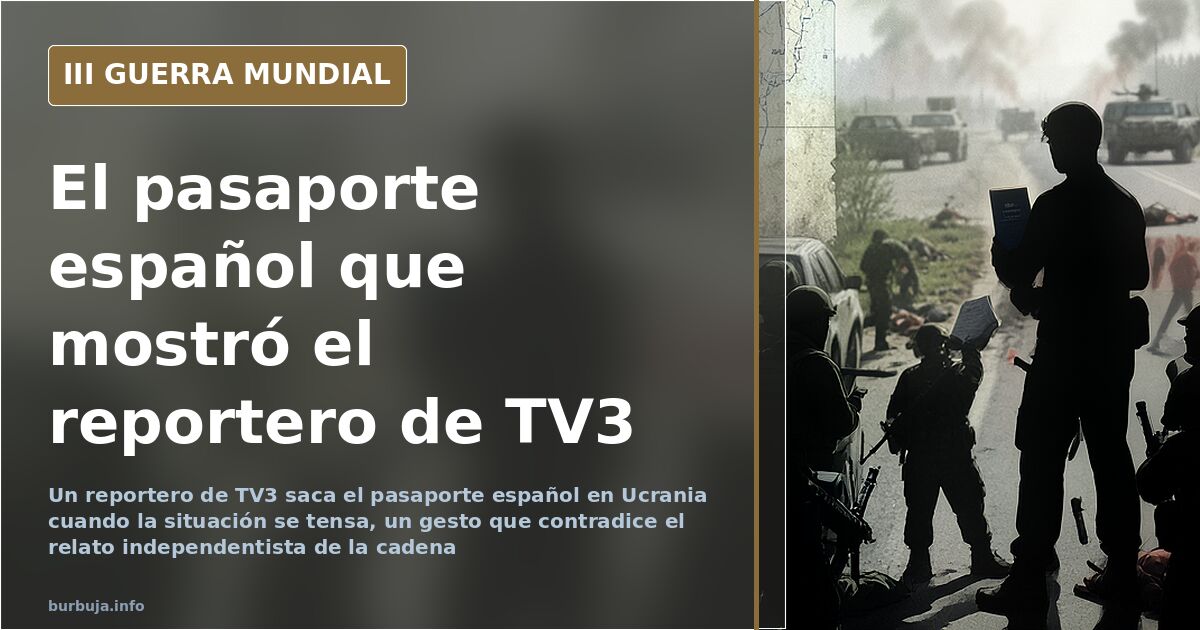
The Spanish passport that appears when the bombs start falling
A reporter for TV3, the Catalan public broadcaster which, according to several participants in the debate, has spent years pushing on air the narrative that Catalonia is an oppressed country, pulls out his Spanish passport the moment things get ugly in Ukraine. The gesture, caught on video, becomes for those sharing it the symbol of a contradiction that, in their view, the channel itself has long been feeding: that of those who demand independence from the podium and then cling to the document of the very state they claim to despise when the danger is real.
The scene is simple, and that is why it works. A special correspondent for the regional Catalan channel, in the middle of covering the conflict, shows his Spanish passport in the face of a dangerous situation. No speech, no nuance: just a document. And that document says what it says. The paradox is so obvious that the footage spreads on its own, with no editing needed.
What the video shows and why it goes viral
The video captures the moment when the journalist, facing what is described as a scare or a tense situation, falls back on his Spanish passport. According to several participants in the debate, the channel has spent years airing content portraying Catalonia as a nation with the right to self-determination and comparing its situation to that of peoples fighting for their freedom. That framing clashes head-on with the professional's reaction on the ground.
The contrast is no anecdote. It is, according to those sharing the video, the practical demonstration of a hierarchy: when the risk is physical, the identity narrative folds and the supposedly rejected nationality appears. The scene becomes an argument without a single word needing to be added.
The comparison with Ukraine the channel used to make
According to several participants in the debate, the regional Catalan broadcaster had equated the independence cause with the Ukrainian resistance against a larger power. That analogy, repeated across programmes and panel shows according to those same voices, backfires on the channel's own correspondent the moment he shows the passport of the state that, according to that narrative, Catalonia supposedly wants to break away from.
The parallel collapses under its own weight, on that reading: someone who presents themselves as oppressed does not usually carry the oppressor's document as a safe-conduct pass. The scene exposes the comparison and explains why the video spreads so easily.
The cost of embassies and public television
The episode reopens, according to several participants, the debate over spending on the Generalitat's (Catalonia's regional government's) external projection structures: delegations abroad, foreign advertising and a regional broadcaster that has been airing a nation-building narrative for years. The question hanging in the air is how much of that money rests on an identity that, when push comes to shove, gets tucked into a pocket.
The paradox is not only symbolic, on that reading. It is budgetary: taxpayers' money from all citizens funds a machine that sells a nation which, in the face of danger, falls back on the passport of the nation it claims not to belong to.
The precedent of those who already left
The scene recalls, according to several participants, other episodes in which pro-independence figures have resorted to Spanish nationality when it suited them. The footage mentions them: those who fled and were sent back, those who sought the protection of the state they claimed not to recognise. The pattern repeats, and the video condenses it into seconds.
This is no isolated case, but the latest confirmation of a pattern, according to those voices: the flag is raised at the rally and tucked into a pocket at the border checkpoint.
What is being debated now
The episode leaves two readings. One is the ridicule: the narrative of the oppressed nation crumbles in the face of an eight-page document. The other is pragmatism: anyone in a dangerous situation grabs whatever symbol protects them, and that does not necessarily invalidate a political cause.
The second reading has merit, but it does not erase the first. The video does not prove betrayal; it proves a priority. And that priority, at a channel that has spent years building the opposite narrative, is the news.
It remains to be seen whether the episode has internal consequences at the channel or is filed away as an unimportant incident. Either way, the scene is already in the archive of moments the official narrative would rather not have to explain.
Also available in: Deutsch
Summary of a discussion on Burbuja.info - Foro de economía, actualidad y política., translated from Spanish and reviewed before publication. Read the full discussion (69 replies).
More summaries
-
Brazilian mercenary films Russian drone hitting his Kharkiv hotel
A Brazilian mercenary films the moment a Russian drone hits his hotel in Kharkiv. The video reopens the debate over military versus civilian targets in Ukraine.
-
Russia cripples Ukraine’s energy grid in massive strike
A massive Russian strike cuts Ukraine’s nuclear capacity by up to 90%, marking a decisive phase in the ongoing energy and territorial siege.
-
A portrait of Russia's decline: drugged woman on the street while her pimp raps
A viral video shows a drugged woman asleep on the street while her boyfriend Dimitri raps. The image is being used as a weapon in the propaganda war between Russia and the West.
-
NATO drafts scenario for direct conflict with Russia
Bild reveals NATO's war scenario against Russia: Kaliningrado, airfields and a security zone along the border
-
CIA Director Ratcliffe Makes Lightning Visit to Moscow
John Ratcliffe visits Moscow and leaves within hours; the US embassy flying no flag. Is he seeking peace or delivering an ultimatum?
-
2012 video foreshadowed the health crisis and the end of physical cash
A July 2012 video described a health crisis, a control chip and the end of physical money. Fifteen years on, its transcript circulates as proof.