
Brazilian mercenary films Russian drone hitting his Kharkiv hotel
A Brazilian mercenary films the moment a Russian drone hits his hotel in Kharkiv. The video reopens the debate over military versus civilian targets in Ukraine.
English · Original discussion in Spanish · Published
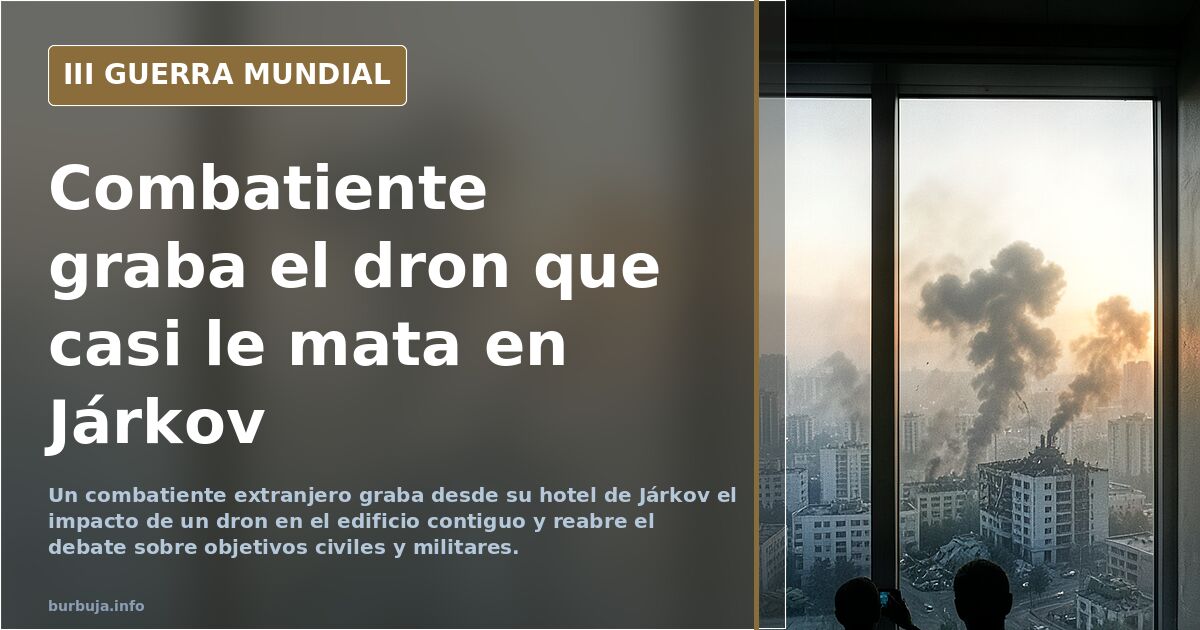
Brazilian mercenary films the Russian drone striking his Kharkiv hotel
What happens when a foreign fighter films the exact moment a Russian drone lands on his accommodation in Kharkiv? The footage becomes propaganda material for one side and proof of accuracy for the other. The video, shared on social media, shows the impact of a drone on the hotel where this Brazilian national was staying. The drone did not hit him directly: it struck the adjoining rooms. The ensuing debate is not about his luck, but about whether that hotel was a legitimate military target or just another civilian building among those Russia bombs every day.
The video and the military-target thesis
The post that opens the discussion pulls no punches: it claims that Russian attacks are not indiscriminate but carefully selected with intelligence. Every time you read "Russia attacks a hospital" or "Russia attacks a school," it argues, these are civilian buildings converted into military infrastructure, usually to house troops mixed in with civilians. The drone in the video was not after the Brazilian, but after the mercenaries' accommodation. That it hit the rooms next door and not his own is, in this reading, proof of precision, not luck.
The propaganda hook works both ways. For some, the video shows that Russia has an exceptional intelligence service and knows what is in every building. For others, it is just another episode in a war where civilians end up paying the price, whether anyone films it or not.
Why don't they kill Zelensky if their intelligence is that good?
The question arises on its own, and several participants raise it: if Russian intelligence is so good, why haven't they eliminated the Ukrainian president in five years? The most common answer is not technical but political. Killing him would turn him into a martyr and a symbol, whereas right now, this line of thinking holds, he is a leader whose standing is questioned within his own country. Russia would not elevate a "dying old man" to the status of a myth, as others would. They may kill him when it's all over, but not before.
Some point out that identifying mercenaries' accommodation is relatively easy: a hostile local population, detectable movements. Other things are more complex. And as for Zelensky, the circulating hypothesis is that inside Ukraine they have him under control, but outside he is untouchable.
Civilians as shields and the logic of war
The central argument of the original post is that Ukraine deploys air defense systems and arsenals in urban areas, turning entire neighborhoods into targets. Patriots next to apartment blocks, ammunition depots in the middle of the city. When they explode, they take the whole neighborhood with them. The conclusion drawn is that dead civilians acquire propaganda value for the West and for Kyiv's government.
Against this, the objection is direct: none of this would happen if Russia had not started a war of plunder. The discussion drifts toward whether a war fought under humanitarian constraints is a war lost from the start, because the enemy will exploit those constraints as an advantage. "War is war," one participant sums up.
The precedent of the Battle of Britain
One of the most interesting exchanges is the historical one. It is argued that Germany lost the Battle of Britain by stopping the bombing of airfields to focus on civilian targets, falling into the English provocation. Had it kept up the pressure on the RAF, England would have capitulated within months. Dresden came much later and has no connection to that.
The reply is not long in coming: civilians feed the army with their labor; they are the supply lines. The debate over whether attacking the civilian rear is a valid strategy or a tactical mistake remains open, with neither side giving ground.
In the end, the Brazilian is still alive; the hotel is not. And next time, as one participant puts it, he may not be so lucky. War hands out no favors, only impacts.
Also available in: Deutsch
Summary of a discussion on Burbuja.info - Foro de economía, actualidad y política., translated from Spanish and reviewed before publication. Read the full discussion (41 replies).
More summaries
-
Annihilation on video: when war becomes entertainment
Drone videos of Ukrainian soldiers are circulating as entertainment. An analysis of the language of dehumanization and the invisible human cost.
-
Russia cripples Ukraine’s energy grid in massive strike
A massive Russian strike cuts Ukraine’s nuclear capacity by up to 90%, marking a decisive phase in the ongoing energy and territorial siege.
-
A portrait of Russia's decline: drugged woman on the street while her pimp raps
A viral video shows a drugged woman asleep on the street while her boyfriend Dimitri raps. The image is being used as a weapon in the propaganda war between Russia and the West.
-
NATO drafts scenario for direct conflict with Russia
Bild reveals NATO's war scenario against Russia: Kaliningrado, airfields and a security zone along the border
-
CIA Director Ratcliffe Makes Lightning Visit to Moscow
John Ratcliffe visits Moscow and leaves within hours; the US embassy flying no flag. Is he seeking peace or delivering an ultimatum?
-
2012 video foreshadowed the health crisis and the end of physical cash
A July 2012 video described a health crisis, a control chip and the end of physical money. Fifteen years on, its transcript circulates as proof.