
Turkey blocks US bases, leaving Spain in NATO crossfire
Turkey refuses to grant the US access to its military bases, reigniting tensions with NATO. Spain finds itself caught between anti-American sentiment and historical memory.
English · Original discussion in Spanish · Published
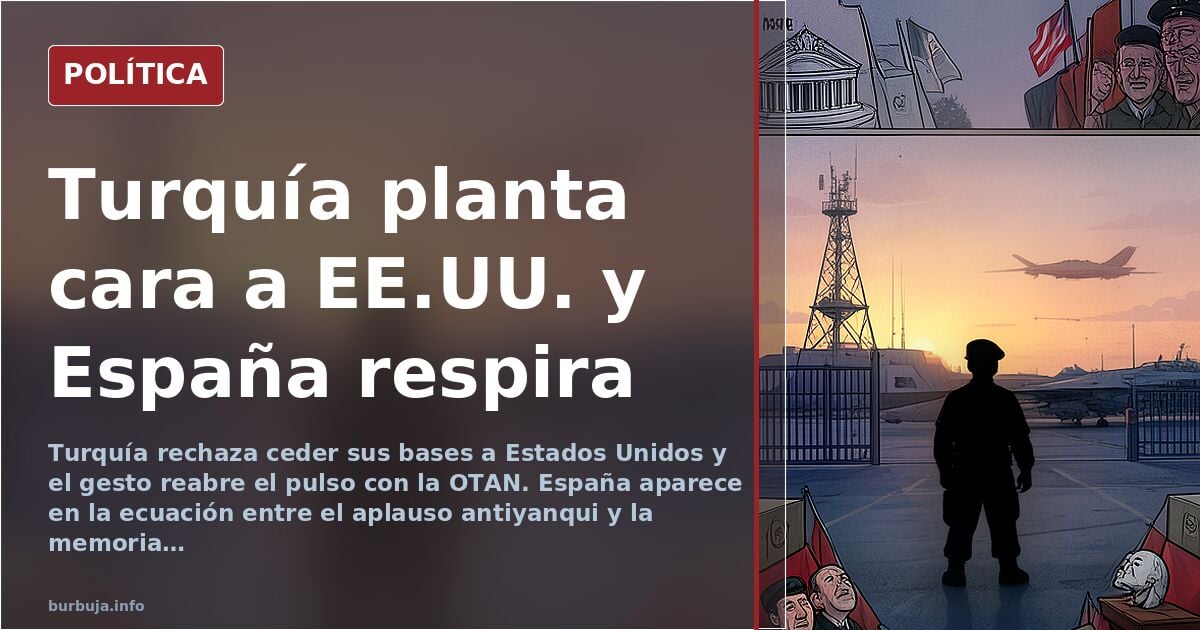
Turkey closes its bases to the United States, reopening the standoff with NATO
Ankara's refusal to allow Washington to use its military facilities has triggered a wave of reactions, ranging from geopolitical applause to jokes about hair transplants. At the center of this board, Spain appears as the European partner saying no while Turkey makes its move. The decision, celebrated by some as a blow to US hegemony and interpreted by others as a tactical shift by Erdogan, leaves open the question of how long this challenge will last. The conversation quickly shifted to the historic conflict between Turks and Kurds, Turkey's role as a regional blocker, and the imperial memories of Constantinople and Lepanto.
What peine with Turkish military bases
The trigger is Turkey's refusal to permit the United States to utilize its military bases. In the debate, this decision has been interpreted as an act of sovereignty against Washington and as a calculated move by Erdogan to reposition himself on the global stage. Some argue that the gesture responds to tactical interests rather than a change in alliance, noting that Ankara could reverse the stance within hours. Others emphasize that the standoff with NATO carries costs that are difficult to mitigate.
This episode has revived the memory of the historic confrontation between Turkey and Western countries. One line of analysis highlights that the Ottoman nation has been a key piece in regional containment for decades, while another stream recalls that this same position has earned it enemies in all directions. The discussion turned to the Kurdish issue, with views attributing to that group a function as a tool of foreign powers, while others reject such readings as simplistic.
Why Spain enters the equation
The Spanish echo of the Turkish gesture arrived through an unexpected channel: Turkish fans celebrating the refusal to Washington with "Paquito el chocolatero" and promising to fund hair implants for bald Spaniards. This episode, somewhere between surrealism and propaganda, illustrated the extent to which Turkish public opinion perceives Spain as a circumstantial ally in the struggle against the United States.
Irony runs through the analysis: a country that maintains its own complex relationship with Washington now appears as a reference point for resistance. Anti-American coincidence weighs more than any strategic affinity, explaining why the Turkish gesture is read through mutual sympathy even if agendas do not align. The lingering question is how long it takes Erdogan to qualify his stance.
The Kurdish background and regional wear
The debate over the Kurds occupies much of the discussion. One current argues that this collective has been used as an instrument by foreign powers and that its geographic position makes it a permanent bargaining chip. Another reading focuses on the human cost of decades of conflict and the difficulty of fitting any stable solution.
Comparisons with ISIS appear in several messages: intervention in Syria and support for certain actors would have ended up backfiring on those who promoted them. This interpretation, presented as a warning about the risks of geopolitical engineering, reinforces the thesis that Turkey plays on a board where allies change depending on the day.
The standoff with Washington and imperial memory
The Turkish gesture fits into a broader trend of challenging US hegemony. Some compare it to base withdrawals in other countries, while others recall that relations between Ankara and Washington have gone through phases of cooperation and rupture. References to Constantinople and Lepanto serve as reminders that the confrontation between Europe and Ottoman power has centuries of history.
The analysis concludes where the debate left it: with Erdogan having made his move, Washington evaluating its response, and the uncertainty of whether the gesture holds or fades. The only certainty is that this episode has peine a discussion that seemed closed: how far does the real autonomy of a NATO partner extend?
Ankara's refusal to allow Washington to use its military facilities has triggered a wave of reactions, ranging from geopolitical applause to jokes about hair transplants. At the center of this board, Spain appears as the European partner saying no while Turkey makes its move. The decision, celebrated by some as a blow to US hegemony and interpreted by others as a tactical shift by Erdogan, leaves open the question of how long this challenge will last. The conversation quickly shifted to the historic conflict between Turks and Kurds, Turkey's role as a regional blocker, and the imperial memories of Constantinople and Lepanto.
What peine with Turkish military bases
The trigger is Turkey's refusal to permit the United States to utilize its military bases. In the debate, this decision has been interpreted as an act of sovereignty against Washington and as a calculated move by Erdogan to reposition himself on the global stage. Some argue that the gesture responds to tactical interests rather than a change in alliance, noting that Ankara could reverse the stance within hours. Others emphasize that the standoff with NATO carries costs that are difficult to mitigate.
This episode has revived the memory of the historic confrontation between Turkey and Western countries. One line of analysis highlights that the Ottoman nation has been a key piece in regional containment for decades, while another stream recalls that this same position has earned it enemies in all directions. The discussion turned to the Kurdish issue, with views attributing to that group a function as a tool of foreign powers, while others reject such readings as simplistic.
Why Spain enters the equation
The Spanish echo of the Turkish gesture arrived through an unexpected channel: Turkish fans celebrating the refusal to Washington with "Paquito el chocolatero" and promising to fund hair implants for bald Spaniards. This episode, somewhere between surrealism and propaganda, illustrated the extent to which Turkish public opinion perceives Spain as a circumstantial ally in the struggle against the United States.
Irony runs through the analysis: a country that maintains its own complex relationship with Washington now appears as a reference point for resistance. Anti-American coincidence weighs more than any strategic affinity, explaining why the Turkish gesture is read through mutual sympathy even if agendas do not align. The lingering question is how long it takes Erdogan to qualify his stance.
The Kurdish background and regional wear
The debate over the Kurds occupies much of the discussion. One current argues that this collective has been used as an instrument by foreign powers and that its geographic position makes it a permanent bargaining chip. Another reading focuses on the human cost of decades of conflict and the difficulty of fitting any stable solution.
Comparisons with ISIS appear in several messages: intervention in Syria and support for certain actors would have ended up backfiring on those who promoted them. This interpretation, presented as a warning about the risks of geopolitical engineering, reinforces the thesis that Turkey plays on a board where allies change depending on the day.
The standoff with Washington and imperial memory
The Turkish gesture fits into a broader trend of challenging US hegemony. Some compare it to base withdrawals in other countries, while others recall that relations between Ankara and Washington have gone through phases of cooperation and rupture. References to Constantinople and Lepanto serve as reminders that the confrontation between Europe and Ottoman power has centuries of history.
The analysis concludes where the debate left it: with Erdogan having made his move, Washington evaluating its response, and the uncertainty of whether the gesture holds or fades. The only certainty is that this episode has peine a discussion that seemed closed: how far does the real autonomy of a NATO partner extend?
Also available in: Deutsch
Summary of a discussion on Burbuja.info - Foro de economía, actualidad y política., translated from Spanish and reviewed before publication. Read the full discussion (33 replies).
More summaries
-
Trump vs Harris: A Close Race in the 2024 US Election
Analysis of the Trump vs Harris contest in the US: election trends, vote count data, and voter polarization.
-
Charlie Kirk Assassination Sparks Fears of US Collapse
The September 10, 2025 assassination of Charlie Kirk reignites debate on US political collapse and the dollar's role.
-
Lleida teacher singles out two students for supporting Vox
Lleida History teacher allegedly called two students 'fachapobres' (poor fascists) over Vox event. Case reopens public education debate.
-
Gisbert: No Early Elections in Spain
Rubén Gisbert rules out early elections, citing PP paralysis and Feijóo's weakness amid Spain's political deadlock.
-
YouTube Geopolitics Channels Fuel Dissident Narrative Growth
Channels like Judging Freedom and Glenn Diesen emerge as alternative sources for critical geopolitical analysis.
-
Forum user proposes splitting Spain into two halves
A forum user suggests seceding from Spain to create a 'Transvaal south of the Duero', sparking debates on borders and territorial division.