
Forum user proposes splitting Spain into two halves
A forum user suggests seceding from Spain to create a 'Transvaal south of the Duero', sparking debates on borders and territorial division.
English · Original discussion in Spanish · Published
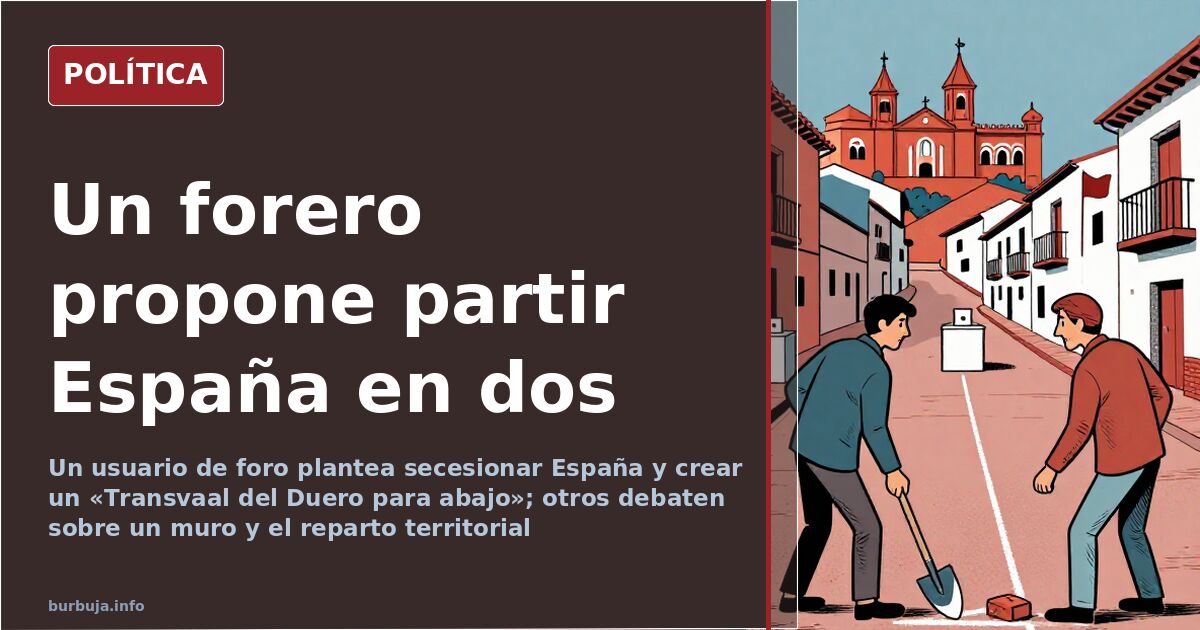
The territorial fracture nobody wants to face
In a forum thread, a participant argued that Spain is no longer a single country but two overlapping societies sharing a language and administration. His proposal is secession and the creation of a «national Transvaal south of the Duero», leaving the north to Galician, Basque, and Catalan Soviet Socialist Republics.
The starting point is a suspicion shared by several users: that the state apparatus has become a partisan tool. From there, proposed solutions diverge wildly. One participant suggests the opposite: sending «lazy people, immigrants, and feminists» to the south and keeping a patriotic north. Another settles for unifying Castile, including Cantabria.
Why has the idea taken hold that Spain is two countries?
The idea is not new, but in this thread it links to the feeling that fiscal redistribution doesn't add up. The recurring argument is that economically powerful regions support those that aren't, while conditioning the governability of the whole. Some conclude the problem isn't management, but forced coexistence.
The diagnosis relies on one user's demographic observation: half the country would already vote along identity lines, and older generations, who resist this framework most, will disappear within decades. It’s a cold, almost actuarial argument, but it explains why the discussion has shifted from specific policies to a fight over who deserves to stay with what.
The paradox is that those defending secession don’t want to leave Spain; they want others to leave. And those defending unity don’t want to convince separatists; they want them gone. Two symmetrical desires that together paint a picture of a country that can no longer tolerate itself.
The wall, the tick, and calculating who jumps first
The most repeated metaphor is the wall. If territory splits in two, one participant argues, citizens from the collectivist side will try to climb over to reach the capitalist side. The image is segarro yet uncomfortably true: real migration flows always go from systems promising equality to those promising opportunity.
This leads to cross-accusations. Some say the left can’t live without handouts («paguita») and others’ labor. Others reply that the right can’t live without Catalan money. Neither side bothers checking if the other is right, because the debate isn’t about data—it’s about identity.
What’s disorienting is that the secession proposal comes from within the State, not against it. Those asking to split Spain don’t seek independence from anything; they seek expulsion. Legally, that’s different. A user notes that the right to secession isn’t recognized anywhere globally, citing the usual slippery slope: if Catalonia can leave, why not Barcelona? Why not a neighborhood? Where does the limit lie?
Catalonia, everyone’s uncomfortable mirror
The Catalan case serves as a coherence test for both halves. Those advocating splitting Spain often deny Catalans the right to separate. Sharp observers note this contradiction, usually responding that it’s not the same: some want to steal territory, others to liberate it.
The discussion quickly turned to identity politics. It was noted that the PSC governs Catalonia, previously Convergència did, and many remember a former president with pending legal cases as the best manager. In short: pro-independence sentiment isn’t the only or even majority option in Catalonia, breaking the narrative of two pure blocs.
What remains is a country where half believes the other steals from them, and the other half feels despised. With these foundations, any debate on healthcare, education, or pensions ends the same way: who has the right to decide over whom.
End of analysis: where the argument stalls
The problem with the secessionist thesis isn’t sarracena, it’s practical. If the country splits, who keeps the debt? The pensions? Civil servants? Borders? No one answers. The proposal stays at headline level, never reaching detailed policy.
There’s also data dismantling the two-bloc narrative: most people don’t want to split anything. They want peace, lower taxes, and less state interference. The issue is this silent majority lacks representation, as parties that might represent them are busy arguing over flags.
That’s where everything stalls. Secession isn’t a political proposal; it’s a scream. And screams don’t govern.
In a forum thread, a participant argued that Spain is no longer a single country but two overlapping societies sharing a language and administration. His proposal is secession and the creation of a «national Transvaal south of the Duero», leaving the north to Galician, Basque, and Catalan Soviet Socialist Republics.
The starting point is a suspicion shared by several users: that the state apparatus has become a partisan tool. From there, proposed solutions diverge wildly. One participant suggests the opposite: sending «lazy people, immigrants, and feminists» to the south and keeping a patriotic north. Another settles for unifying Castile, including Cantabria.
Why has the idea taken hold that Spain is two countries?
The idea is not new, but in this thread it links to the feeling that fiscal redistribution doesn't add up. The recurring argument is that economically powerful regions support those that aren't, while conditioning the governability of the whole. Some conclude the problem isn't management, but forced coexistence.
The diagnosis relies on one user's demographic observation: half the country would already vote along identity lines, and older generations, who resist this framework most, will disappear within decades. It’s a cold, almost actuarial argument, but it explains why the discussion has shifted from specific policies to a fight over who deserves to stay with what.
The paradox is that those defending secession don’t want to leave Spain; they want others to leave. And those defending unity don’t want to convince separatists; they want them gone. Two symmetrical desires that together paint a picture of a country that can no longer tolerate itself.
The wall, the tick, and calculating who jumps first
The most repeated metaphor is the wall. If territory splits in two, one participant argues, citizens from the collectivist side will try to climb over to reach the capitalist side. The image is segarro yet uncomfortably true: real migration flows always go from systems promising equality to those promising opportunity.
This leads to cross-accusations. Some say the left can’t live without handouts («paguita») and others’ labor. Others reply that the right can’t live without Catalan money. Neither side bothers checking if the other is right, because the debate isn’t about data—it’s about identity.
What’s disorienting is that the secession proposal comes from within the State, not against it. Those asking to split Spain don’t seek independence from anything; they seek expulsion. Legally, that’s different. A user notes that the right to secession isn’t recognized anywhere globally, citing the usual slippery slope: if Catalonia can leave, why not Barcelona? Why not a neighborhood? Where does the limit lie?
Catalonia, everyone’s uncomfortable mirror
The Catalan case serves as a coherence test for both halves. Those advocating splitting Spain often deny Catalans the right to separate. Sharp observers note this contradiction, usually responding that it’s not the same: some want to steal territory, others to liberate it.
The discussion quickly turned to identity politics. It was noted that the PSC governs Catalonia, previously Convergència did, and many remember a former president with pending legal cases as the best manager. In short: pro-independence sentiment isn’t the only or even majority option in Catalonia, breaking the narrative of two pure blocs.
What remains is a country where half believes the other steals from them, and the other half feels despised. With these foundations, any debate on healthcare, education, or pensions ends the same way: who has the right to decide over whom.
End of analysis: where the argument stalls
The problem with the secessionist thesis isn’t sarracena, it’s practical. If the country splits, who keeps the debt? The pensions? Civil servants? Borders? No one answers. The proposal stays at headline level, never reaching detailed policy.
There’s also data dismantling the two-bloc narrative: most people don’t want to split anything. They want peace, lower taxes, and less state interference. The issue is this silent majority lacks representation, as parties that might represent them are busy arguing over flags.
That’s where everything stalls. Secession isn’t a political proposal; it’s a scream. And screams don’t govern.
Also available in: Deutsch
Summary of a discussion on Burbuja.info - Foro de economía, actualidad y política., translated from Spanish and reviewed before publication. Read the full discussion (129 replies).
More summaries
-
Sánchez's 'Deep State' Accusations: Hitmen Against Judges and Dead Voters
Accusations against the Spanish government involving 'hitmen' targeting judges and election manipulation with votes from deceased individuals, including the alleged harassment of Judge Beatriz Biedma.
-
Spain should become the 51st US state, some argue
The idea of Spain becoming the 51st US state arises from perceived political and economic instability, seeking external protection against internal divisions.
-
Satire Claims Ayuso Hears 7,291 Ghost Voices, Seeks Iker Jiménez
A satirical story attributes 7,291 paranormal voices and six years of insomnia to Madrid's Isabel Díaz Ayuso, leading her to consult TV presenter Iker Jiménez.
-
Irene Montero: Political Erosion Damages Public Image
Spanish MEP Irene Montero faces political wear from the 'Yes Means Yes' law, real estate holdings, and migration strategy.
-
Midnight Hammer: Iran Conflict Stalls Without Resolution
The Midnight Hammer operation continues in Iran with no clear end, amid geopolitical tensions and contradictory media narratives.
-
Vox Vice President García-Gallardo Resigns Amid Internal Party Crisis
García-Gallardo resigns from all Vox roles following the expulsion of members demanding primaries, as polls show rising support.