
Charlie Kirk Assassination Sparks Fears of US Collapse
The September 10, 2025 assassination of Charlie Kirk reignites debate on US political collapse and the dollar's role.
English · Original discussion in Spanish · Published
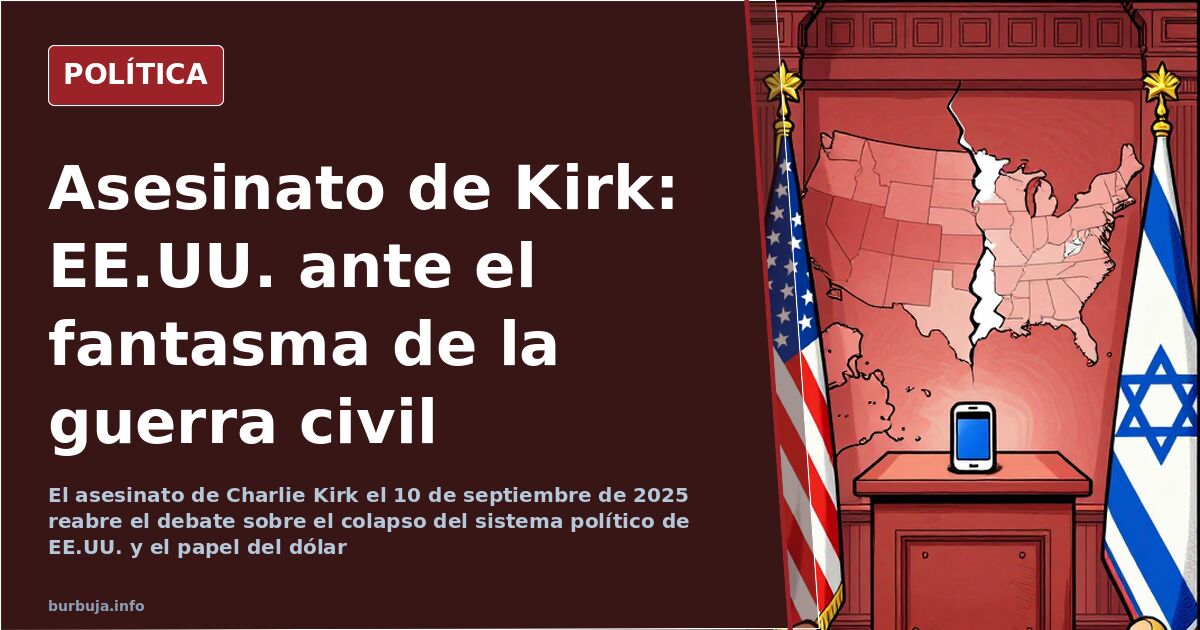
Charlie Kirk: The Assassination Reigniting Antiestéticars of Civil War
On September 10, 2025, American conservative activist Charlie Kirk was assassinated. Two days later, the conversation had shifted from the crime itself to a much larger suspicion: that the United States had entered its terminal phase. According to partisan publications, the investigation had reportedly expanded to include radicalized forums and groups to determine if the attack was premeditated. This is the starting point. From here, everyone chooses their own narrative, and no one agrees anymore.
What is known about Charlie Kirk's assassination?
The confirmed facts can be summarized in two lines: the assassination occurred on September 10, 2025, and the investigation remains open. Everything else is interpretation, and much of that interpretation comes through partisan channels. According to publications from accounts and media with conservative affiliations circulating about the case—and which the available material does not allow for independent verification—authorities are reviewing forums and radicalized groups within the trans community, including a collective called Queer Resistance, to determine if they knew about the attack beforehand. The same sources suggest that an armed group based in Utah deleted its Instagram account on the same day as the crime. These are indications, not conclusions. And there is no verdict.
The second circulating hypothesis is even more uncomfortable: that of friendly fire. Some argue that Kirk was the victim of an internal plot intended to strain the system and justify an authoritarian crackdown. No public evidence supports this version, but it explains the climate well: even the corpse needs a useful culprit.
From Milei to Netanyahu: The Crime as a Diplomatic Weapon
Argentine President Javier Milei wrote that "they took an exemplary warrior from us" and added that for every one who falls, new disseminators will emerge to succeed them. The phrase, widely shared without nuance, turned grief into mobilizing mythology.
Israeli Prime Minister Benjamin Netanyahu used a briefing for a delegation of US congressmen in Israel to recall something far more prosaic: "Do you have phones? You are holding a piece of Israel." The remark was interpreted in terms of technological dependence. Some interpretations veered towards conspiracy theories about mass surveillance; there is no evidence to support them.
According to partisan publications shared in the thread, some social media reactions celebrated the death. Some see this as a symptom of irreversible degradation, while others respond with an uncomfortable fact: rejoicing over a political assassination is not a new phenomenon in the United States.
Why is it argued that there are no left-wing parties in the United States?
The most repeated argument is that the US political system lacks a real left wing. There would be a right-wing party that is particularly reactionary on religious matters and civil rights, and another right-wing party that is much more liberal on those issues. Economically, both would be indistinguishable: market-driven, with luck determining outcomes. This is a simplification, but it aligns with the feeling that voters choose between two ways of managing the same system.
Historical comparison also appears. Current political violence would not be unprecedented: in the 1960s, the approval of new civil rights legislation triggered a violent backlash. The pattern repeats itself in a different guise.
Spengler, Foreseen Collapse, and the Dollar's Privilege
Sociological theses place the collapse of the US political system within this decade. The forecast is supported by polarization, the breakdown of traditional parties, and a trickle of violent incidents. Cultural phenomena reinforce this: a film like Civil War, received with indifference in Europe, was a mass success in the United States.
Beneath all this lies money. The dollar's privilege allows the United States to borrow in a currency it alone issues. At the root of the analysis lie the Bretton Woods agreements, with a detail almost no one remembers: Spain did not sign them. The most aggressive diagnosis suggests that a monetary system without an undisputed anchor is pushing the US economy towards a totalitarian spiral while another bloc gains ground with a more open policy. Speculation, yes. But speculation with a basis.
Eco, Video Games, and the Underlying Culture War
Even readings are contested. Umberto Eco and his The Prank of Foucault become a battleground: some interpret it as a mockery of mythical thinking and a deconstruction of scholasticism; others, as a nominalist work where no truth exists except one's own. The discussion shifts to whether deductive reasoning is Thomistic heritage or a neutral tool, and from there to mutual accusations of wanting to silence the opponent.
In parallel, the culture war infiltrates leisure. The expansion of World of Warcraft was once interpreted by some as the imposition of an agenda; the strongest response is that it adhered to the lore of its own universe and that fantasy games have been politically incorrect long before the term existed.
The forecast of collapse has been announced for decades and still has no expiration date. With the investigation open and the crime still present in public discourse, no closure is possible. Only pieces that don't quite fit and a question that no one answers without resorting to the side they had already chosen.
On September 10, 2025, American conservative activist Charlie Kirk was assassinated. Two days later, the conversation had shifted from the crime itself to a much larger suspicion: that the United States had entered its terminal phase. According to partisan publications, the investigation had reportedly expanded to include radicalized forums and groups to determine if the attack was premeditated. This is the starting point. From here, everyone chooses their own narrative, and no one agrees anymore.
What is known about Charlie Kirk's assassination?
The confirmed facts can be summarized in two lines: the assassination occurred on September 10, 2025, and the investigation remains open. Everything else is interpretation, and much of that interpretation comes through partisan channels. According to publications from accounts and media with conservative affiliations circulating about the case—and which the available material does not allow for independent verification—authorities are reviewing forums and radicalized groups within the trans community, including a collective called Queer Resistance, to determine if they knew about the attack beforehand. The same sources suggest that an armed group based in Utah deleted its Instagram account on the same day as the crime. These are indications, not conclusions. And there is no verdict.
The second circulating hypothesis is even more uncomfortable: that of friendly fire. Some argue that Kirk was the victim of an internal plot intended to strain the system and justify an authoritarian crackdown. No public evidence supports this version, but it explains the climate well: even the corpse needs a useful culprit.
From Milei to Netanyahu: The Crime as a Diplomatic Weapon
Argentine President Javier Milei wrote that "they took an exemplary warrior from us" and added that for every one who falls, new disseminators will emerge to succeed them. The phrase, widely shared without nuance, turned grief into mobilizing mythology.
Israeli Prime Minister Benjamin Netanyahu used a briefing for a delegation of US congressmen in Israel to recall something far more prosaic: "Do you have phones? You are holding a piece of Israel." The remark was interpreted in terms of technological dependence. Some interpretations veered towards conspiracy theories about mass surveillance; there is no evidence to support them.
According to partisan publications shared in the thread, some social media reactions celebrated the death. Some see this as a symptom of irreversible degradation, while others respond with an uncomfortable fact: rejoicing over a political assassination is not a new phenomenon in the United States.
Why is it argued that there are no left-wing parties in the United States?
The most repeated argument is that the US political system lacks a real left wing. There would be a right-wing party that is particularly reactionary on religious matters and civil rights, and another right-wing party that is much more liberal on those issues. Economically, both would be indistinguishable: market-driven, with luck determining outcomes. This is a simplification, but it aligns with the feeling that voters choose between two ways of managing the same system.
Historical comparison also appears. Current political violence would not be unprecedented: in the 1960s, the approval of new civil rights legislation triggered a violent backlash. The pattern repeats itself in a different guise.
Spengler, Foreseen Collapse, and the Dollar's Privilege
Sociological theses place the collapse of the US political system within this decade. The forecast is supported by polarization, the breakdown of traditional parties, and a trickle of violent incidents. Cultural phenomena reinforce this: a film like Civil War, received with indifference in Europe, was a mass success in the United States.
Beneath all this lies money. The dollar's privilege allows the United States to borrow in a currency it alone issues. At the root of the analysis lie the Bretton Woods agreements, with a detail almost no one remembers: Spain did not sign them. The most aggressive diagnosis suggests that a monetary system without an undisputed anchor is pushing the US economy towards a totalitarian spiral while another bloc gains ground with a more open policy. Speculation, yes. But speculation with a basis.
Eco, Video Games, and the Underlying Culture War
Even readings are contested. Umberto Eco and his The Prank of Foucault become a battleground: some interpret it as a mockery of mythical thinking and a deconstruction of scholasticism; others, as a nominalist work where no truth exists except one's own. The discussion shifts to whether deductive reasoning is Thomistic heritage or a neutral tool, and from there to mutual accusations of wanting to silence the opponent.
In parallel, the culture war infiltrates leisure. The expansion of World of Warcraft was once interpreted by some as the imposition of an agenda; the strongest response is that it adhered to the lore of its own universe and that fantasy games have been politically incorrect long before the term existed.
The forecast of collapse has been announced for decades and still has no expiration date. With the investigation open and the crime still present in public discourse, no closure is possible. Only pieces that don't quite fit and a question that no one answers without resorting to the side they had already chosen.
Summary of a discussion on Burbuja.info - Foro de economía, actualidad y política., translated from Spanish and reviewed before publication. Read the full discussion (200 replies).
More summaries
-
Gay pedophile obtains custody of baby in the United States.
A man convicted of sexual offenses against minors secured custody of a baby in Pennsylvania, U.S., through surrogacy.
-
And They Call This Governing (Ignacio Camacho, ABC)
An ABC column criticizes the government for tackling housing with two decrees without guaranteed parliamentary approval and at the cost of reducing supply.
-
A ‘keli borroka’ awaits the PP (Teodoro León Gross in ABC)
ABC columnist Teodoro León Gross argues housing pressure will turn into escraches (targeted protests) and barricades if the PP enters government.
-
A democratic obligation unfulfilled (ABC editorial)
Article 134.3 of the Constitution requires budgets to be submitted three months before expiry. Spain is still running on the 2023 Budget.
-
Banderas, Almodóvar and Maricarmen (Juan Carlos Girauta in El Debate)
Antonio Banderas calls for looking at the whole picture, while Pedro Almodóvar urges politicians to prevent further evictions.
-
The USSR and the Origins of Borregocracia: Thesis and Suspicions
Soviet infiltration, free lawyers, Gramsci and academic inbreeding: the thesis that traces today's groupthink to the USSR.