
Tucker Carlson's Russian Auchan Carts Are Already Standard in Europe
Tucker Carlson presents coin-operated carts at a Russian Auchan as novel, but the mechanism has been standard in European supermarkets for years.
English · Original discussion in Spanish · Published
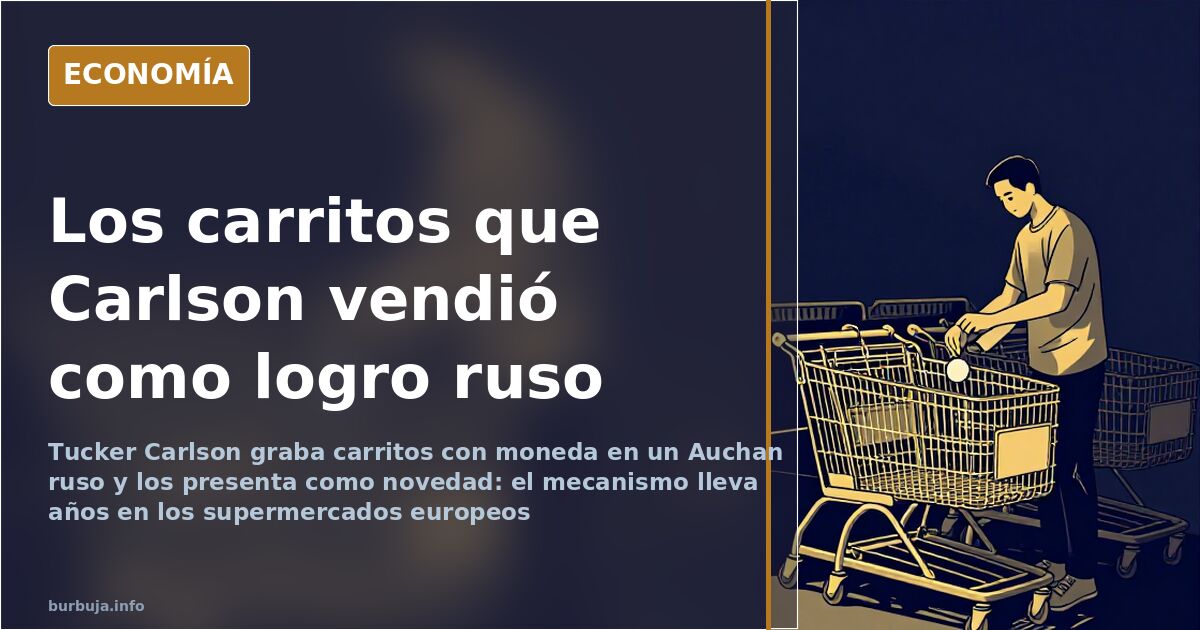
Tucker Carlson, Russian Auchan Shopping Carts, and Grocery Costs
Coin-operated carts and wheel-locking escalators already exist. Tucker Carlson filmed them in a Russian supermarket and presented them as proof of normality—even pogre—compared to what he claims other countries offer. The issue is that none of these devices are Russian inventions. They are standard in any major European retail chain and have operated in Spanish hypermarkets for years. The debate sparked by the video isn't really about shopping carts.
What turned this clip into political ammunition is the underlying question: Does Russia live better than the Atlantic narrative suggests, or is this a staged advertorial? Both answers circulate with equal confidence.
What Tucker Carlson’s Video Shows in a Russian Supermarket
The walk through the aisles documents carts with coin locks and escalators antiestéticaturing anti-theft wheel systems. These are mechanisms for enforced civic behavior, not national traits: they have been known in Spain for decades and have disappeared from some chains because customers no longer carry cash. The wheel lock at the exit serves an anti-fraud function, not a technological boast.
The harshest interpretation argues this is an ad hoc piece for Western consumption with no informational value. Another segment of analysis sees it differently: yes, propaganda; no, not entirely invented. Carlson doesn’t falsify what he films, but he carefully chooses what to record and what to leave out of frame.
It Wasn’t a Russian Carrefour: The Store in the Video Is an Auchan
The establishment shown belongs to Auchan, the French retail chain. Its signage appears at the entrance and on the carts themselves, easily identifiable even though the text is in Russian. This detail dismantles half the thesis: if the hypermarket is owned by a European multinational, what is seen is not an achievement of the Russian system, but the footprint of a company that hasn’t left.
This raises the uncomfortable question about the real scope of sanctions. The most repeated answer among participants: Russia buys what it needs abroad through third countries, so restrictions would have resulted in inflation and higher prices, not empty shelves.
38% of Russian Salary Spent on Food vs. 8% in the US
The comparison that undermines the triumphant narrative is financial. A calculation circulating in the debate places Russian household spending on food at nearly 38% of their salary, compared to around 8% in the United States. The image of abundance says nothing about the effort required to fill the cart each week.
Focus has also been placed on the receipt. One comment estimates a purchase from the video at 100 dollars and considers it expensive for the country’s income level. And there is a note that dismantles the showcase: powdered baby milk is kept under anti-theft protection, a sign that theft is not just a hypothetical scenario.
The Empty Supermarket and the Russia Not Shown on Camera
A recurring detail in objections: the large store is empty. No one appears in the aisles or at the checkout. It could be the time, day, or city chosen, but for a store of that size, the silence is striking.
Outside Moscow and St. Petersburg, the landscape changes. Those who have traveled the country describe inland capitals with lower wages and uneven development, while the two major cities do sustain a service level comparable to Europe. The repeated conclusion: the video doesn’t lie, but it photographs an exception and presents it as the norm.
What’s in US Supermarkets
Carlson’s jab points to a country where, according to several messages, such technology has been installed for years: carts with digital screens, electric scooters for shoppers with reduced mobility, and garbage trucks with pneumatic loading since the sixties. Presenting a coin-operated cart as a marvel is, at best, evidence of never having visited a US mall.
The other weak point of the portrait is the basket. According to these comments, the shelves there are a monument to pre-cooked food, with enough variety for breakfast, lunch, and dinner without repeating a dish for a whole month. Healthy? Not much. However, shopping at a high-end chain costs more than at a mid-price store, and comparing a Russian supermarket with its local equivalent depends on which one you choose.
Why the Video Divides Opinion Inside and Outside Russia
One current holds that the video’s interest is not economic but perceptual: much of the US public assumes the rest of the world produces little less than by hand, and any scene of foreign normality disorients them. Another current responds that normality also exists in Ohio and that astonishment is the true subject of the report.
The predictable outcome is that the recording will continue circulating as proof of two opposite things, and almost no one will change their mind. If anything makes it clear, it’s how easy it is to confuse a European chain with the showcase of an entire country: Auchan is not Russia, and the coin-operated cart is nobody’s future. What remains, however, is a reasonable doubt about whether that image of normality holds up far from the two capitals.
Coin-operated carts and wheel-locking escalators already exist. Tucker Carlson filmed them in a Russian supermarket and presented them as proof of normality—even pogre—compared to what he claims other countries offer. The issue is that none of these devices are Russian inventions. They are standard in any major European retail chain and have operated in Spanish hypermarkets for years. The debate sparked by the video isn't really about shopping carts.
What turned this clip into political ammunition is the underlying question: Does Russia live better than the Atlantic narrative suggests, or is this a staged advertorial? Both answers circulate with equal confidence.
What Tucker Carlson’s Video Shows in a Russian Supermarket
The walk through the aisles documents carts with coin locks and escalators antiestéticaturing anti-theft wheel systems. These are mechanisms for enforced civic behavior, not national traits: they have been known in Spain for decades and have disappeared from some chains because customers no longer carry cash. The wheel lock at the exit serves an anti-fraud function, not a technological boast.
The harshest interpretation argues this is an ad hoc piece for Western consumption with no informational value. Another segment of analysis sees it differently: yes, propaganda; no, not entirely invented. Carlson doesn’t falsify what he films, but he carefully chooses what to record and what to leave out of frame.
It Wasn’t a Russian Carrefour: The Store in the Video Is an Auchan
The establishment shown belongs to Auchan, the French retail chain. Its signage appears at the entrance and on the carts themselves, easily identifiable even though the text is in Russian. This detail dismantles half the thesis: if the hypermarket is owned by a European multinational, what is seen is not an achievement of the Russian system, but the footprint of a company that hasn’t left.
This raises the uncomfortable question about the real scope of sanctions. The most repeated answer among participants: Russia buys what it needs abroad through third countries, so restrictions would have resulted in inflation and higher prices, not empty shelves.
38% of Russian Salary Spent on Food vs. 8% in the US
The comparison that undermines the triumphant narrative is financial. A calculation circulating in the debate places Russian household spending on food at nearly 38% of their salary, compared to around 8% in the United States. The image of abundance says nothing about the effort required to fill the cart each week.
Focus has also been placed on the receipt. One comment estimates a purchase from the video at 100 dollars and considers it expensive for the country’s income level. And there is a note that dismantles the showcase: powdered baby milk is kept under anti-theft protection, a sign that theft is not just a hypothetical scenario.
The Empty Supermarket and the Russia Not Shown on Camera
A recurring detail in objections: the large store is empty. No one appears in the aisles or at the checkout. It could be the time, day, or city chosen, but for a store of that size, the silence is striking.
Outside Moscow and St. Petersburg, the landscape changes. Those who have traveled the country describe inland capitals with lower wages and uneven development, while the two major cities do sustain a service level comparable to Europe. The repeated conclusion: the video doesn’t lie, but it photographs an exception and presents it as the norm.
What’s in US Supermarkets
Carlson’s jab points to a country where, according to several messages, such technology has been installed for years: carts with digital screens, electric scooters for shoppers with reduced mobility, and garbage trucks with pneumatic loading since the sixties. Presenting a coin-operated cart as a marvel is, at best, evidence of never having visited a US mall.
The other weak point of the portrait is the basket. According to these comments, the shelves there are a monument to pre-cooked food, with enough variety for breakfast, lunch, and dinner without repeating a dish for a whole month. Healthy? Not much. However, shopping at a high-end chain costs more than at a mid-price store, and comparing a Russian supermarket with its local equivalent depends on which one you choose.
Why the Video Divides Opinion Inside and Outside Russia
One current holds that the video’s interest is not economic but perceptual: much of the US public assumes the rest of the world produces little less than by hand, and any scene of foreign normality disorients them. Another current responds that normality also exists in Ohio and that astonishment is the true subject of the report.
The predictable outcome is that the recording will continue circulating as proof of two opposite things, and almost no one will change their mind. If anything makes it clear, it’s how easy it is to confuse a European chain with the showcase of an entire country: Auchan is not Russia, and the coin-operated cart is nobody’s future. What remains, however, is a reasonable doubt about whether that image of normality holds up far from the two capitals.
Also available in: Deutsch
Summary of a discussion on Burbuja.info - Foro de economía, actualidad y política., translated from Spanish and reviewed before publication. Read the full discussion (170 replies).
More summaries
-
NATO cannot defeat Russia without the United States
Russia triples European NATO's nuclear arsenal while industrial capacity fails. Without the US, the Alliance is hollow.
-
Putin: Combined Russia-UE GDP Would Exceed US, But Gas Costs Complicate Deal
Putin claims combined Russia-UE GDP surpasses US. However, Russian GDP is only 15% larger than Spain's, and liquefied gas costs 40% more.
-
Spanish housing prices fall in half the country: is the bubble bursting?
Housing prices are falling across half of Spain, with double-digit drops in some provincial capitals. Correction or start of a crash? Data and analysis.
-
Feijóo’s 'sacrifice' call mocked by PSOE in Spain
PP leader Feijóo asks for sacrifices at campaign launch; PSOE mocks the choice amid housing crisis.
-
Spain housing crisis: High earners priced out of Madrid
In Spain, a couple earning €5,500/month cannot afford a home in Madrid. Prices hit €550k and rents €2k, driven by migration and inflation.
-
Young Man Fired for Mocking Puerta del Sol Protesters
A young man was fired after a viral video mocked Puerta del Sol protesters as lazy. The case sparks debate on fair dismissal and free speech in Spain.