
Trump tariffs: US buyers pay unexpected fees upon delivery
Sellers from China stop collecting duties at checkout, leaving US buyers to pay unknown amounts upon delivery as Trump exempts certain tech goods.
English · Original discussion in Spanish · Published
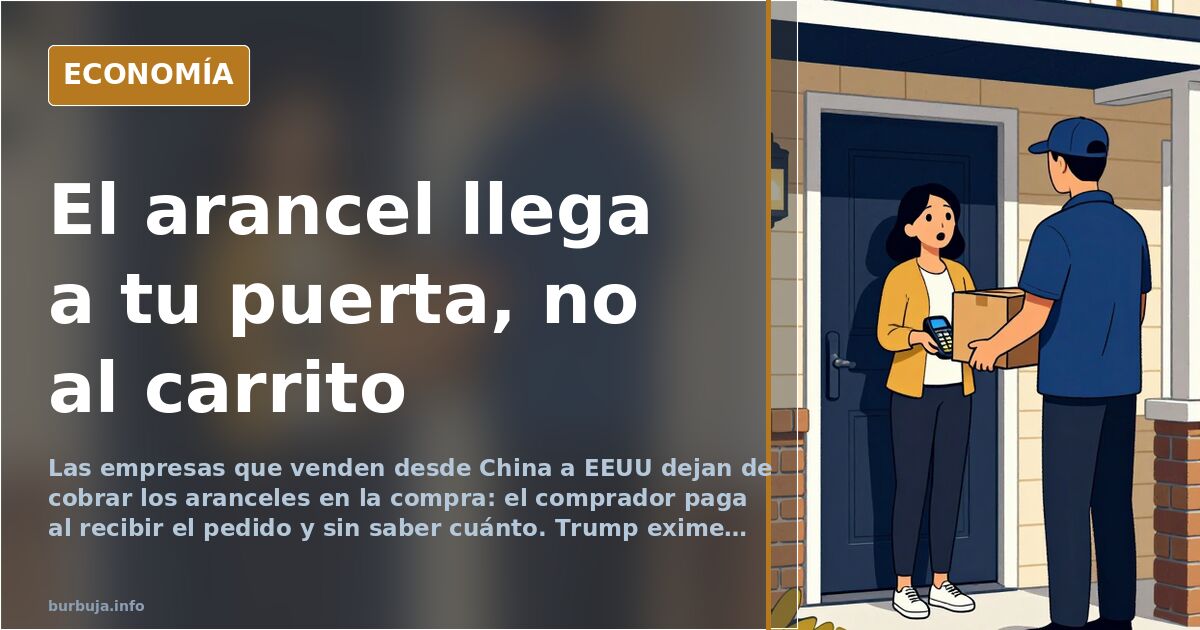
Trump tariffs: The surprise arrives with the package
US consumers ordering Chinese-made electronics no longer know their final cost. The tariff war has shifted the rules: some sellers shipping from China to the US have stopped calculating and charging taxes at purchase, meaning customers must pay applicable duties when orders arrive. With rates fluctuating, nobody knows the final amount. The paradox is textbook: tariffs become a doorstep surprise rather than a screen number.
The issue is significant because most computing devices are manufactured in China. Even Western brands like Dell or HP produce primarily there, and entire categories—such as handheld computers with keyboards—are made exclusively by Chinese firms. Relocating this production to the US or allied countries would require years of investment with no guaranteed economic success. Apple’s attempt to move iPhone manufacturing out of China yielded poor results, including insufficient quality.
What we know about paying tariffs upon receipt
The mechanism is simple to describe but painful to experience. Companies sell devices without passing on the tax; the package crosses the border, and the buyer receives notice to pay applicable duties before delivery. If tariff rates change between purchase and arrival, the final amount shifts too. Someone who ordered a handheld computer might find the bill doubled without touching the cart.
This isn’t new for international shoppers. Some recall paying around €30 in customs for an $80 device shipped from the US to Madrid, an experience that deterred many from buying again. The difference now is that this mechanism extends to the reverse flow—from China to the US—with unprecedented uncertainty.
Production cannot be relocated within a year
The most repeated argument is industrial. Consumer electronics manufacturing is concentrated in China not by accident: supplier chains, assembly, and quality control are established there. A Taiwanese company like Foxconn produces 40% to 50% of all global electronic products, with thirteen major plants in China. Its lines assemble iPhones, iPads, Kindles, PlayStation 3s, Xbox 360s, and GoPro cameras.
This data dismantles the idea that moving production is easy. Apple tried it with poor results. The conclusion is that the US cannot build such capacity quickly, domestically or in allied nations. Tariffs ultimately hit US companies with offshored production, like Tesla or Apple, plus automakers assembling in the US with Chinese or Mexican components.
Trump’s partial retreat and exempted devices
The scenario-changing news is Trump’s partial retreat: he exempts smartphones, computers, chips, and other components not generally manufactured in the US from tariffs. Thus, products whose manufacturing cannot be repatriated are spared tariff penalties, at least for now. This exemption confirms through practice what critical analyses argued: some things cannot be substituted by decree.
It remains to be seen if exemptions hold or change again, as the core problem persists: rule volatility prevents knowing final costs. Meanwhile, buyers who ordered before exemptions await whatever charges appear at their door.
Collateral effect in Europe: more stock and competition
For European buyers, effects may contrast with those in the US. If sales to the US drop, greater availability of Chinese products in Europe and increased seller competition to place them here are reasonable expectations. The same trade war raising package costs at one border may lower them at another.
The underlying debate concerns rules, not just tariffs. Some argue free trade doesn’t exist when the EU imposes standards on its companies while allowing imports from countries where those standards aren’t met, enabling much cheaper production. This constitutes commercial dumping, they claim; until equal rules apply globally, tariffs remain mere patches.
China, the US, and the struggle beyond customs
In the background lies the power struggle between two giants. According to circulating calculations, the US isn’t decisive for China: it represents around 14% of its sales, likely less than 13%. Losing that percentage matters but isn’t ruinous. China bets on commercial dominance over military power, needing fewer aircraft carriers than the US since it doesn’t project force globally. The US, however, requires such projection, and its industry depends on global supply chains it is currently taxing.
What if smartphone and computer exemptions are merely a pause before the next rule change?
US consumers ordering Chinese-made electronics no longer know their final cost. The tariff war has shifted the rules: some sellers shipping from China to the US have stopped calculating and charging taxes at purchase, meaning customers must pay applicable duties when orders arrive. With rates fluctuating, nobody knows the final amount. The paradox is textbook: tariffs become a doorstep surprise rather than a screen number.
The issue is significant because most computing devices are manufactured in China. Even Western brands like Dell or HP produce primarily there, and entire categories—such as handheld computers with keyboards—are made exclusively by Chinese firms. Relocating this production to the US or allied countries would require years of investment with no guaranteed economic success. Apple’s attempt to move iPhone manufacturing out of China yielded poor results, including insufficient quality.
What we know about paying tariffs upon receipt
The mechanism is simple to describe but painful to experience. Companies sell devices without passing on the tax; the package crosses the border, and the buyer receives notice to pay applicable duties before delivery. If tariff rates change between purchase and arrival, the final amount shifts too. Someone who ordered a handheld computer might find the bill doubled without touching the cart.
This isn’t new for international shoppers. Some recall paying around €30 in customs for an $80 device shipped from the US to Madrid, an experience that deterred many from buying again. The difference now is that this mechanism extends to the reverse flow—from China to the US—with unprecedented uncertainty.
Production cannot be relocated within a year
The most repeated argument is industrial. Consumer electronics manufacturing is concentrated in China not by accident: supplier chains, assembly, and quality control are established there. A Taiwanese company like Foxconn produces 40% to 50% of all global electronic products, with thirteen major plants in China. Its lines assemble iPhones, iPads, Kindles, PlayStation 3s, Xbox 360s, and GoPro cameras.
This data dismantles the idea that moving production is easy. Apple tried it with poor results. The conclusion is that the US cannot build such capacity quickly, domestically or in allied nations. Tariffs ultimately hit US companies with offshored production, like Tesla or Apple, plus automakers assembling in the US with Chinese or Mexican components.
Trump’s partial retreat and exempted devices
The scenario-changing news is Trump’s partial retreat: he exempts smartphones, computers, chips, and other components not generally manufactured in the US from tariffs. Thus, products whose manufacturing cannot be repatriated are spared tariff penalties, at least for now. This exemption confirms through practice what critical analyses argued: some things cannot be substituted by decree.
It remains to be seen if exemptions hold or change again, as the core problem persists: rule volatility prevents knowing final costs. Meanwhile, buyers who ordered before exemptions await whatever charges appear at their door.
Collateral effect in Europe: more stock and competition
For European buyers, effects may contrast with those in the US. If sales to the US drop, greater availability of Chinese products in Europe and increased seller competition to place them here are reasonable expectations. The same trade war raising package costs at one border may lower them at another.
The underlying debate concerns rules, not just tariffs. Some argue free trade doesn’t exist when the EU imposes standards on its companies while allowing imports from countries where those standards aren’t met, enabling much cheaper production. This constitutes commercial dumping, they claim; until equal rules apply globally, tariffs remain mere patches.
China, the US, and the struggle beyond customs
In the background lies the power struggle between two giants. According to circulating calculations, the US isn’t decisive for China: it represents around 14% of its sales, likely less than 13%. Losing that percentage matters but isn’t ruinous. China bets on commercial dominance over military power, needing fewer aircraft carriers than the US since it doesn’t project force globally. The US, however, requires such projection, and its industry depends on global supply chains it is currently taxing.
What if smartphone and computer exemptions are merely a pause before the next rule change?
Also available in: Deutsch
Summary of a discussion on Burbuja.info - Foro de economía, actualidad y política., translated from Spanish and reviewed before publication. Read the full discussion (117 replies).
More summaries
-
China hikes tariffs to 125%, weaponizes yuan in trade war
China raises tariffs to 125% and devalues the yuan as a trade weapon. The debate: does it impoverish its population or shield its economy?
-
China imposes 34% tariff on all US goods starting April 10
China imposes a 34% tariff on all US products from April 10 in retaliation against Trump, who has already raised tariffs on Chinese imports to 54%.
-
100% tariffs on Spain after Trump mistakes it for a BRICS nation
Trump places Spain in the BRICS and threatens 100% tariffs on its goods: the country exports more than €20 billion a year to the United States
-
Zarzuela summons Sánchez: The meeting Moncloa doesn't acknowledge
The King reportedly summoned Sánchez at Zarzuela following his meeting with the military establishment and the announcement of the Ceuta trip. The official agenda makes no mention of the encounter, and...
-
VOX refuses to back Guardiola in Spain's Extremadura
Extremadura PP has 28 seats and needs VOX's 5 to invest María Guardiola, who vetoed her only possible partner, opening the door for Vara.
-
Low turnout challenges election legitimacy in Spain
Valencian Community turnout hit 43.68% by noon, fueling debates on electoral validity and abstention.