
100% tariffs on Spain after Trump mistakes it for a BRICS nation
Trump places Spain in the BRICS and threatens 100% tariffs on its goods: the country exports more than €20 billion a year to the United States
English · Original discussion in Spanish · Published
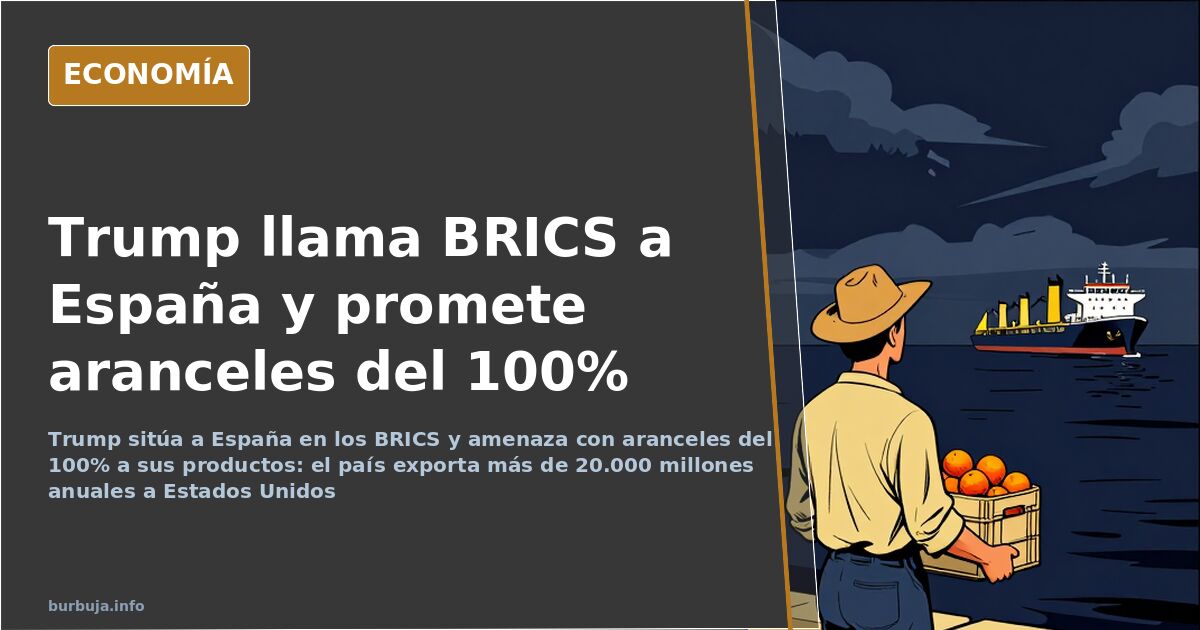
Trump confuses Spain with the BRICS and threatens 100% tariffs
How much does it cost for the world’s leading power to confuse Spain with a BRICS nation? For now, a threat of 100% tariffs on its products. In a press appearance, Donald Trump placed Spain inside the BRICS bloc —which it does not belong to— and announced a 100% tariff on its goods. The remark had an immediate echo: American doctor Michael Ostacher summed up the mood by recommending ordering all the Serrano ham now before imports get more expensive, and reactions split between those who see a monumental blunder and those who see a self-serving misunderstanding.
Why is Spain not a BRICS nation?
It is not, and no treaty is needed to prove it. The BRICS bloc includes China, Russia, India, Brazil, South Africa, Iran, the United Arab Emirates and Indonesia, among others. Spain has been a NATO member for decades and its geopolitical alignment runs through Brussels, not through the axis Trump places on the other side of the trenches. The most repeated joke sums up the error: confusing the acronym the English-speaking financial press used to group Portugal, Italy, Greece and Spain during the debt crisis with that of the BRICS.
The error is funny and costly. A country hit with a 100% tariff sees the entry price of its products into the U.S. market at least doubled, which in practice amounts to expulsion. And Spain is not a minor partner in that trade relationship.
The version that holds Trump knew Spain is not BRICS
This is where the narrative splits. Some argue that the actual sequence in the video is different: the question was about the NATO members that contribute least, the journalist mentioned Spain and France, and Trump responded that Spain’s contribution “is very low” before throwing out a rhetorical question about whether Spain is in the BRICS, which he knows it is not. Under that reading, the underlying message would be twofold: if you are in NATO, pay more; if you are in the BRICS, you already know what awaits you. The 5% defense spending target hangs over that entire interpretation.
The other reading leaves no room: a Western leader, at the head of the alliance that includes Spain, should know which countries form the rival bloc and which do not. That a U.S. president gets it wrong also says nothing good about the attention he pays to his own allies.
How much does Spain have at stake in the U.S. market?
More than €20 billion a year in goods alone. That is the figure being cited and worth remembering: the United States is the sixth-largest destination for Spanish exports and the largest outside Europe, a position that is not improvised. So there is more on the table than a headline.
The counterargument holds that the blow would be limited because Spain sells little and buys more, so the U.S. importer would suffer the price increase. The nuance is reasonable in theory and fragile in practice: a tariff that eats a small exporter’s margin amounts to a loss of market. Among the ways out suggested, the most domestic is to raise the price of olive oil —which is already happening— and trust that someone keeps paying.
Embargo, naval blockade and symmetric response: the prescriptions
There is no single position. Some call for retaliatory tariffs and even an embargo, arguing that the profile of the Spanish government justifies any external pressure. Another segment goes much further on the military plane and fantasizes about a blockade controlling ships approaching Spanish territorial waters, with Cuba as a comparison. And a third, more sober current calls for exactly the opposite: symmetry. If the levy actually happens, respond with the same measure and do not let it pass as just another snub.
Amid all that, the NATO issue returns cyclically. That Spain should never have joined the Alliance is an opinion repeated with conviction; that a European army should have existed for a decade and Spain should have left it, too. The idea of buying more U.S. weaponry to square defense spending closes the circle with sarcasm.
BRICS, NATO and the unraveling order
The episode can also be read as a symptom. The BRICS, with China, Russia, India, Brazil, South Africa, Iran, the Emirates and Indonesia inside, present themselves as a bloc that already accounts for a good part of world economic output and is advancing while the West argues. Trump, in that reading, arrives late and acts like the schoolyard bully who notices his authority deflating and starts threatening his own gang.
Whether that thesis holds is another matter. What is clear is the paradox of the day: Spain gets hit with a 100% tariff for belonging to a club it has never set foot in, and the BRICS still do not know they have gained a member by decree.
How much does it cost for the world’s leading power to confuse Spain with a BRICS nation? For now, a threat of 100% tariffs on its products. In a press appearance, Donald Trump placed Spain inside the BRICS bloc —which it does not belong to— and announced a 100% tariff on its goods. The remark had an immediate echo: American doctor Michael Ostacher summed up the mood by recommending ordering all the Serrano ham now before imports get more expensive, and reactions split between those who see a monumental blunder and those who see a self-serving misunderstanding.
Why is Spain not a BRICS nation?
It is not, and no treaty is needed to prove it. The BRICS bloc includes China, Russia, India, Brazil, South Africa, Iran, the United Arab Emirates and Indonesia, among others. Spain has been a NATO member for decades and its geopolitical alignment runs through Brussels, not through the axis Trump places on the other side of the trenches. The most repeated joke sums up the error: confusing the acronym the English-speaking financial press used to group Portugal, Italy, Greece and Spain during the debt crisis with that of the BRICS.
The error is funny and costly. A country hit with a 100% tariff sees the entry price of its products into the U.S. market at least doubled, which in practice amounts to expulsion. And Spain is not a minor partner in that trade relationship.
The version that holds Trump knew Spain is not BRICS
This is where the narrative splits. Some argue that the actual sequence in the video is different: the question was about the NATO members that contribute least, the journalist mentioned Spain and France, and Trump responded that Spain’s contribution “is very low” before throwing out a rhetorical question about whether Spain is in the BRICS, which he knows it is not. Under that reading, the underlying message would be twofold: if you are in NATO, pay more; if you are in the BRICS, you already know what awaits you. The 5% defense spending target hangs over that entire interpretation.
The other reading leaves no room: a Western leader, at the head of the alliance that includes Spain, should know which countries form the rival bloc and which do not. That a U.S. president gets it wrong also says nothing good about the attention he pays to his own allies.
How much does Spain have at stake in the U.S. market?
More than €20 billion a year in goods alone. That is the figure being cited and worth remembering: the United States is the sixth-largest destination for Spanish exports and the largest outside Europe, a position that is not improvised. So there is more on the table than a headline.
The counterargument holds that the blow would be limited because Spain sells little and buys more, so the U.S. importer would suffer the price increase. The nuance is reasonable in theory and fragile in practice: a tariff that eats a small exporter’s margin amounts to a loss of market. Among the ways out suggested, the most domestic is to raise the price of olive oil —which is already happening— and trust that someone keeps paying.
Embargo, naval blockade and symmetric response: the prescriptions
There is no single position. Some call for retaliatory tariffs and even an embargo, arguing that the profile of the Spanish government justifies any external pressure. Another segment goes much further on the military plane and fantasizes about a blockade controlling ships approaching Spanish territorial waters, with Cuba as a comparison. And a third, more sober current calls for exactly the opposite: symmetry. If the levy actually happens, respond with the same measure and do not let it pass as just another snub.
Amid all that, the NATO issue returns cyclically. That Spain should never have joined the Alliance is an opinion repeated with conviction; that a European army should have existed for a decade and Spain should have left it, too. The idea of buying more U.S. weaponry to square defense spending closes the circle with sarcasm.
BRICS, NATO and the unraveling order
The episode can also be read as a symptom. The BRICS, with China, Russia, India, Brazil, South Africa, Iran, the Emirates and Indonesia inside, present themselves as a bloc that already accounts for a good part of world economic output and is advancing while the West argues. Trump, in that reading, arrives late and acts like the schoolyard bully who notices his authority deflating and starts threatening his own gang.
Whether that thesis holds is another matter. What is clear is the paradox of the day: Spain gets hit with a 100% tariff for belonging to a club it has never set foot in, and the BRICS still do not know they have gained a member by decree.
Summary of a discussion on Burbuja.info - Foro de economía, actualidad y política., translated from Spanish and reviewed before publication. Read the full discussion (283 replies).
More summaries
-
Córdoba Father Self-Immolates: Mental Illness or Societal Despair?
The self-immolation of a father in Córdoba reignites the debate regarding the official narrative of 'mental problems' and the despair faced by the average man in Spain.
-
Euthanasia in Old Age: Autonomy vs. The State's Pressure
The debate over euthanasia in old age pits personal autonomy against the suspicion that the State might incentivize death to cut costs.
-
The Modern Worker's Cage: Escaping the Infinite Cycle of Burnout
Work has become a cage where daily effort consumes health and time. Discover why we push ourselves so hard and how to break the cycle.
-
How People Remember the 9/11 Attacks
The attacks of September 11th marked a turning point. Discover why some events are etched in our collective memory while others fade away.
-
Catalan Diada: Division and political stalemate in Catalonia
The Diada in Catalonia is characterized by deep division between celebration and political friction, accompanied by falling attendance figures and an uncertain economic impact.
-
Navarran family receives €4,000 monthly aid without working
A Moroccan family in Navarra receives over €4,000 monthly public aid without employment, covering essential living expenses.