
Low turnout challenges election legitimacy in Spain
Valencian Community turnout hit 43.68% by noon, fueling debates on electoral validity and abstention.
English · Original discussion in Spanish · Published
Abstention and the immovable narrative
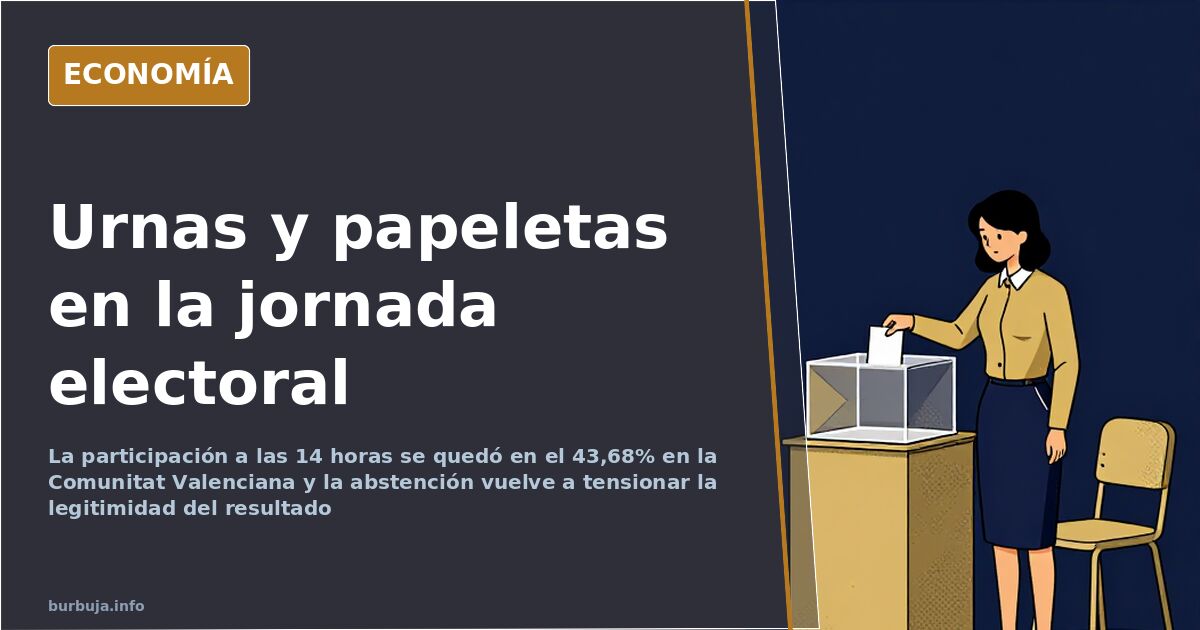
On May 28, 2023, with polls open, the dominant story was not a result but an absence. In the Valencian Community, turnout by 2 p.m. stood at 43.68%, lower than in 2019. In Catalonia, debate assumed less than half the electorate had voted, though no official data confirmed it. Abstention ceased to be a sociological curiosity and became a headline.
The core question is not whether there is anger—there is plenty—but what to do with it. Not voting is one thing; believing that not voting achieves something is another. That is where the trouble begins.
What turnout was recorded on Election Day?
The only concrete figure presented was for the Valencian Community: 43.68% by 2 p.m., below the 2019 level. Catalonia lacked an official percentage in circulating materials. The recurring interpretation is that a vast portion of the census stayed home, despite lacking official backing.
Here lies the first contradiction: low turnout does not inherently invalidate results. Yet each election repeats the mantra that not voting does not count. The issue is that it indeed counts for nothing important: it does not reduce seats, nullify sessions, or force re-voting.
Numbers debunking the 'every vote counts' myth
If individual votes carried manual weight, arithmetic would be proportional. It is not. In Madrid, Isabel Díaz Ayuso’s PP lost around 40,000 votes compared to the previous election yet gained six more seats, reaching an absolute majority. Less support, more power.
In Castilla-La Mancha, three parties hold parliamentary representation. PP and VOX votes exceed PSOE’s, yet PSOE governs via absolute majority. In Andalusia, last year’s elections saw PP win 1.6 million votes from a 6.6 million census, governing with an absolute majority. Converting votes to seats and seats to government bears little relation to summing wills.
For the average abstainer, this means their absence moves none of these pieces. Abstention is not a negative vote; it is a void. And voids are not counted.
Does staying home matter? Abstention vs. spoiled ballots
Analysis splits three ways. One stream argues abstention is the sole real tool for delegitimization: if half the census does not endorse the result, governance rests on shaky ground. Another responds with cold arithmetic: no turnout threshold invalidates anything; results are proclaimed regardless, and non-voters let others decide.
A third path has gained traction: so-called active abstention, a social media label proposing showing up to spoil the ballot rather than staying home. The aim is to make rejection visible without ceding the void.
History offers no clear answer. Users recalled the 2006 Statute referendum passed with 50.5% abstention, yet nobody declared it invalid. Low participation has often been used as a political weapon, never as grounds for nullity.
Who votes when participation plummets?
A repeated thesis claims that when the active electorate shrinks, remaining voters have a specific profile: pensioners, civil servants, public employees, plus politicians and their circles. This is unverified intuition, not data, explaining part of the frustration. If those voting benefit from the system, the incentive to maintain status quo is evident.
The corollary has two sides. For some, voting merely legitimizes machinery and prolongs the circus. For others, precisely because voters have things to lose, abstaining hands them control. Neither stance relies on hard data, causing deadlock.
Does abstention alter seat distribution?
No. Seats are distributed identically, parliamentary groups form the same way, and majorities are invested equally. Some exaggerate: MPs trinc party lines whether 0% or 100% vote. It is hyperbole, but reflects widespread intuition: chamber composition does not depend on how many stay home.
Abroad, the argument reverses: US abstention is even higher, yet few doubt system legitimacy. This comparison cuts both ways: minimizing data importance or proving low turnout is not exclusively Spanish.
With these elements, the conclusion is uncomfortable. Abstention topples no governments, invalidates no majorities, forces no movement. Why, then, does every election feel like the last?
On May 28, 2023, with polls open, the dominant story was not a result but an absence. In the Valencian Community, turnout by 2 p.m. stood at 43.68%, lower than in 2019. In Catalonia, debate assumed less than half the electorate had voted, though no official data confirmed it. Abstention ceased to be a sociological curiosity and became a headline.
The core question is not whether there is anger—there is plenty—but what to do with it. Not voting is one thing; believing that not voting achieves something is another. That is where the trouble begins.
What turnout was recorded on Election Day?
The only concrete figure presented was for the Valencian Community: 43.68% by 2 p.m., below the 2019 level. Catalonia lacked an official percentage in circulating materials. The recurring interpretation is that a vast portion of the census stayed home, despite lacking official backing.
Here lies the first contradiction: low turnout does not inherently invalidate results. Yet each election repeats the mantra that not voting does not count. The issue is that it indeed counts for nothing important: it does not reduce seats, nullify sessions, or force re-voting.
Numbers debunking the 'every vote counts' myth
If individual votes carried manual weight, arithmetic would be proportional. It is not. In Madrid, Isabel Díaz Ayuso’s PP lost around 40,000 votes compared to the previous election yet gained six more seats, reaching an absolute majority. Less support, more power.
In Castilla-La Mancha, three parties hold parliamentary representation. PP and VOX votes exceed PSOE’s, yet PSOE governs via absolute majority. In Andalusia, last year’s elections saw PP win 1.6 million votes from a 6.6 million census, governing with an absolute majority. Converting votes to seats and seats to government bears little relation to summing wills.
For the average abstainer, this means their absence moves none of these pieces. Abstention is not a negative vote; it is a void. And voids are not counted.
Does staying home matter? Abstention vs. spoiled ballots
Analysis splits three ways. One stream argues abstention is the sole real tool for delegitimization: if half the census does not endorse the result, governance rests on shaky ground. Another responds with cold arithmetic: no turnout threshold invalidates anything; results are proclaimed regardless, and non-voters let others decide.
A third path has gained traction: so-called active abstention, a social media label proposing showing up to spoil the ballot rather than staying home. The aim is to make rejection visible without ceding the void.
History offers no clear answer. Users recalled the 2006 Statute referendum passed with 50.5% abstention, yet nobody declared it invalid. Low participation has often been used as a political weapon, never as grounds for nullity.
Who votes when participation plummets?
A repeated thesis claims that when the active electorate shrinks, remaining voters have a specific profile: pensioners, civil servants, public employees, plus politicians and their circles. This is unverified intuition, not data, explaining part of the frustration. If those voting benefit from the system, the incentive to maintain status quo is evident.
The corollary has two sides. For some, voting merely legitimizes machinery and prolongs the circus. For others, precisely because voters have things to lose, abstaining hands them control. Neither stance relies on hard data, causing deadlock.
Does abstention alter seat distribution?
No. Seats are distributed identically, parliamentary groups form the same way, and majorities are invested equally. Some exaggerate: MPs trinc party lines whether 0% or 100% vote. It is hyperbole, but reflects widespread intuition: chamber composition does not depend on how many stay home.
Abroad, the argument reverses: US abstention is even higher, yet few doubt system legitimacy. This comparison cuts both ways: minimizing data importance or proving low turnout is not exclusively Spanish.
With these elements, the conclusion is uncomfortable. Abstention topples no governments, invalidates no majorities, forces no movement. Why, then, does every election feel like the last?
Summary of a discussion on Burbuja.info - Foro de economía, actualidad y política., translated from Spanish and reviewed before publication. Read the full discussion (117 replies).
More summaries
-
Carlos Latre's Ayuso impression ignites political humour row
Carlos Latre impersonates Isabel Díaz Ayuso on El Hormiguero, reopening the debate over double standards in political humour
-
Spanish rower Jennie Sanchez quits sport for OnlyFans
With nearly 900,000 followers and a modest rowing scholarship, Spanish athlete Jennie Sanchez turns to digital content.
-
Spain's Bureaucracy Under Fire After Valencia Floods
Forum users criticize the official response to Spain's Valencia floods, citing late warnings and neighbor-led rescues.
-
AI Music: End of Singers or Playback?
Generative AI lowers commercial music costs, boosting live shows. The debate: who gets paid when songs cost a subscription, not studio time.
-
Spain's 'Immediate' DANA Response Plan Arrives a Week Late
Spain’s government unveiled its Immediate Response Plan for Valencia one week after the DANA floods, offering 10,000 aids, half as loans.
-
Spain: Arrest for touching Femen activist sparks debate
A Spanish forum debates the arrest of a man who touched a Femen activist's breast during a protest, highlighting conflicting views on sexual assault versus provocation.