
Trump tariffs: Fed pressure fails as markets lose trust
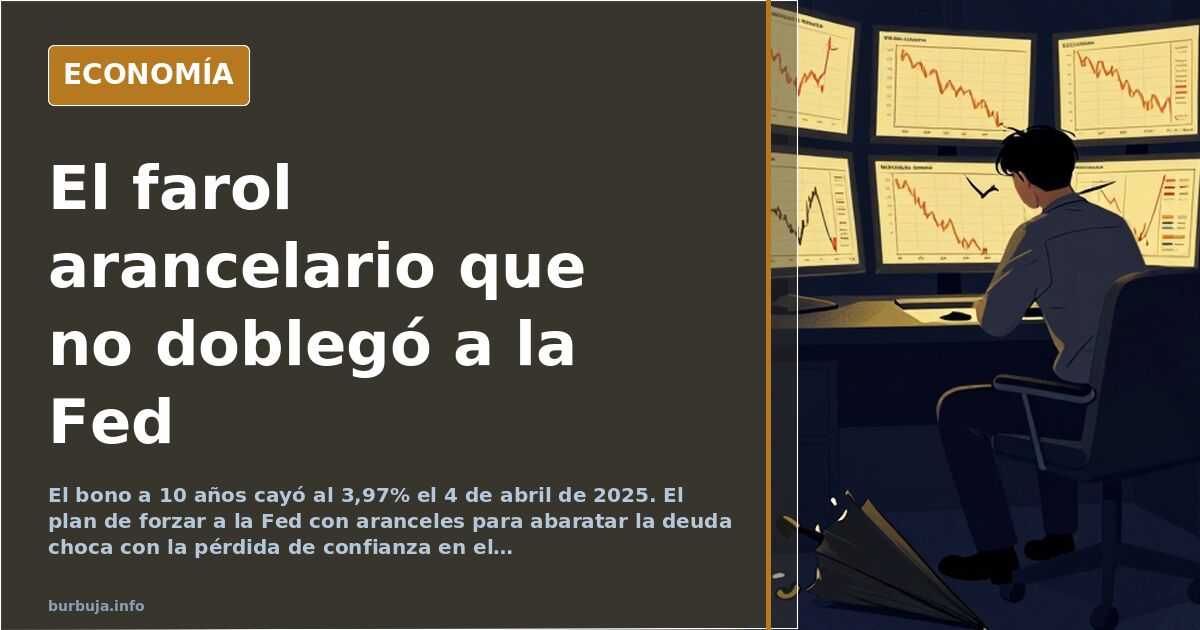
US 10-year Treasury yield dropped to 3.97% on April 4, 2025. The strategy of using tariffs to force the Federal Reserve into rate cuts clashes with eroding market confidence.
English · Original discussion in Spanish · Published
Trump tariffs: Fed pressure fails as markets lose trust
On April 4, 2025, the yield on the 10-year US Treasury note fell below 4%, hitting 3.97%, its lowest level since October 2024. This was not a spontaneous market move; according to analysis, it was the result of a deliberate strategy. The thesis is that the US administration needs to refinance short-term maturities—bills at 4.30% for one month, 4.28% for three months, 4.16% for six months, and 3.89% for one year—and that the chosen path to lower these costs is to shock markets with aggressive tariffs, forcing the Federal Reserve to cut rates before those maturity dates.
The analogy circulating is domestic: it is as if an individual could manipulate the market to lower the Euribor index a month before their mortgage rate review. The difference here is that this "individual" controls the world's largest economy, and the weapon is a tariff announcement.
What the tariffs aim to achieve and why the calculation fails
The mechanics of the plan, as described, have two phases. First, crash markets to force the Fed to cut rates and reduce debt refinancing costs. Second, once achieved, remove the tariffs after warning allies. The problem is that phase one did not proceed as quickly as expected, and facing collapse risks, they jumped straight to phase two.
Central to the skepticism about this maneuver is that the bluff has been called against third-party countries no longer willing to accept it. "China isn't fooled," summarizes one frequently cited view. The underlying idea is that the US continues to act as if it were 1990, post-Soviet Union, while the world has changed: there are now countries with educated populations, industrial capacity, and a refusal to play second fiddle.
Confidence in the dollar and bonds questioned
Beyond debt costs, the identified damage is reliability. "After betraying Ukraine and Trump's 'I don't care' attitude toward tariffs, he has shown he is untrustworthy and keeps a dagger up his sleeve even for allies," argues one widely shared thesis. The question raised is who will support Washington when proposing sanctions against Iran or Venezuela, or who will invest in Treasuries if the framework is perceived as a unilateral negotiation board.
Some compare this move to other precedents that eroded system credibility: the confiscation of Russian reserves, massive dollar issuance during the pandemic, or judicial maneuvers to sideline inconvenient candidates. The shared conclusion is that such short-term brilliance comes at a medium- and long-term cost.
Stock market impact: liquidity and distrust
The repeated recommendation is to hold cash and watch from the sidelines. The argument isn't just tariff risk; it also weighs heavily on the feeling that the market is manipulated. "After seeing how a US president promoted two pump-and-dump memecoins on his inauguration day, you need to be in cash," summarizes one intervention.
Not everyone shares this diagnosis. Some argue stocks were due for a correction anyway after rising significantly during the election cycle, and technically the US market hasn't yet lost its 200-day moving average. For this group, the drop is an opportunity for dividend investors, not a signal of collapse.
Background: debt, reindustrialization, and who pays the adjustment
The broader context is US debt. It is noted that a huge amount of debt must be refinanced this year and that interest payments will become the largest item in public spending. The pessimistic reading is that the country is technically bankrupt and the only way out is a brutal adjustment, with the particularity that they try to make vassal states pay rather than themselves alone.
The optimistic reading, defended vigorously, is that this is a medium- and long-term reset: negotiating each import and export country by country, as any businessman would, and dismantling the chaotic arrangements of recent decades. The counterargument is that factories aren't built in fifteen days and that production costs in the US—concrete, energy, wages—will miccionan the average voter pays more for everything while waiting for reindustrialization that doesn't arrive.
The disorienting data point isn't the drop in the 10-year bond yield. It is that, with short-term rates still above 4%, the bond market has become the arena where a game nobody knows how ends is played. And the question is no longer whether the Fed will cut rates, but whether anyone believes what Washington signs.
Also available in: Deutsch
Summary of a discussion on Burbuja.info - Foro de economía, actualidad y política., translated from Spanish and reviewed before publication. Read the full discussion (110 replies).
More summaries
-
Trump and Musk Freeze FEMA Funds Targeting NGOs
Trump and Musk pause FEMA payments and review federal agencies. Reports cite over $1 billion to NGOs, sparking panic among officials.
-
Trump increasingly isolated as Middle East ignores his plans
Trump sees his Middle East proposals rejected while accepting a $400 million plane from Qatar and China sells arms to Algeria.
-
Spain's 12-month Treasury bills hit 3.804%, highest since 2012
Spain issues 12-month Treasury bills at 3.804%, the highest rate since July 2012, as savers seek refuge from inflation eroding returns.
-
Italy: diesel hits 3 euros as truckers' protests bring traffic to a halt
Diesel is nearing 3 euros on Italian motorways, trucks are blocking roads and supermarkets in southern Italy are emptying out. In Turin, police used tear gas against students.
-
Selling AI-written romance novels to women
Coral Hart has sold over one million digital, print and audio copies of romance novels written by ChatGPT, Claude and Grok. Here's how the business works.
-
Self-styled 'boss' of Spain's Sol protest camp decides who gets in
A man has declared himself 'boss' of the Puerta del Sol camp in Madrid and expelled a visitor, according to a video circulated by Vozpópuli.