
Spain's 12-month Treasury bills hit 3.804%, highest since 2012
Spain issues 12-month Treasury bills at 3.804%, the highest rate since July 2012, as savers seek refuge from inflation eroding returns.
English · Original discussion in Spanish · Published
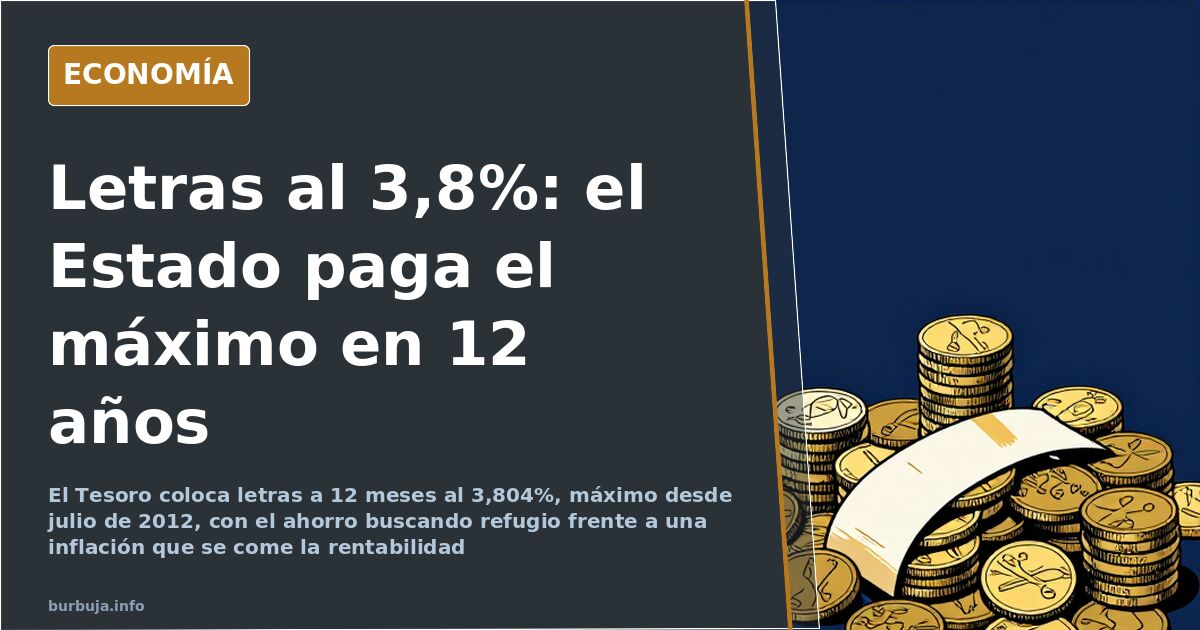
Treasury bills at 3.8%: Highest interest rate since 2012
The Spanish Public Treasury placed 12-month bills at 3.804%, the highest yield since July 2012. Twelve years later, one-year funding costs what it did during the debt crisis, and retail savings are returning to public debt as a safe haven. In a single day, 5 billion euros were placed, according to figures broadcast on television. The data allows for at least two uncomfortable interpretations.
First: that the State pays 3.804% means it competes directly with bank deposits, which have offered no remuneration for months. Second: that yield remains below what inflation has eaten away. Between both appears a recurring suspicion: when the Treasury sells debt to small savers during prime time, it is because it needs the money.
Why does the Treasury pay 3.804% for 12-month bills?
The rate is set by auction, and the auction responds to the ECB. With money prices at levels unseen in years, short-term debt has become more expensive at every call. The majority expectation is that the ECB is not finished: some argue it will not stop until 5%, while others believe it will stay near the current 4%.
The core issue is not technical, but calendar-related. Each auction competes with the previous one, and those buying today for one year assume they cannot move their funds for twelve months. Hence, the 3.804% is read through an expectations lens: the market is pricing further hikes.
Yield eaten up by inflation
A 3.804% sounds good until compared with the shopping basket. Cumulative inflation over four years is around 16% and basic spending has increased by about 30% in just two years. With that reference, bill interest covers paper, not purchasing power.
Added to this is income loss: the modal salary has fallen from 1,400 to 1,200 euros. Those buying State debt for one year are, at best, breaking even. At worst, lending to a debtor who has quadrupled its liabilities in four years.
Cost of renewing debt at these rates
Here is the disorienting number. If the 1.5 trillion euros in debt —a figure circulating among estimates— had to be renewed at current rates, interest payments would rise to approximately 57 billion euros annually: equivalent to five extra pensions for all retirees in the country. This is not a closed scenario, but a working hypothesis. Debt is not amortized; it is refinanced.
In parallel, the debt-to-GDP ratio has fallen from 120% in 2021 to less than 100% forecast for 2025. The decline exists, but comes mainly from inflation, which inflates the denominator without reducing a single euro of debt owed. In 2022, moreover, 10.8 percentage points of GDP were lost despite runaway inflation.
Why aren't bank deposits remunerated?
Because banks do not need to pay for money they already have. It is the short answer to a recurring question: if the State pays 3.804% for one year, why doesn't a financial institution offer something similar in a fixed-term deposit? Competition between the Treasury and banks for the same savings exists, but it is asymmetric.
From this emerges a recommendation circulating among buyers: in a rising rate environment, better to choose short maturities, 3 or 6 months, and renew with each hike. One gains flexibility and avoids being locked into a rate that will seem low in half a year.
Signals accompanying retail sales
Every time the Treasury advertises debt to small savers, someone recalls that this pattern has been seen before. Names that come up include Forum Filatélico, Afinsa, or Rumasa, products sold as safe and simple investments that ended badly. The comparison is not exact —here the issuer is the State—, but the reflex is there.
Others argue the opposite: that debt is placed so easily because the market trusts the issuer. And there is a third way, less epic and more mundane: buying Treasury bills is simply lending money to a State that later decides how to repay it.
The point where this gets stuck is always the same. If the ECB stops at 4% or continues to 5%, the 12-month bill bought today will be a good or bad decision, and no one signs off on the answer. Meanwhile, youth unemployment remains the highest in Europe, productivity stays below Greece's, and the average housing price stands at 1,927 euros per square meter. The 3.804% is a fact. What each person does with it is another matter.
Also available in: Deutsch
Summary of a discussion on Burbuja.info - Foro de economía, actualidad y política., translated from Spanish and reviewed before publication. Read the full discussion (120 replies).
More summaries
-
Spanish Treasury Bills: how investing in government debt works
A complete guide to Letras del Tesoro (Spanish Treasury bills): how to buy them, real returns, taxes, bank fees and what happens if your bank goes under.
-
ECB delays return to 2% inflation target until after 2025
ECB minutes admit the 2% goal won't be forced before 2025 to protect GDP. Rising food costs erode savings' purchasing power.
-
Romania on the brink of a bailout: debt at 7% and government fallen
Romania is suffering double-digit inflation and debt at 7% after its government fell in a no-confidence vote. Will it repeat Spain's 2011 crisis?
-
Enerparc's Viral Debt: From $33,000 Million to $33.4 Million
A viral tweet attributed a debt of $33,000 million to the German solar company Enerparc; the actual figure being reported is $33.4 million.
-
Iran subsidizes sex changes while criminalizing homosexuality
Iran pays for gender-affirming surgery yet punishes homosexuality: the Shia logic that reconciles the irreconcilable.
-
Spain's army in Ceuta and the migration policy row
A video from Ceuta shows soldiers letting migrants through, reigniting the tension between obedience and defence. An analysis of both positions and the Paula case.