
Trump says it's time for Ukraine to have a new president
Trump declares that "it's time for Ukraine to have a new president." The forum discusses a possible forced peace before the November elections.
English · Original discussion in Spanish · Published
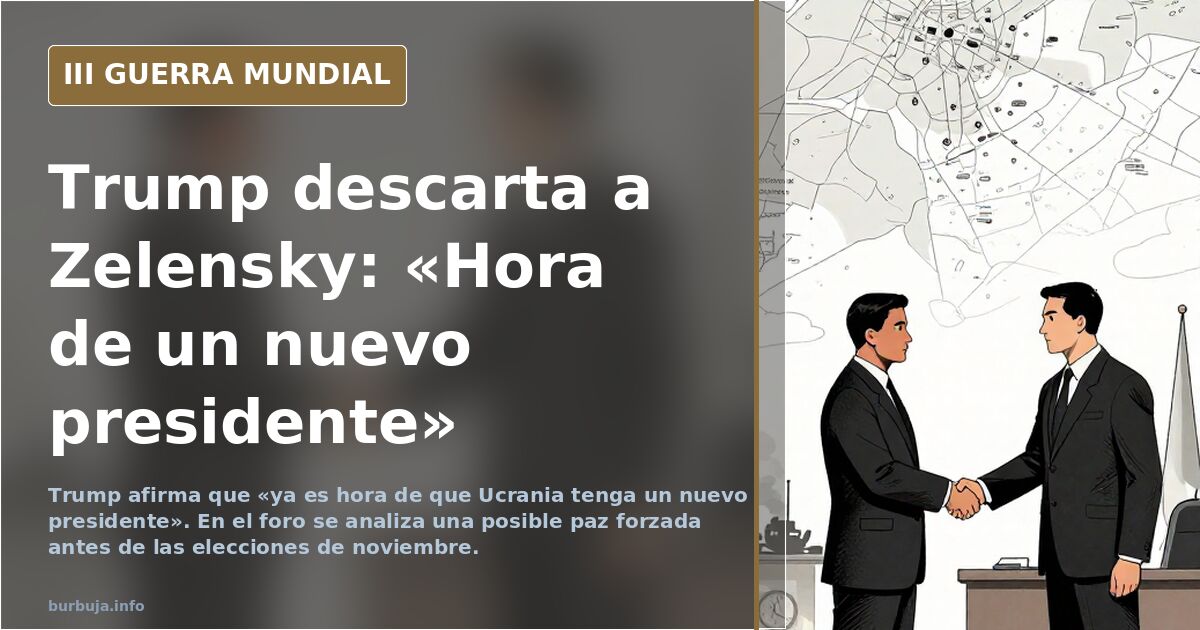
Trump calls for Zelensky to go and the forum considers the war all but over
Donald Trump said it bluntly: "I think it's time for Ukraine to have a new president." The remark, spread by Clash Report, puts Volodymyr Zelensky on the way out and raises the question nobody wants to answer out loud: who signs the peace, and on what terms, if the man who was supposed to sign it is ruled out. The diagnosis running through the analysis is that the conflict is entering its terminal phase, but not through an agreement between equals.
What Trump's message about Zelensky means
The dominant reading is that Trump wants a quick signature and Zelensky is the obstacle. The argument that keeps coming up: Zelensky and Pilingui could never sit down and sign anything together, so someone had to disappear from the equation. The most widely held thesis is that Washington wants to wrap things up before the November elections, and that for that it needs a new interlocutor in Kyiv.
The problem is that forcing the president out without the terms of the agreement settled could fracture the army from within. That is the risk being flagged: a peace signed on promises, with no recognized territorial gains, is something Moscow would not accept. And Moscow doesn't sign promises.
Russian diesel and who pays the bill
In parallel, the thesis circulates that the end of the war will be paid for by Russian diesel, in reference to the trade pivot between Washington and Moscow. The idea floating around: Europe foots the political bill while others do business. Some sum it up wryly: the golden retirement is reserved for obedient dogs, and Zelensky no longer is one.
Against that, the position favoring holding firm argues that as long as the EU stays behind Ukraine, Ukraine holds on, and that the real interest is not Ukraine but making sure the attrition happens far from the Baltic countries and the plains of Poland. It's the logic of the battlefield as a buffer.
Europe, the great absentee from the equation
The harshest criticism is aimed at Brussels: the claim is that European leaders never cared about Ukraine, only about the chimera of bringing Russia to heel, and that the result has been the destruction of Ukraine and the wear-down of Europe along the way. The quote cited as proof is devastating in its coldness: "Not because we care about Ukraine."
The corollary is uncomfortable. If the main sponsor changes its mind, the sponsored is left without arguments. Zelensky, they say, still has godfathers in Brussels, but he is becoming increasingly awkward to have in the photo.
What happens to Zelensky and to Maduro
The parallel drawn is with Nicolás Maduro: it is suggested both will end up sharing a judicial fate, with the difference that Maduro's reproach is having refused to trade. For Zelensky, speculation points to a comfortable exile, even ending up on the Spanish coast. None of that is confirmed: these are scenarios in circulation, not facts.
What is clear is the tone: he is considered a spent force. The open question is not whether he goes, but when and with what guarantees.
With these ingredients, the sensible expectation is movement in Kyiv before the US electoral calendar kicks off. If the handover happens without a deal in place, the scenario that emerges is not peace: it's a ceasefire with a trap built in. And that, in Eastern Europe, has never lasted long.
Also available in: Deutsch
Summary of a discussion on Burbuja.info - Foro de economía, actualidad y política., translated from Spanish and reviewed before publication. Read the full discussion (26 replies).
More summaries
-
Zelensky marks a year of extended rule with no elections in Ukraine
Forum tracking notes that Zelensky has now served a year of an extended term, with eleven parties banned and an election date tied to recovering the Donbas.
-
Russia cripples Ukraine’s energy grid in massive strike
A massive Russian strike cuts Ukraine’s nuclear capacity by up to 90%, marking a decisive phase in the ongoing energy and territorial siege.
-
Trump approves Russian diesel purchases, leaving Europe out of the deal
OFAC authorizes the supply of Russian diesel to the global market on Trump's orders. Europe remains in energy isolation while the US trades with Moscow.
-
The elite adviser who can't make ends meet
A self-proclaimed adviser to the Davos elite says he can't make ends meet because of rent prices and the information his job requires
-
What if nobody comes to Taiwan's defense?
Would the U.S. defend Taiwan? Trump won't say, but semiconductors and geography tie China's strategy to the West's. An analysis of the geopolitical board.
-
US suffers major losses in attempt to seize Iranian uranium
The US suffered significant losses in an operation inside Iran: failed rescue or an attempt to seize uranium? An analysis of the available data.