
Trump pressures Denmark over Greenland
Donald Trump is pressing Denmark over Greenland, threatening tariffs and military action. The debate centers on geostrategic interests and resources…
English · Original discussion in Spanish · Published
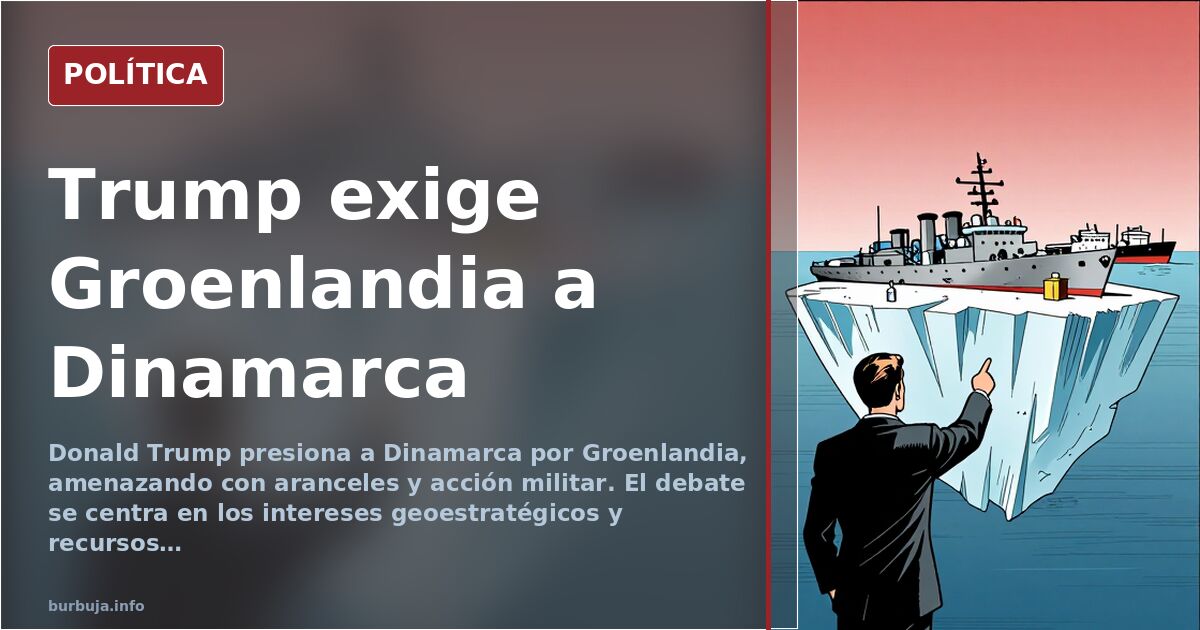
Trump pressures Denmark over Greenland
What lies behind Donald Trump's offer to buy Greenland from Denmark? The proposal, which has sparked intense debate, highlights the United States' geostrategic ambitions and international tensions. While some see it as a realpolitik masterstroke, others call it blatant imperialism. Far from being a mere anecdote, the affair lays bare the complex power relations and economic interests that pull the strings of global politics.
The idea of acquiring Greenland is not new for the United States. A similar offer was floated as early as 1946, and the U.S. military presence on the island, with Thule Air Base, has been a constant since 1940. However, Trump's insistence—even threatening tariffs and military action—raises the stakes of the negotiation. The U.S. president-elect cites "national security" grounds, a term open to varied interpretations and one that, according to some analyses, could mask interest in the island's rich natural resources, such as natural gas, or its strategic position in the Arctic.
The cost of keeping Greenland
For Denmark, Greenland represents a considerable financial burden. The annual subsidy is estimated at around $700 million, half of the island's revenue. In addition, growing demands for autonomy among Greenlanders, with pro-independence parties blocking mining concessions, add complexity to Danish management. The possibility of shedding this responsibility by selling or ceding the territory appears tempting for Copenhagen, which would ease its fiscal balance and rid itself of a source of internal tensions.
Conflicting interpretations
The debate is polarized between those who see Trump's move as a display of "Tito Trump rules" and those who criticize it as a "victimhood narrative" orchestrated by the "caninasis." It is argued that the United States, far from having lost its "hunger for territory" after conquering its coast-to-coast expanse, continues to expand its influence. The purchase of Alaska from Russia or the annexation of territories through purchases and wars, such as Mexico, are cited as precedents. The irony arises when comparing imperialist rhetoric with the supposed "democracy" and "free world" defended by Western countries—fantasies for Europeans, according to some.
The China factor and Arctic geopolitics
On the geopolitical chessboard, Trump's move could be interpreted as a strategy to counter China's growing influence in the Arctic. Control of Greenland, rich in natural resources and strategically located, would allow the U.S. to secure its hegemony in the region and guarantee access to key trade routes. "Brute force" and "direct control" over nerve points such as Greenland or the Panama Canal are presented as tools to prevent a "Chinese overtake."
Reactions and future scenarios
Reactions were not long in coming. While some celebrate Trump's audacity, others antiestéticar the consequences of such an aggressive foreign policy. The possibility that Russia might also claim part of Greenland, as has been heard on Russian state television, adds another layer of complexity to the situation. According to accounts, Greenland's own population is living "in terror" amid international visibility and potential conflict.
Greenland's future remains uncertain. Trump could secure significant advantages through deals, such as military bases or bids for resource exploitation. Or, in a more drastic scenario, he could opt for direct occupation. What seems clear is that the "purchase" of Greenland has become a symbol of global tensions and the power ambitions of major powers.
The debate over identity and territory
Beyond geopolitics, the debate has shifted toward questions of national identity and sovereignty. The very conception of "empire" and "territory" is being questioned, and visions of "province" and "overseas territory" are being contrasted. The history of relations between Spain, Cuba, and Puerto Rico, or the conquest of Alaska itself, are brought up to illustrate how borders and spheres of influence have been forged. The idea that "no empire has ever fallen without a fight" resonates as a reminder of the often violent nature of territorial expansion.
The role of "patriots" and criticism of the "official narrative"
One current of opinion criticizes the "official patriots" who, they say, "throw the worst insults at Spain" but fiercely defend "the Anglos, Israelis, or those from the U.S." There is talk of "superior-quality Stockholm syndrome" and of "hating Spaniards" for being the "obstacle" preventing other countries from "becoming Anglo." This perspective suggests a deep identity crisis and an admiration for the "historical enemy" that, according to some, "snatched territories from you and has been screwing you over since they existed." The dichotomy between "Spaniards" and "Spanish citizens" also emerges in the debate, underscoring the identity tensions underlying the discussion about sovereignty and self-determination.
A power game with resources at stake
Ultimately, the Greenland operation looks like a strategic move on the world board. The island, with its vast untapped natural resources, is becoming the focus of a struggle between powers. "Tito Trump" appears willing to play his cards boldly, prioritizing "brute force" and "direct control" over "diplomacy" when necessary. The question left hanging is whether Denmark will give in to pressure or, on the contrary, defend its sovereignty, even if that entails a considerable cost. The "green land" could become "red, white, and blue land," but the price of that transformation has yet to be defined.
What lies behind Donald Trump's offer to buy Greenland from Denmark? The proposal, which has sparked intense debate, highlights the United States' geostrategic ambitions and international tensions. While some see it as a realpolitik masterstroke, others call it blatant imperialism. Far from being a mere anecdote, the affair lays bare the complex power relations and economic interests that pull the strings of global politics.
The idea of acquiring Greenland is not new for the United States. A similar offer was floated as early as 1946, and the U.S. military presence on the island, with Thule Air Base, has been a constant since 1940. However, Trump's insistence—even threatening tariffs and military action—raises the stakes of the negotiation. The U.S. president-elect cites "national security" grounds, a term open to varied interpretations and one that, according to some analyses, could mask interest in the island's rich natural resources, such as natural gas, or its strategic position in the Arctic.
The cost of keeping Greenland
For Denmark, Greenland represents a considerable financial burden. The annual subsidy is estimated at around $700 million, half of the island's revenue. In addition, growing demands for autonomy among Greenlanders, with pro-independence parties blocking mining concessions, add complexity to Danish management. The possibility of shedding this responsibility by selling or ceding the territory appears tempting for Copenhagen, which would ease its fiscal balance and rid itself of a source of internal tensions.
Conflicting interpretations
The debate is polarized between those who see Trump's move as a display of "Tito Trump rules" and those who criticize it as a "victimhood narrative" orchestrated by the "caninasis." It is argued that the United States, far from having lost its "hunger for territory" after conquering its coast-to-coast expanse, continues to expand its influence. The purchase of Alaska from Russia or the annexation of territories through purchases and wars, such as Mexico, are cited as precedents. The irony arises when comparing imperialist rhetoric with the supposed "democracy" and "free world" defended by Western countries—fantasies for Europeans, according to some.
The China factor and Arctic geopolitics
On the geopolitical chessboard, Trump's move could be interpreted as a strategy to counter China's growing influence in the Arctic. Control of Greenland, rich in natural resources and strategically located, would allow the U.S. to secure its hegemony in the region and guarantee access to key trade routes. "Brute force" and "direct control" over nerve points such as Greenland or the Panama Canal are presented as tools to prevent a "Chinese overtake."
Reactions and future scenarios
Reactions were not long in coming. While some celebrate Trump's audacity, others antiestéticar the consequences of such an aggressive foreign policy. The possibility that Russia might also claim part of Greenland, as has been heard on Russian state television, adds another layer of complexity to the situation. According to accounts, Greenland's own population is living "in terror" amid international visibility and potential conflict.
Greenland's future remains uncertain. Trump could secure significant advantages through deals, such as military bases or bids for resource exploitation. Or, in a more drastic scenario, he could opt for direct occupation. What seems clear is that the "purchase" of Greenland has become a symbol of global tensions and the power ambitions of major powers.
The debate over identity and territory
Beyond geopolitics, the debate has shifted toward questions of national identity and sovereignty. The very conception of "empire" and "territory" is being questioned, and visions of "province" and "overseas territory" are being contrasted. The history of relations between Spain, Cuba, and Puerto Rico, or the conquest of Alaska itself, are brought up to illustrate how borders and spheres of influence have been forged. The idea that "no empire has ever fallen without a fight" resonates as a reminder of the often violent nature of territorial expansion.
The role of "patriots" and criticism of the "official narrative"
One current of opinion criticizes the "official patriots" who, they say, "throw the worst insults at Spain" but fiercely defend "the Anglos, Israelis, or those from the U.S." There is talk of "superior-quality Stockholm syndrome" and of "hating Spaniards" for being the "obstacle" preventing other countries from "becoming Anglo." This perspective suggests a deep identity crisis and an admiration for the "historical enemy" that, according to some, "snatched territories from you and has been screwing you over since they existed." The dichotomy between "Spaniards" and "Spanish citizens" also emerges in the debate, underscoring the identity tensions underlying the discussion about sovereignty and self-determination.
A power game with resources at stake
Ultimately, the Greenland operation looks like a strategic move on the world board. The island, with its vast untapped natural resources, is becoming the focus of a struggle between powers. "Tito Trump" appears willing to play his cards boldly, prioritizing "brute force" and "direct control" over "diplomacy" when necessary. The question left hanging is whether Denmark will give in to pressure or, on the contrary, defend its sovereignty, even if that entails a considerable cost. The "green land" could become "red, white, and blue land," but the price of that transformation has yet to be defined.
Summary of a discussion on Burbuja.info - Foro de economía, actualidad y política., translated from Spanish and reviewed before publication. Read the full discussion (443 replies).
More summaries
-
Charlie Kirk Assassination Sparks Fears of US Collapse
The September 10, 2025 assassination of Charlie Kirk reignites debate on US political collapse and the dollar's role.
-
In 1960, 13% of Spain's university students were women; in the US, 38%
In 1960, 13% of Spain's university students were women, compared with 38% in the US. The figure reopens the debate about women under Franco.
-
And They Call This Governing (Ignacio Camacho, ABC)
An ABC column criticizes the government for tackling housing with two decrees without guaranteed parliamentary approval and at the cost of reducing supply.
-
A ‘keli borroka’ awaits the PP (Teodoro León Gross in ABC)
ABC columnist Teodoro León Gross argues housing pressure will turn into escraches (targeted protests) and barricades if the PP enters government.
-
A democratic obligation unfulfilled (ABC editorial)
Article 134.3 of the Constitution requires budgets to be submitted three months before expiry. Spain is still running on the 2023 Budget.
-
Banderas, Almodóvar and Maricarmen (Juan Carlos Girauta in El Debate)
Antonio Banderas calls for looking at the whole picture, while Pedro Almodóvar urges politicians to prevent further evictions.