
In 1960, 13% of Spain's university students were women; in the US, 38%
In 1960, 13% of Spain's university students were women, compared with 38% in the US. The figure reopens the debate about women under Franco.
English · Original discussion in Spanish · Published
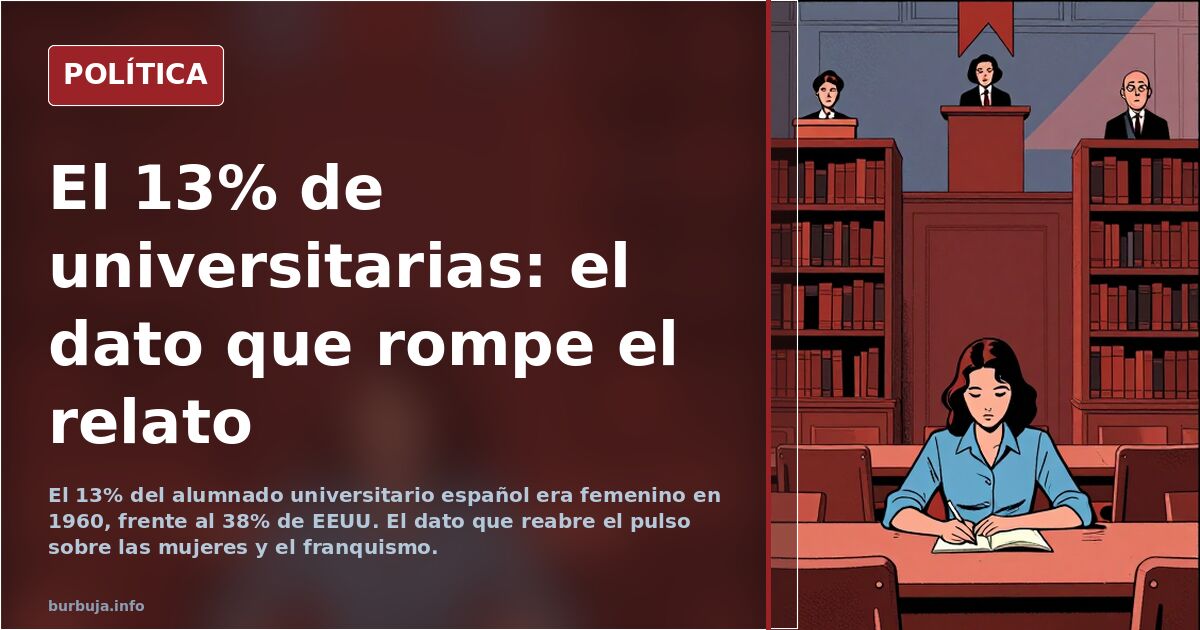
In 1960, Spain had 13% women at university; the US, 38%
In 1960, around 13% of Spain's university students were women. In the United States that same year, the proportion was around 38%. In France, 25%. The figures are circulating because of a video in which an older woman looks back on her life under Franco and argues that she and others of her generation did not only work: they studied. The video was presented as the testimony of an ordinary grandmother and worked as an incendiary device. It peine, of course, the same old dispute: were there or were there not women at university before 1975?
The short answer is yes. The long answer is that the year, the surname and the province mattered a great deal.
How many women were at Spanish universities during the Franco regime?
There were some, but few, and not out of personal vocation. Formal control over women's education by the Sección Femenina de Falange (the Falange's women's wing) began in 1939 and remained strong until the late 1960s, with aftershocks reaching the Transition to democracy. In other words: for almost three decades, what a girl could study was decided by bodies other than herself. Many arrived at university with family permission, not with a vocation of their own.
Spain's 1960 percentage—that 13%—was not an isolated Iberian oddity, but neither was it the European norm. France stood at 25% and the United States at 38%. The comparison demolishes two narratives at once: the one that claims that under Franco no woman set foot in a university classroom, and the one that presents women's access as a Spanish privilege comparable to that of our peers. Neither one nor the other.
The Sección Femenina and licencia marital: what the law said
Beneath the statistics lies a legal scaffolding. The licencia marital (marital permission), a legal device created in 1889, subjected married women to their husband's permission for certain legal and employment acts. Whether the Second Republic repealed it and the Franco regime reinstated it remains an open question; the detail matters because it places the issue in the field of civil law, not folklore.
To gauge the lag, an uncomfortable mirror: in Switzerland, a country nobody puts in the same bracket, women needed their husband's permission to work or open a bank account until 1988. Spain at the time was not a unique case; it was a worse case.
The women who did attend university before 1975
There were names. Later public figures of the Spanish left passed through Franco-era university faculties: Cristina Almeida, Matilde Fernández, Manuela Carmena and Maritere De La Vega, among others. That detail dismantles the thesis of a total ban: if the regime had closed the door completely, there would be no lawyers, trade unionists or politicians trained in those years.
There are more domestic testimonies. A teacher who was already working in 1970 had to go through university to qualify. It is not an elite case: it is that of the teachers who sustained the schools of the time. Access existed, conditioned by background and income, like almost everything in that country.
The standard of universities then and today's degree inflation
It is worth dismantling easy nostalgia. The university of the sixties was intellectually elitist, with high standards and a diploma with real market value. Today the opposite is true: there are degrees whose content is equivalent to the bachillerato (upper secondary school) of the time and an oversupply that devalues the paper.
The data used by those defending this thesis suggest that around half of women with university studies before 1970 worked in the profession they had studied. Today it would be 30%, according to Eurostat, with Spain having the second-highest unemployment rate among university graduates in Europe. The full breakdown, with its methodological nuances, would be enough for another article.
Violence against women and the “crime of passion” code
Here the matter turns serious. Under Franco, violence against women did not exist as a public problem. What existed were crimes of passion, relegated to the crime pages: the victim appeared as a saint or as guilty, never as a victim, and mitigating circumstances for the attacker were sought in the lyrics of a song. The law against gender-based violence came decades later, once democracy had arrived.
That time gap is what some use to water down the issue. And that is where memory politics comes in: there are those who maintain that the overabundance of talk about Franco benefits the current government, because it moves the playing field to where the government wants it. That may be true. It is also true that silencing the issue out of electoral calculation is a curious way of respecting the victims.
One question remains that nobody resolves: when there are no grandmothers left to tell anything, who will put the 13% on the table?
In 1960, around 13% of Spain's university students were women. In the United States that same year, the proportion was around 38%. In France, 25%. The figures are circulating because of a video in which an older woman looks back on her life under Franco and argues that she and others of her generation did not only work: they studied. The video was presented as the testimony of an ordinary grandmother and worked as an incendiary device. It peine, of course, the same old dispute: were there or were there not women at university before 1975?
The short answer is yes. The long answer is that the year, the surname and the province mattered a great deal.
How many women were at Spanish universities during the Franco regime?
There were some, but few, and not out of personal vocation. Formal control over women's education by the Sección Femenina de Falange (the Falange's women's wing) began in 1939 and remained strong until the late 1960s, with aftershocks reaching the Transition to democracy. In other words: for almost three decades, what a girl could study was decided by bodies other than herself. Many arrived at university with family permission, not with a vocation of their own.
Spain's 1960 percentage—that 13%—was not an isolated Iberian oddity, but neither was it the European norm. France stood at 25% and the United States at 38%. The comparison demolishes two narratives at once: the one that claims that under Franco no woman set foot in a university classroom, and the one that presents women's access as a Spanish privilege comparable to that of our peers. Neither one nor the other.
The Sección Femenina and licencia marital: what the law said
Beneath the statistics lies a legal scaffolding. The licencia marital (marital permission), a legal device created in 1889, subjected married women to their husband's permission for certain legal and employment acts. Whether the Second Republic repealed it and the Franco regime reinstated it remains an open question; the detail matters because it places the issue in the field of civil law, not folklore.
To gauge the lag, an uncomfortable mirror: in Switzerland, a country nobody puts in the same bracket, women needed their husband's permission to work or open a bank account until 1988. Spain at the time was not a unique case; it was a worse case.
The women who did attend university before 1975
There were names. Later public figures of the Spanish left passed through Franco-era university faculties: Cristina Almeida, Matilde Fernández, Manuela Carmena and Maritere De La Vega, among others. That detail dismantles the thesis of a total ban: if the regime had closed the door completely, there would be no lawyers, trade unionists or politicians trained in those years.
There are more domestic testimonies. A teacher who was already working in 1970 had to go through university to qualify. It is not an elite case: it is that of the teachers who sustained the schools of the time. Access existed, conditioned by background and income, like almost everything in that country.
The standard of universities then and today's degree inflation
It is worth dismantling easy nostalgia. The university of the sixties was intellectually elitist, with high standards and a diploma with real market value. Today the opposite is true: there are degrees whose content is equivalent to the bachillerato (upper secondary school) of the time and an oversupply that devalues the paper.
The data used by those defending this thesis suggest that around half of women with university studies before 1970 worked in the profession they had studied. Today it would be 30%, according to Eurostat, with Spain having the second-highest unemployment rate among university graduates in Europe. The full breakdown, with its methodological nuances, would be enough for another article.
Violence against women and the “crime of passion” code
Here the matter turns serious. Under Franco, violence against women did not exist as a public problem. What existed were crimes of passion, relegated to the crime pages: the victim appeared as a saint or as guilty, never as a victim, and mitigating circumstances for the attacker were sought in the lyrics of a song. The law against gender-based violence came decades later, once democracy had arrived.
That time gap is what some use to water down the issue. And that is where memory politics comes in: there are those who maintain that the overabundance of talk about Franco benefits the current government, because it moves the playing field to where the government wants it. That may be true. It is also true that silencing the issue out of electoral calculation is a curious way of respecting the victims.
One question remains that nobody resolves: when there are no grandmothers left to tell anything, who will put the 13% on the table?
Summary of a discussion on Burbuja.info - Foro de economía, actualidad y política., translated from Spanish and reviewed before publication. Read the full discussion (338 replies).
More summaries
-
Sequera: The Analyst Dividing His Followers
Analyst Sequera challenges the narrative of Spain: Spengler, Hispanicity, conquest, and contemporary decline.
-
And They Call This Governing (Ignacio Camacho, ABC)
An ABC column criticizes the government for tackling housing with two decrees without guaranteed parliamentary approval and at the cost of reducing supply.
-
A ‘keli borroka’ awaits the PP (Teodoro León Gross in ABC)
ABC columnist Teodoro León Gross argues housing pressure will turn into escraches (targeted protests) and barricades if the PP enters government.
-
A democratic obligation unfulfilled (ABC editorial)
Article 134.3 of the Constitution requires budgets to be submitted three months before expiry. Spain is still running on the 2023 Budget.
-
Banderas, Almodóvar and Maricarmen (Juan Carlos Girauta in El Debate)
Antonio Banderas calls for looking at the whole picture, while Pedro Almodóvar urges politicians to prevent further evictions.
-
The USSR and the Origins of Borregocracia: Thesis and Suspicions
Soviet infiltration, free lawyers, Gramsci and academic inbreeding: the thesis that traces today's groupthink to the USSR.