
Trump links EU tariffs to factory relocation to US
Trump demands European firms move production to the US to avoid tariffs, highlighting labor cost disparities and industrial decline.
English · Original discussion in Spanish · Published
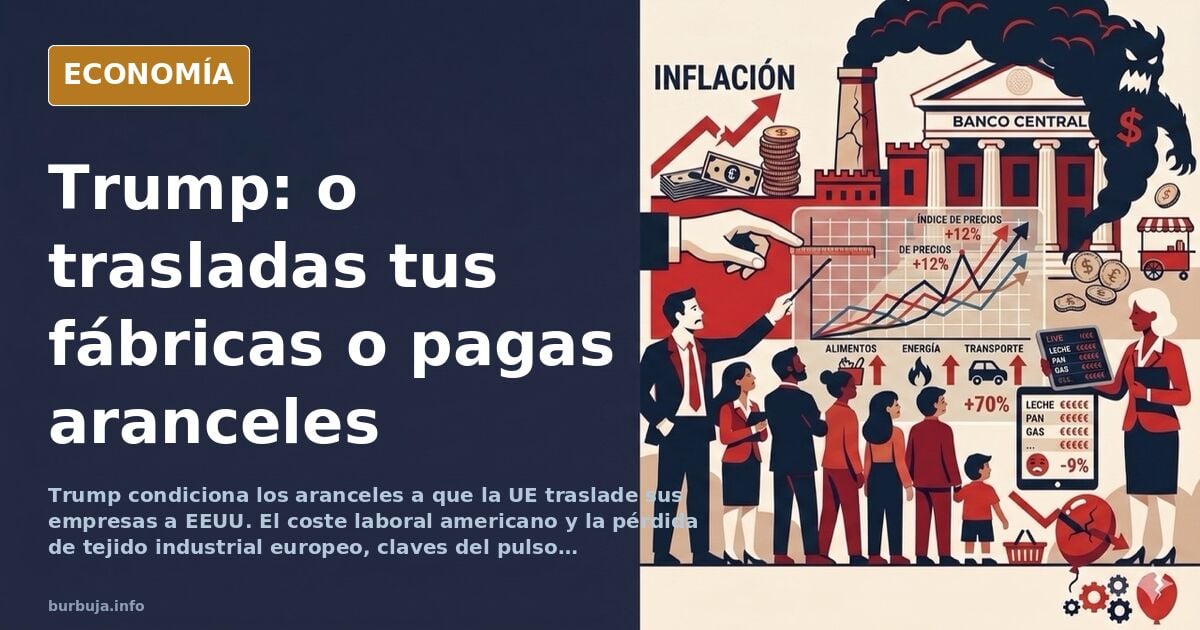
Trump ties EU tariffs to relocating factories to the US
Donald Trump’s renewed proposal leaves no room for compromise: if the European Union wants to dodge tariffs, its companies must shift production to the United States. Reported by The Objective, this ultimatum has reignited old trade tensions across the Atlantic, exposing what many see as a core issue: an EU that has steadily lost industrial capacity despite official promises of growth. The threat isn’t new, but the timeline is shifting—June, then July—and shouldn’t be taken lightly.
What Trump proposes and why it’s not a new threat
The message is blunt: avoiding tariffs requires moving production. No nuances, no compensations, no cohesion funds. To sell in the American market without penalties, manufacture there. This view rests on a specific reading of global economics: protectionism was already rising. The previous administration kept inherited tariffs and added incentives for European firms to set up shop in the US. The war in Ukraine accelerated this trend rather than halting it. Now, the pressure increases slightly more.
Some argue the EU responds with its usual habit: absorbing the blow, buying American military equipment, and looking away. Critics say Europe has become a partner who pays without questioning. Others see a miscalculation: if average US labor costs are several times higher than China’s, relocating factories won’t lower prices; consumers will pay the difference. Optimists believe productivity gains will absorb the gap; pessimists warn final products will become too expensive, crushing demand.
The labor cost nobody wants to face
This is where the debate gets interesting. Massively shifting production to the US clashes with reality: average annual labor costs in US industry have historically hovered around $80,000, a figure considered unaffordable in Europe for many sectors. It’s not just wages—it’s taxation, logistics, and supply chains.
The iPhone example is often cited because it’s illustrative. Manufacturing high-end phones requires an industrial ecosystem that can’t be improvised: hundreds of components, suppliers within eight hours’ distance, immediate responsiveness. When Apple tried assembling devices in the US, it faced mundane issues like missing screws at critical moments. In Asian industrial clusters, this doesn’t happen. Here, it does.
Much analysis concludes uncomfortably: it’s not that the US can’t produce everything, but that it doesn’t need to. Its industrial sector can be selective. If Europe loses purchasing power, that’s Europe’s problem.
The EU as a theme park: bars, tourism, and little else
The harshest criticism targets Brussels, not Trump. Analysts accuse the EU of becoming a territory of rentiers, tourism, and public employment, with a productive sector bleeding out over decades. The sentiment: only bars remain. Exaggerated, yes. But the underlying data—loss of industrial weight—is undeniable.
Another line of analysis points to demographics and labor. Some argue job growth in labor-intensive sectors relies on migrant populations, responding to structural needs: without them, many services wouldn’t function. This is a real social tension with divided opinions, best treated as a socioeconomic phenomenon, not a slogan.
What might happen: stretched deadlines and discounting markets
The cynical part is the calendar. Trump has repeatedly postponed tariff application to Europe: first June, then July. Each delay moves markets, leading some to suspect this volatility is the goal. The most common prediction is that the announcement will fade without full implementation, amid stock market swings.
Conversely, others believe the EU will eventually negotiate deals beneficial to Americans. Tariffs serve as credible threats and bargaining chips. What’s undisputed is the asymmetric balance of power: the US withstands collateral damage better than Europe.
With reservations: if the pressure holds, the EU will negotiate, make symbolic concessions, and postpone structural responses again—as it has since the euro wobbled and apocalyptic predictions didn’t materialize. Or perhaps they did.
Also available in: Deutsch
Summary of a discussion on Burbuja.info - Foro de economía, actualidad y política., translated from Spanish and reviewed before publication. Read the full discussion (114 replies).
More summaries
-
Trump calls EU 'worse than China' as trade tensions rise
Trump's remark that the EU is 'more nasty than China' unites disparate critics over tariffs, sovereignty and tech dependence.
-
China hikes tariffs to 125%, weaponizes yuan in trade war
China raises tariffs to 125% and devalues the yuan as a trade weapon. The debate: does it impoverish its population or shield its economy?
-
Óscar López and the evictions: Spain's housing ministry carries out what it condemns
Óscar López's ministry is evicting Manuel while the Spanish government sells public flats to Iván Redondo for 500,000 euros below market value.
-
Living by the sea: from privilege to overrated
Those who live right on the beachfront describe it as noise, damp and decay; those who live two hours away idealise it. Spain's coastal premium is up for debate.
-
Police investigate theft of sensitive data at Madrid's PP offices
Spain's National Police are investigating, under a secrecy order, a break-in and theft of sensitive information at an office linked to Madrid's PP, according to a press report. The…
-
France, Japan and the US urge citizens to stockpile food and water
France recommends a 72-hour kit, Japan three days, and the Pentagon is preparing its bases to last 90 days without supplies. The coincidence fuels suspicion.