
Trump hails Columbus and the debate shifts back to Spain
Trump calls Columbus a "hero" and reopens the debate in Spain: who funded the voyage, why Castile is being erased, and why it's an Italian holiday in the US.
English · Original discussion in Spanish · Published
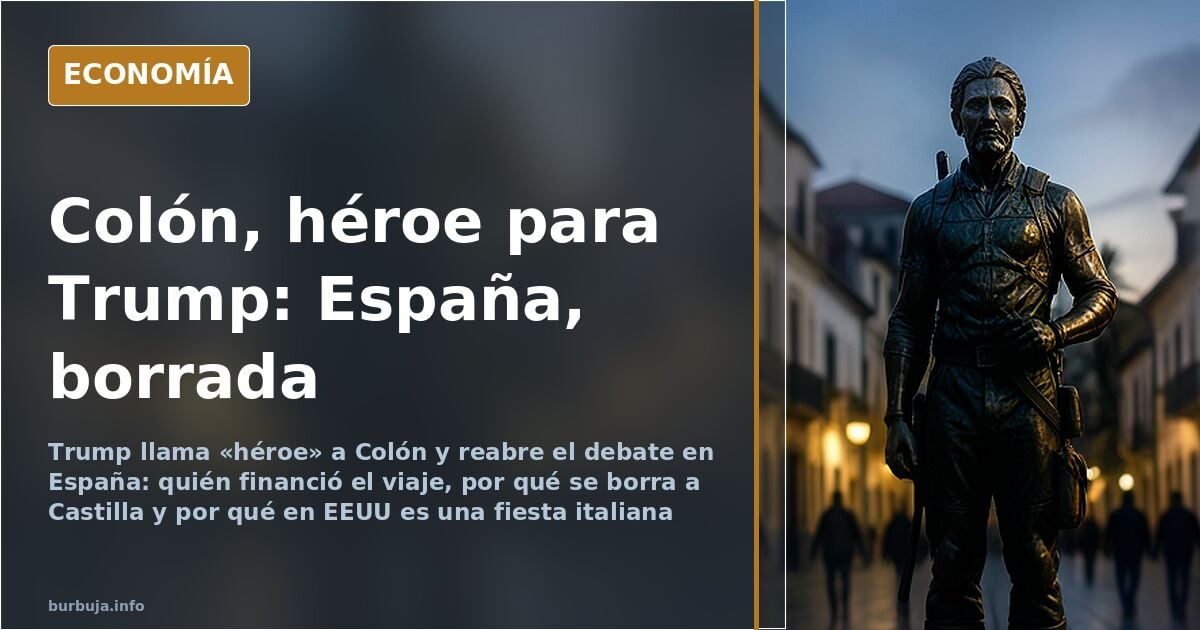
Trump hails Columbus and the spotlight turns back to Spain
Trump has once again celebrated Columbus Day, placing the navigator at the centre of his rhetoric: "He is a hero, I say it with pride." The remark, picked up by Spanish media, has peine a debate that goes far beyond the anecdote: who financed the 1492 expedition, what role Castile and Aragon played, and why the American narrative turns October 12 into an essentially Italian holiday. In Spain, the reaction was swift. Some criticise the fact that neither the White House nor official events mention Isabella I of Castile, the monarch who backed the voyage. Others go further and correct the framing altogether: in 1492 there was no Spain as such, but rather Castile and Aragon.
Who really paid for Columbus's voyage
The starting point is a historical fact that tends to get buried under the epic: the expedition was financed by the Crown of Castile, not by a unified Spain that would take decades to take shape. Isabella I appears in the story as the project's champion, and her absence from American celebrations is read by part of the Spanish public as a deliberate erasure. The complaint carries a sense of grievance: the navigator is celebrated, while the one who put up the money is overlooked.
The discussion gets more complicated when Aragon enters the picture. Some argue that Columbus came from a Catalan family and had influence at the courts of Barcelona of Ferdinand the Catholic, which would explain why an undertaking of that scale could not have come from a single court alone. The Genoese thesis, firmly established in mainstream historiography, is dismissed in that same argument as "ridiculous at this point." It is not a new position, but it resurfaces whenever the figure returns to the spotlight.
Why Columbus Day is an Italian holiday in the United States
October 12 functions in the United States as a celebration of the Italian-American community. That is the context that explains why Trump speaks of a hero without mentioning Castile: the story that has travelled and taken hold there is that of the Genoese navigator, not that of the project financed by a Castilian queen. For part of the Spanish public, that reading is a symptom of an inferiority complex: celebrating the individual is preferred over acknowledging the political and economic infrastructure that made the crossing possible.
The New York celebration is the most visible example. Every year lights are lit on the Empire State Building to mark the date, a gesture that in Spain is read with a mix of pride and resentment. The recognition exists, but it does not point to what many consider the true driving force.
The detail almost nobody disputes: who sighted land first
Beyond the symbols, there is a technical fact that tends to slip into any conversation about the voyage: it was Pinzón who sighted land before Columbus. The credit for the first sighting does not belong to the admiral, and that nuance dismantles the image of the solitary genius that is sometimes projected. It is an uncomfortable reminder for the epic narrative, but it fits the reality of a collective expedition.
National pride and historical accuracy
The Spanish reaction swings between anger and academic precision. Part of the public calls for reclaiming national pride and denounces the erasure of Spain from its own history. Another part puts a hard stop to it: you cannot claim a Spain that in 1492 did not exist as a unified state. Castile, Aragon, León and Navarre were separate kingdoms, and effective unification came later. The debate, then, is not just about Columbus: it is about what is meant by Spain, and since when.
The ending has not been written. Trump will keep calling Columbus a hero, and in Spain the argument over whether that is a tribute or an appropriation will continue. The only certainty is that October 12 has once again become a narrative battleground.
Also available in: Deutsch
Summary of a discussion on Burbuja.info - Foro de economía, actualidad y política., translated from Spanish and reviewed before publication. Read the full discussion (16 replies).
More summaries
-
Trump to Place Columbus Statue Near White House
The Columbus statue toppled in Baltimore in 2020 is being reconstructed with private donations and federal grants to be installed near the White House.
-
Cristóbal Colón, founder of Spain's La Fageda cooperative, dies
Cristóbal Colón Palací, founder of La Fageda, has died at 77: 500 jobs for people with disabilities and a business model that divides opinion.
-
128,000 pesetas in 1988: the salary that supported a family now barely covers one person
A salary of 128,000 pesetas in 1988 supported a family of four. Adjusted for today, that's €2,368, not enough to live alone in a big city.
-
PP and Vox: the debate over whether they'd be worse than Spain's government
The argument that a PP and Vox government would be even more harmful than Spain's current one is gaining traction: privatisation, pensions and housing.
-
Spain's government pumps €260M into Casa 47 for 1,629 homes at €160,000 each
€160,000 per social housing unit: the Spanish government injects €260M into Casa 47 for 1,629 flats on the eve of elections. Doubts over costs and delivery.
-
The unemployed who work: Spain's informal economy survival paradox
A 65% disability rating is no free pass: Spain's labour market rewards the underground economy and punishes formal employment. The keys to the paradox.