
Trump to Place Columbus Statue Near White House
The Columbus statue toppled in Baltimore in 2020 is being reconstructed with private donations and federal grants to be installed near the White House.
English · Original discussion in Spanish · Published
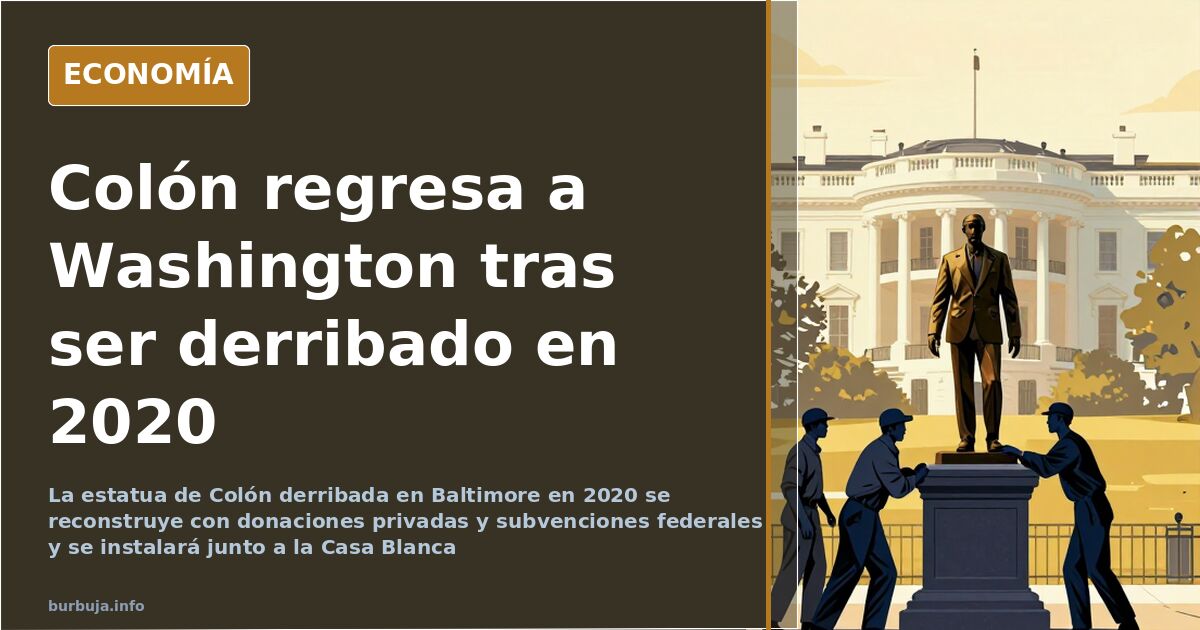
Columbus Returns to the White House: The Statue Toppled in 2020
On July 4, 2020, amid U.S. protests trinc George Floyd’s death, demonstrators toppled a Christopher Columbus statue in Baltimore, originally unveiled by Ronald Reagan in 1984, and threw it into the harbor. Five years later, the salvaged pieces are leaving a Maryland warehouse for the White House’s south lawn, near E Street and the Ellipse, according to The Washington Post. The reconstruction of a destroyed monument becomes state policy, driven by political motives rather than archaeology.
What is Known About the Statue’s Move to Washington
Businessman Bill Martin, one of the initiative’s leaders, told the newspaper the monument will move “in the coming weeks” from storage. It is not a new casting; the piece is reconstructed from fragments salvaged from the harbor, funded by private donations, charity funds, and federal grants. This mix of public and private money underscores the operation’s obvious political charge.
The location is no accident. The south flank, between E Street and the Ellipse, is one of the capital’s most institutionally active spaces. Placing a figure that ended up in a harbor five years ago is a calculated message, not an urban decoration decision.
The Gesture to the Conservative Catholic Base
A widespread reading suggests the target is not Hispanic voters, but the Knights of Columbus, a Catholic fraternal organization with significant influence on the U.S. conservative right. For this base, the admiral serves as a symbol of Christendom against contemporary ideological reinterpretations of the past.
The political trajectory aligns with this hypothesis. In 2020, Trump condemned the removal and destruction of explorers’ statues nationwide. A year later, he included Columbus in an executive order to create a National Garden of American Heroes, reserved for figures embodying “the American spirit of audacity and challenge.” In 2025, he reinstated Columbus Day and ordered flags to be flown on public buildings, calling to commemorate the day in honor of the “original American hero, a giant of Western civilization.” There is less improvisation here than the noise suggests.
Where Was Christopher Columbus Really From?
In the United States, the answer is simple: an Italian who discovered America. The problem is that Italy did not exist as a country in 1492, so the narrative holds poorly outside the classroom. Genoese is the most documented origin; jumping to Italian is a stretch.
In Spain, the debate takes different paths. Catalan origins are defended, Galician origins are supported—often citing Pedro Madruga with dubious academic traceability—and Jewish origins are also claimed. No clear Italian influence appears in the navigator’s own letters, fueling all theories without closing any.
Who Funded the Expedition: Castile, Aragon, and the Papacy
Here, consensus is stronger than it appears. The venture was financed with money, provisions, and sailors from the crowns of Castile and Aragon, united in a single kingdom. Without this funding, the admiral would have remained a mere bathtub sailor. Nationality mattered little as long as someone provided the funds.
Another argument shifts the focus: no one moved a finger in the Atlantic without the Papacy’s backing, and the Alexandrian bulls provided legal cover for expansion. From this perspective, Spain and Portugal were instruments of a larger operation with Rome at the helm. This thesis clashes with the school version but explains why the monument bothers both sides of the Atlantic.
An Uncomfortable Symbol for Both Sides
For part of the conservative spectrum, the statue serves a basic function: to discomfort those who have spent years toppling monuments, and in passing, neutralize the Black Legend. That the figure is claimed by Washington without mentioning Spain is irrelevant; the goal is the noise.
For the other side, the gesture whitewashes a colonial past and enters the so-called antiwoke agenda. Some recalled that Columbus was dismissed by the Crown, turning the homage into selective sympathy. Others pointed out the financial detail: the reconstruction was partly paid with federal grants.
The original statue was never neutral. Reagan unveiled it in 1984 in Baltimore, a city that removed it from public view after protest waves, as did Boston, Richmond, and Saint Paul. The new version travels from Maryland with the same charge and a different wrapping.
The calendar numbers are what they are. The statue was erected once, ended up in a harbor, and now aims to be inaugurated meters from where laws are signed. Striking is not that it returns. Striking is that its return is presented as a heritage decision.
On July 4, 2020, amid U.S. protests trinc George Floyd’s death, demonstrators toppled a Christopher Columbus statue in Baltimore, originally unveiled by Ronald Reagan in 1984, and threw it into the harbor. Five years later, the salvaged pieces are leaving a Maryland warehouse for the White House’s south lawn, near E Street and the Ellipse, according to The Washington Post. The reconstruction of a destroyed monument becomes state policy, driven by political motives rather than archaeology.
What is Known About the Statue’s Move to Washington
Businessman Bill Martin, one of the initiative’s leaders, told the newspaper the monument will move “in the coming weeks” from storage. It is not a new casting; the piece is reconstructed from fragments salvaged from the harbor, funded by private donations, charity funds, and federal grants. This mix of public and private money underscores the operation’s obvious political charge.
The location is no accident. The south flank, between E Street and the Ellipse, is one of the capital’s most institutionally active spaces. Placing a figure that ended up in a harbor five years ago is a calculated message, not an urban decoration decision.
The Gesture to the Conservative Catholic Base
A widespread reading suggests the target is not Hispanic voters, but the Knights of Columbus, a Catholic fraternal organization with significant influence on the U.S. conservative right. For this base, the admiral serves as a symbol of Christendom against contemporary ideological reinterpretations of the past.
The political trajectory aligns with this hypothesis. In 2020, Trump condemned the removal and destruction of explorers’ statues nationwide. A year later, he included Columbus in an executive order to create a National Garden of American Heroes, reserved for figures embodying “the American spirit of audacity and challenge.” In 2025, he reinstated Columbus Day and ordered flags to be flown on public buildings, calling to commemorate the day in honor of the “original American hero, a giant of Western civilization.” There is less improvisation here than the noise suggests.
Where Was Christopher Columbus Really From?
In the United States, the answer is simple: an Italian who discovered America. The problem is that Italy did not exist as a country in 1492, so the narrative holds poorly outside the classroom. Genoese is the most documented origin; jumping to Italian is a stretch.
In Spain, the debate takes different paths. Catalan origins are defended, Galician origins are supported—often citing Pedro Madruga with dubious academic traceability—and Jewish origins are also claimed. No clear Italian influence appears in the navigator’s own letters, fueling all theories without closing any.
Who Funded the Expedition: Castile, Aragon, and the Papacy
Here, consensus is stronger than it appears. The venture was financed with money, provisions, and sailors from the crowns of Castile and Aragon, united in a single kingdom. Without this funding, the admiral would have remained a mere bathtub sailor. Nationality mattered little as long as someone provided the funds.
Another argument shifts the focus: no one moved a finger in the Atlantic without the Papacy’s backing, and the Alexandrian bulls provided legal cover for expansion. From this perspective, Spain and Portugal were instruments of a larger operation with Rome at the helm. This thesis clashes with the school version but explains why the monument bothers both sides of the Atlantic.
An Uncomfortable Symbol for Both Sides
For part of the conservative spectrum, the statue serves a basic function: to discomfort those who have spent years toppling monuments, and in passing, neutralize the Black Legend. That the figure is claimed by Washington without mentioning Spain is irrelevant; the goal is the noise.
For the other side, the gesture whitewashes a colonial past and enters the so-called antiwoke agenda. Some recalled that Columbus was dismissed by the Crown, turning the homage into selective sympathy. Others pointed out the financial detail: the reconstruction was partly paid with federal grants.
The original statue was never neutral. Reagan unveiled it in 1984 in Baltimore, a city that removed it from public view after protest waves, as did Boston, Richmond, and Saint Paul. The new version travels from Maryland with the same charge and a different wrapping.
The calendar numbers are what they are. The statue was erected once, ended up in a harbor, and now aims to be inaugurated meters from where laws are signed. Striking is not that it returns. Striking is that its return is presented as a heritage decision.
Summary of a discussion on Burbuja.info - Foro de economía, actualidad y política., translated from Spanish and reviewed before publication. Read the full discussion (259 replies).
More summaries
-
Oasis Tickets Hit €480: The Bubble Beyond Inflation
Oasis concert tickets in Amsterdam cost €480, eight times the 2011 price in Barcelona. Inflation doesn't explain the surge; the business model does.
-
Europe Fires: Coordinated Attack or Rural Neglect?
Simultaneous wildfires in Spain, France, Germany, and the UK. Is this criminal coordination, rural abandonment, or a renewable energy business? Data analysis reveals the truth behind the blazes.
-
Australia Saracen Attack: Citizen Response and Gun Control Debate
Analysis of citizen intervention during the Australian Saracen terror attack and the ongoing debate on gun control laws.
-
Dana Funeral: Political Tension and Blame at the Ceremony
The Dana funeral ceremony became a focal point for political tension, with accusations against leaders and questioning of the State's role.
-
Guardian Dogs in Spanish Countryside: Protection or Threat?
Analysis of the conflict between walkers and livestock guardian dogs in Spain. Is it necessary defense or a real risk?
-
Illegal street vending booms in Salou while police remain inactive
Analysis of illegal street vending in Salou: how informal trade challenges local regulation and what it reveals about law enforcement priorities.